What Really Happened in Tunisia's UFO Reports?
Tunisia has no well-documented national UFO case file comparable to France’s official GEIPAN archive or the United States’ recent UAP investigations.
Page outline Jump by section
Introduction
That does not make the subject empty. Tunisia is a useful case study in how UFO folklore forms where the sky is active, public reporting channels are thin, and natural phenomena can be striking. The country’s coastal cities, southern desert regions, and clear night skies produce different kinds of reports, but the pattern is the same: the more a case depends on vague testimony or reposted video, the less confident any conclusion can be.
What Tunisia’s public UFO record actually contains
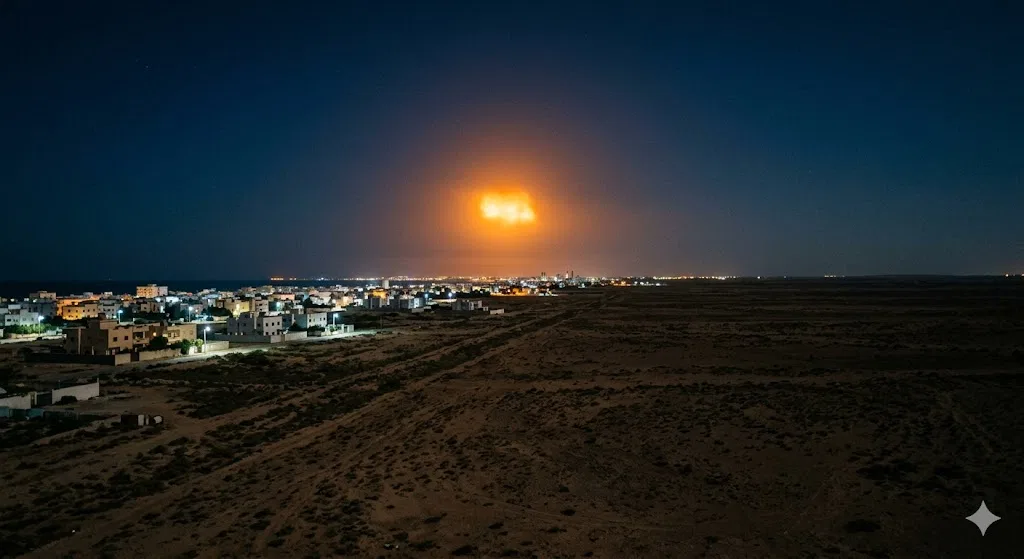
The most-cited Tunisian UFO incident in English- and French-language online catalogues is the Sfax report from November 1997. According to the version preserved by Patrick Gross’s “UFOs at Close Sight” archive, witnesses in Sfax saw a bright orange luminous mass at about 22:10. The report describes a dense centre, a clearer outer glow, an alleged odour in the air, and a movement away towards the south-west, in the direction of the Chott Fejaj salt desert. The same entry credits “Mahmoud el-Mejdoub and Banque OVNI-Tunisie” as its source, but it does not provide a primary document, police record, observatory note, radar trace, or original newspaper clipping on the page itself. [Ufologie]ufologie.patrickgross.orgSource details in endnotes.
That single limitation matters. A bright, low-altitude-looking orange light could describe several different things: a meteor fragment, an aircraft or flare seen under unusual atmospheric conditions, burning debris, a local industrial or maritime source seen through haze, or something genuinely unidentified because the available data are inadequate. The Sfax story is interesting because it includes multiple witnesses and sensory details, but it remains contested because the chain of evidence is weak and heavily dependent on a secondary ufology archive.
Other Tunisian claims are even thinner. Searchable public material includes online recollections, community posts, and videos labelled as UFOs from places such as Médenine or Monastir, but many are hard to verify because they lack original metadata, exact filming location, direction of view, weather conditions, astronomical checks, or independent witness statements. In a modern UAP assessment, those details are not optional extras; they are the difference between a case that can be investigated and one that can only be repeated.
A short chronology of notable Tunisian sky reports
Tunisia’s public record is best read as a mixed chronology, not as a single mystery tradition. Some entries are “UFO” reports in the narrow sense; others are important because they show how spectacular sky events are later identified.
27 June 1931: Tataouine meteorite. A major meteorite fall near Foum Tataouine in southern Tunisia was documented in the Bulletin de Minéralogie by Alfred Lacroix. The account records a meteorite fall in the far south of Tunisia near Foum Tataouine, about 120 km south-south-east of Gabès. Although this is not a UFO case, it is a crucial control example: a dramatic aerial event can be frightening, luminous, noisy, and still entirely natural once recovered material and scientific documentation exist. [Persée]meteo.tnSource details in endnotes.
November 1997: Sfax luminous mass. The Sfax report is the main unresolved Tunisian UFO claim in public circulation. It describes a bright orange phenomenon seen for several minutes above a major coastal city, with the object or light moving away towards the south-west. The report’s evidential weakness is that the surviving accessible account is not a primary investigation file. [Ufologie]ufologie.patrickgross.orgSource details in endnotes.
2013 onward: online video claims. Médenine and other southern locations appear in video-sharing and social-media claims, but the publicly accessible material is usually caption-led rather than investigation-led. Without a timestamped original file, camera data, sky direction, corroborating reports, and checks against satellites, aircraft, drones, planets and meteors, these clips are best treated as unverified claims rather than cases.
11 November 2021: fireball over Tunis and nearby areas. Tunisian media reported that witnesses saw a burning object over Tunis and surrounding zones at about 18:00. The Tunis Science City explanation, as reported by Tunisie Numérique, was that the object was a natural fireball caused by a meteor entering the atmosphere; the event reportedly lasted about 30 seconds and appeared brighter than the Moon’s first quarter phase. [Tunisie Numerique]tunisienumerique.comSource details in endnotes.
25 September 2023: blue luminous trail. A blue trail seen from Tunisia was explained by Hichem Ben Yahia of the Tunisian Astronomical Society as a meteor entering Earth’s atmosphere. The report also notes that the blue colour was attributed to the object’s composition and combustion at high speed. [African Manager]africanmanager.comSource details in endnotes.
August 2024: Perseid meteor activity. Tunisia’s National Institute of Meteorology described the Perseid meteor shower as visible over Tunisia and other northern-hemisphere regions around the night of 11–12 August 2024, with peak activity that can produce dozens of meteors per hour. Such predictable astronomical events are a recurring source of honest misidentification when viewers see an unusually bright meteor or cluster of streaks without knowing a shower is underway. [meteo.tn]meteo.tnSource details in endnotes.

Why Sfax remains the key contested case
The Sfax report is the only Tunisian case in the public record that has the outline of a classic UFO incident: a named city, a time, a striking description, multiple onlookers, and an unresolved label. It is also a good example of why “unresolved” does not mean “extraordinary craft”.
Several details make the case memorable. The object is described as orange, luminous, plasma-like, and large to the eye. The direction towards the Chott Fejaj area gives the story a strong geographical anchor. The alleged smell of sulphuric acid and dead fish adds a sensory element uncommon in simple distant-light reports. [Ufologie]ufologie.patrickgross.orgSource details in endnotes.
Yet those same details are difficult to assess without primary records. Witnesses are not named on the accessible archive page; no original interview transcripts are provided; no meteorological data are tied to the report; no astronomical reconstruction is shown; and no aviation, military or radar confirmation is cited. Using GEIPAN’s public classification logic as a benchmark, the Sfax material would struggle to rise above a weakly documented case unless fresh primary material emerged. GEIPAN distinguishes between cases identified after investigation, probably identified, not identified because of insufficient data, and not identified after investigation; it also stresses the importance of direct testimony, questionnaires, and supporting visual or detection material. [cnes-geipan.fr]cnes-geipan.frClassification | GEIPANClassification | GEIPAN
The fairest status for Sfax is therefore “contested and insufficiently documented”. It is not debunked in the strong sense, because the surviving account does not prove a conventional explanation. But it is not confirmed as anomalous in the strong sense either, because the evidence does not meet the standard needed to eliminate ordinary explanations.
The confirmed side: meteors explain some Tunisian “UFO” moments
The strongest Tunisian evidence is not for exotic craft; it is for spectacular natural events being misread at first glance. The 1931 Tataouine meteorite fall is historically important because it moved from witness experience to scientific documentation. The 2021 and 2023 light reports show the same pattern in modern media: a dramatic light appears, people wonder what it was, and a science or astronomy source explains it as a meteor or fireball. [Persée]meteo.tnSource details in endnotes. [Tunisie Numerique]tunisienumerique.comSource details in endnotes.
Meteors are especially relevant to Tunisia because the country has large dark-sky areas, including southern desert regions where luminous events can appear more vivid than they would in light-polluted cities. A meteor does not need to be exotic to look extraordinary. Bright bolides can appear larger than expected, change colour, fragment, leave trails, create delayed sounds, or seem close even when they are high in the atmosphere.
This matters for UFO assessment because many public reports begin with sincere witness surprise. A person can accurately report shock, brightness, direction, and duration while still misjudging altitude, distance, size, or speed. NASA’s UAP study makes the same broader point in a different setting: the bottleneck is not only witness sincerity but the lack of standardised, well-curated data. The report says civilian UAP reporting is sparse and incomplete without common curation or vetting protocols, and that better-quality data are a higher priority than new analysis techniques. [NASA Science]science.nasa.govSource details in endnotes.
Regional variation inside Tunisia
Tunisia’s UFO and unusual-sky reports are shaped by geography. The same kind of light can mean different things depending on where it is seen.
Tunis and the north-east generate reports that are more likely to be filtered through dense urban observation: aircraft traffic, atmospheric haze, bright planets low on the horizon, fireworks, drones, and reflected city light can all complicate interpretation. The 2021 Tunis fireball was widely noticeable because it appeared over a populated area, but it was also quickly explainable once a scientific source addressed it. [Tunisie Numerique]tunisienumerique.comSource details in endnotes.
Sfax and the central coast are important because the 1997 report sits between urban observation and open coastal/desert horizons. Coastal haze, maritime activity, industry, aircraft corridors and low-angle atmospheric effects are all plausible confounders, but the public record does not supply enough information to test them properly.
The south, including Tataouine, Médenine, Gabès and the desert margins, has the strongest “skywatch” character. Darker skies make meteors, satellites and re-entering debris more visible. The same openness also makes witnesses more likely to see an event for longer and across a wider arc of sky. The Tataouine meteorite demonstrates that southern Tunisia can produce genuine, scientifically important celestial events; it also warns against treating every dramatic southern-sky story as a vehicle or craft. [Persée]meteo.tnSource details in endnotes.
Official records and the missing Tunisian archive problem
A major difficulty with Tunisia is the absence of a visible, dedicated public UAP archive. There is no easily searchable Tunisian equivalent of GEIPAN’s case database, and public search results do not reveal a systematic national declassification release focused on UFOs or UAP. That absence should not be overinterpreted: it does not prove concealment, and it does not prove there were no reports. It simply means that public analysis has to rely on local media, astronomy bodies, scattered ufology catalogues, and social-media traces.
This creates a reliability imbalance. When a Tunisian science institution or astronomy representative explains a fireball or meteor, the claim is anchored in a relevant expert context. When a ufology page repeats a witness report without primary documents, the claim is useful as folklore or a lead, but much weaker as evidence. When a social-media video is reposted without metadata, it may be visually interesting but has little investigative value.
International UAP practice reinforces this caution. AARO’s historical review of United States government UAP work found no evidence that any official US investigation, academic-sponsored research, or review panel had confirmed a UAP sighting as extraterrestrial, and it assessed that many unresolved cases would probably be resolved as ordinary objects or phenomena if better-quality data were available. [AARO]aaro.milUnclassified Final DSD AARO Historical ReportUnclassified Final DSD AARO Historical Report That finding is not a direct judgement on Tunisia, but it is a useful standard: unexplained status is often a data problem, not proof of an extraordinary origin.
Confirmed, contested and debunked claims
A practical Tunisia page needs to separate categories rather than treat every strange light the same.
Confirmed natural or astronomical events include the Tataouine meteorite fall, the 2021 Tunis fireball explanation, the 2023 blue luminous trail explanation, and predictable meteor-shower visibility such as the Perseids. These are not “fake” reports; they are real observations whose causes are natural. [meteo.tn]meteo.tnSource details in endnotes. [3Persée]meteo.tnSource details in endnotes. [Tunisie Numerique]tunisienumerique.comSource details in endnotes.
Contested or unresolved claims include the 1997 Sfax report. It has enough narrative detail to be worth preserving in a national chronology, but not enough documentation to support a strong conclusion. Its best use is as a case study in what Tunisian UFO reporting lacks: primary files, exact witness handling, environmental checks, and independent corroboration. [Ufologie]ufologie.patrickgross.orgSource details in endnotes.
Weak or unverified claims include most short online videos and casual posts labelled as UFOs. These may deserve attention if original files and witnesses are available, but without those elements they should not be treated as evidence of anything beyond public perception and local interest.
Debunked or explained claims are best understood as successful identifications, not embarrassments. The Tunis fireball and 2023 meteor explanation show how a good local response can prevent a mystery from hardening into legend. [Tunisie Numerique]tunisienumerique.comSource details in endnotes.
How to read Tunisian UFO claims without overreacting
The most useful test for any Tunisian UFO claim is not whether it sounds dramatic, but whether it can survive basic reconstruction. A credible report should provide date, time, place, direction of view, duration, angular size, movement, weather, nearby airports or military activity, astronomical conditions, and original media files if any exist. It should also distinguish direct witnesses from people repeating a story.
For Tunisia specifically, three checks are especially important:
Amazon book picks
Further Reading
Books and field guides related to What Really Happened in Tunisia's UFO Reports?. Use these as the next step if you want deeper reading beyond the article.
The Report on Unidentified Flying Objects
Useful background for understanding UFO case documentation.
- Meteor and fireball checks. Southern and central Tunisia can produce vivid meteor observations, and recent Tunisian reports show that meteors are a live explanation, not a theoretical fallback. [Tunisie Numerique]tunisienumerique.comSource details in endnotes.
- Urban light and aircraft checks. Tunis, Sfax, Sousse, Monastir and coastal corridors have ordinary aerial and atmospheric sources that can look odd from the ground, especially at dusk, through haze, or when viewed with a phone camera.
- Source-chain checks. A local science explanation, a named astronomy representative, or an archived technical article carries more weight than a reposted video or an unsourced ufology paragraph. NASA’s UAP study emphasises that transparent reporting, rigorous analysis and better data collection are central to moving beyond speculation. [NASA Science]science.nasa.govSource details in endnotes.
Tunisia’s place in the wider North African UFO project is therefore not as a country with a large official mystery archive, but as a country where a few striking reports sit beside strong examples of natural explanation. That makes it a useful sibling page for comparison with better-documented neighbouring or regional branches: the key question is not only “what was seen?”, but “what kind of evidence survived?”
Endnotes
-
Source: meteo.tn
Link: https://www.meteo.tn/fr/Perseides -
Source: cnes-geipan.fr
Title: Classification | GEIPAN
Link: https://www.cnes-geipan.fr/en/node/58787 -
Source: science.nasa.gov
Link: https://science.nasa.gov/wp-content/uploads/2023/09/uap-independent-study-team-final-report.pdf -
Source: aaro.mil
Title: Unclassified Final DSD AARO Historical Report
Link: https://www.aaro.mil/Portals/136/PDFs/AARO_Historical_Record_Report_Vol_1_2024.pdf -
Source: aaro.mil
Link: https://www.aaro.mil/UAP-Cases/Official-UAP-Imagery/ -
Source: aaro.mil
Title: UAP Records
Link: https://www.aaro.mil/UAP-Records/ -
Source: cnes-geipan.fr
Link: https://www.cnes-geipan.fr/en/node/412 -
Source: cnes-geipan.fr
Link: https://www.cnes-geipan.fr/en/node/58788 -
Source: cnes-geipan.fr
Link: https://www.cnes-geipan.fr/en/missions-methodes-et-resultats -
Source: archive.org
Title: May 22 1987, International Herald Tribune, #32422, France (en) djvu.txt
Link: https://archive.org/stream/InternationalHeraldTribune1987FranceEnglish/May%2022%201987%2C%20International%20Herald%20Tribune%2C%20%2332422%2C%20France%20%28en%29_djvu.txt -
Source: ia601405.us.archive.org
Link: https://ia601405.us.archive.org/28/items/B-001-014-055/B-001-014-055.pdf -
Source: archive.org
Link: https://archive.org/stream/bulletinofafrica1322afri/bulletinofafrica1322afri_djvu.txt -
Source: archive.org
Title: Full text of “World Atlas”
Link: https://archive.org/stream/worldatlaseverythingyouneedtoknowaboutourplanettoday/World%20Atlas-%20Everything%20you%20need%20to%20know%20about%20our%20planet%20today_djvu.txt -
Source: news.sky.com
Link: https://news.sky.com/story/nasa-ufo-report-live-scientists-to-release-unidentified-anomalous-phenomena-findings-12960933 -
Source: geipan.fr
Link: https://geipan.fr/en/search/cas?field_date_d_observation_value%5Bmax%5D=&field_date_d_observation_value%5Bmin%5D=&field_document_existe_ou_pas_value=All&field_is_new_value=All&field_is_revisited_value=All&field_latitude_value%5Bmax%5D=&field_latitude_value%5Bmin%5D=&field_longitude_value%5Bmax%5D=&field_longitude_value%5Bmin%5D=&field_type_de_cas_target_id=All&order=field_date_d_observation_textuel&page=%2C466&sort=desc -
Source: ufologie.patrickgross.org
Link: https://ufologie.patrickgross.org/htm/faqafrica.htm -
Source: ufologie.patrickgross.org
Link: https://ufologie.patrickgross.org/htm/faqafricaf.htm -
Source: persee.fr
Title: bulmi 0366 3248 1932 num 55 3 4150
Link: https://www.persee.fr/doc/bulmi_0366-3248_1932_num_55_3_4150 -
Source: tunisienumerique.com
Link: https://www.tunisienumerique.com/tunisie-une-boule-de-feu-au-ciel-de-tunis-la-cite-des-sciences-clarifie/ -
Source: africanmanager.com
Link: https://africanmanager.com/la-trainee-lumineuse-bleue-vue-lundi-dans-le-ciel-est-un-meteorite-selon-la-sta/ -
Source: aviation-accidents.net
Link: https://www.aviation-accidents.net/tag/tunisia/ -
Source: trove.nla.gov.au
Link: https://trove.nla.gov.au/newspaper/article/11678882 -
Source: ejournals.epublishing.ekt.gr
Link: https://ejournals.epublishing.ekt.gr/index.php/hcmr-med-mar-sc/article/view/13146 -
Source: ejournals.epublishing.ekt.gr
Link: https://ejournals.epublishing.ekt.gr/index.php/hcmr-med-mar-sc/article/view/31284/24604
Additional References
-
Source: youtube.com
Title: Did Someone Write in the Sand? Markings Seen from Space Above Tunisia
Link: https://www.youtube.com/watch?v=mJsvr6YzOy4Source snippet
The Mystery of UFO's FINALLY REVEALED | The Most Authentic UFO Cases In The World...
-
Source: youtube.com
Link: https://www.youtube.com/watch?v=M8Rrq2RKXFUSource snippet
Why This UFO Sighting Was Different | Monstrum...
-
Source: war.gov
Title: department of war releases unidentified anomalous phenomena files in historic t
Link: https://www.war.gov/News/Releases/Release/Article/4480582/department-of-war-releases-unidentified-anomalous-phenomena-files-in-historic-t/ -
Source: youtube.com
Link: https://www.youtube.com/watch?v=dOOxUcX6_NcSource snippet
Did Someone Write in the Sand? Markings Seen from Space Above Tunisia...
-
Source: researchgate.net
Link: https://www.researchgate.net/publication/369507030_GEIPAN_classification_with_text_mining_and_machine_learning -
Source: fr.sott.net
Link: https://fr.sott.net/article/38727-Tunisie-Une-boule-de-feu-meteorique-dans-le-ciel-de-Tunis-la-Cite-des-Sciences-clarifie -
Source: facebook.com
Link: https://www.facebook.com/groups/663488548027128/posts/1294768014899175/ -
Source: instagram.com
Link: https://www.instagram.com/reel/DV7IJeKjP3W/ -
Source: researchgate.net
Link: https://www.researchgate.net/profile/Ernesto-Azzurro/publication/235007083_Alien_species_in_the_Mediterranean_Sea_by_2012_A_contribution_to_the_application_of_European_Union%27s_Marine_Strategy_Framework_Directive_MSFD_Part_2_Introduction_trends_and_pathways/links/02bfe510a9d49c5921000000/Alien-species-in-the-Mediterranean-Sea-by-2012-A-contribution-to-the-application-of-European-Unions-Marine-Strategy-Framework-Directive-MSFD-Part-2-Introduction-trends-and-pathways.pdf -
Source: instagram.com
Link: https://www.instagram.com/reel/DYqfvWHNzIm/
Topic Tree
Follow this branch
Related pages 192
- Afghanistan UAP
- AlbanianUFOs
- Algeria UFOs
- Antigua UFOs
- Monaco UFOs
- +187 more in sidebar