Within Croatia UFOs
How 1970s Aviation Reports Shaped Croatia’s UFO History
Explores Yugoslav-era aviation cases touching Croatian airspace, including the 172nd Aviation Regiment and Pan Adria reports.
On this page
- 172nd Aviation Regiment radar observations
- Pan Adria night flight incident
- Impact on Croatian aviation awareness
Page outline Jump by section
Introduction
The most discussed aviation-related UFO stories connected to Croatia emerged during the final decades of socialist Yugoslavia, especially in the 1970s. Unlike later civilian sightings built around blurry photographs or anecdotal recollections, these cases involved commercial aircraft crews, military radar operators, air-defence systems, and reports of interceptor activity. The two incidents most often cited are the alleged radar observations associated with the Yugoslav Air Force’s 172nd Aviation Regiment and the 1977 Pan Adria encounter involving a Zagreb-based airline operating over Yugoslav airspace. Together, these stories helped shape how UFO reports were understood in Croatia: less as folklore and more as aviation-security anomalies linked to trained witnesses.
 The historical problem is that the evidence remains fragmented. Much of the material comes from later interviews, UFO publications, secondary retellings, or post-Yugoslav media accounts rather than fully released military archives. That makes the Croatian-linked aviation cases historically interesting but evidentially uneven. Some details are corroborated across multiple retellings — such as radar tracking claims, military involvement, and the participation of airline crews — while more dramatic elements, including extraordinary speeds and pilot deaths linked directly to UFO pursuit, remain contested or poorly documented. [Wikipedia]WikipediaNLP Pan Adria incidentWikipedija, prosta enciklopedijaAugust 28, 2018 — Vse se je zgodilo ob priložnosti poleta letala Fokker 227 Pan Adrie na liniji Zagreb –…
Why Yugoslav aviation incidents mattered in Croatia
During the 1970s, Croatia occupied a strategically sensitive position within Yugoslavia’s aviation network. Zagreb was a major air-traffic node linking western Europe with the Balkans, the eastern Mediterranean, and the Middle East. The Adriatic coast also sat close to NATO and Warsaw Pact monitoring zones, giving Yugoslav radar and air-defence units heightened sensitivity to unidentified aircraft or unusual radar returns.
This aviation environment mattered because Yugoslavia’s military culture treated unexplained aerial activity primarily as a defence issue rather than a paranormal subject. Reports associated with Croatian airspace therefore tended to emerge through:
- airline crews operating from Zagreb or the Adriatic coast;
- military radar stations along the southern Adriatic;
- Yugoslav Air Force interception procedures;
- civil aviation authorities monitoring congested routes.
The period also coincided with severe stress inside Yugoslav air-traffic control. The 1976 Zagreb mid-air collision, which killed 176 people, exposed overcrowded skies, understaffing, and radar-management problems over Croatia. [Wikipedia]WikipediaNLO Pan Adria incidentZna se samo da je jedan pilot te noći poginuo. Vojna lica… ↑ „Yugoslavian UFO incident 'Pan Adria' in 1977”. sanjindumisic.com. 16.3… That tragedy was unrelated to UFO claims, but it shaped later interpretations of anomalous aviation reports. In practical terms, it demonstrated that radar confusion, communication failures, and fast-moving aircraft in dense corridors could produce situations that observers initially struggled to interpret.
As a result, Croatian-linked UFO stories from the era occupy a complicated space between air-defence history, Cold War anxiety, and later myth-making.
The 172nd Aviation Regiment radar reports
The military setting behind the story
The most persistent military-linked Croatian UFO narrative concerns reports associated with the Yugoslav Air Force’s 172nd Aviation Regiment and radar coverage near the southern Adriatic. Later UFO groups in the former Yugoslavia connected the story to radar operators monitoring the Prevlaka and Dubrovnik region, an area of high military importance because it overlooked Adriatic access routes and southern Yugoslav coastal airspace.
The 172nd Regiment itself belonged to the Yugoslav Air Force structure during the Cold War period and operated within a broader network of reconnaissance and fighter aviation units. Some associated aviation squadrons were linked to bases in the wider Adriatic region, including installations in what are now Croatia and Montenegro. [Wikipedia]Wikipedia1976 Zagreb mid air collision1976 Zagreb mid air collision
Accounts published decades later describe radar operators detecting unidentified targets that reportedly manoeuvred in unusual ways near the Adriatic coast. The claims vary by source, but recurring elements include:
- objects entering monitored airspace without identification;
- abrupt directional changes;
- radar tracks allegedly inconsistent with conventional aircraft;
- scramble or alert activity involving military aviation units.
In Croatian UFO literature, the case is often presented as one of the earliest examples in the region where radar data supposedly reinforced visual observations.
What can actually be verified
The central difficulty is the absence of publicly released original Yugoslav military documentation confirming the extraordinary claims. No declassified radar logs, interceptor transcripts, or official Yugoslav defence reports have emerged in a form that historians can independently authenticate.
What survives instead is a layered chain of retellings:
- alleged witness memories from former military personnel;
- later interviews in regional UFO media;
- summaries reproduced on websites and discussion forums after the breakup of Yugoslavia.
That does not automatically make the incidents false, but it weakens confidence in precise technical claims. In particular, assertions about impossible acceleration, supersonic manoeuvres, or advanced craft capabilities usually appear only in retrospective accounts rather than contemporary aviation documents.
Another important issue is that Cold War Yugoslav radar systems were imperfect. Radar anomalies could arise from atmospheric propagation, clutter over the Adriatic, military exercises, or tracking limitations. The lack of surviving primary records means it is difficult to separate genuinely unexplained observations from radar misinterpretation.
Still, the persistence of the story is historically significant because it helped establish a regional belief that Yugoslav authorities possessed unpublished UFO files connected to military aviation activity around the Croatian coast.
The 1977 Pan Adria incident
A Zagreb-linked airline at the centre of the case
The most famous Croatian-linked aviation UFO case of the 1970s is the so-called Pan Adria incident of August 1977. Pan Adria Airways was a Zagreb-based Yugoslav airline operating passenger, cargo, and charter routes. [Wikipedia]Wikipedia355th Reconnaissance Aviation Squadron355th Reconnaissance Aviation Squadron
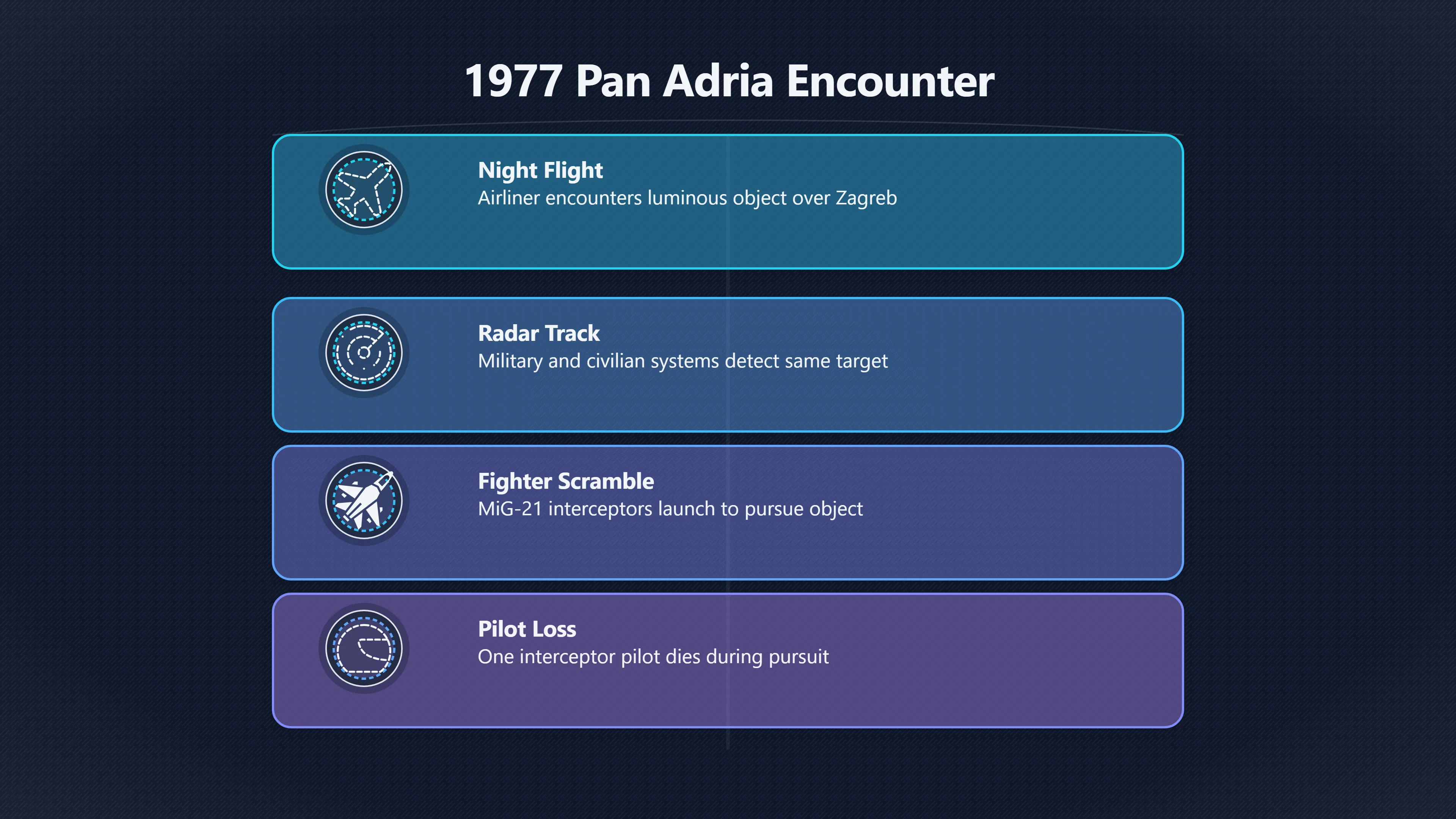
According to later accounts, a Pan Adria aircraft flying on a night route from Zagreb toward Belgrade and onward to Titograd encountered an unusual luminous object that appeared to pace the aircraft for an extended period. The incident later became one of the best-known UFO stories from the former Yugoslavia because it allegedly involved:
- commercial pilots;
- passengers observing unusual lights;
- civilian and military radar tracking;
- military interceptor aircraft.
The most widely repeated version states that the crew first noticed a blue-red or red-coloured light near Sremska Mitrovica during the early hours of 16 August 1977. The object reportedly remained near the aircraft as it descended toward Belgrade and later continued to follow the flight after departure toward Titograd. [Wikipedia]WikipediaPan Adria AirwaysPan Adria Airways
Radar tracking and interception claims
Later retellings claim the object was simultaneously visible on both military and civilian radar systems. Some versions state that Yugoslav MiG-21 fighters were launched in response and attempted to intercept the target.
The most dramatic narratives add that:
- the object matched the airliner’s speed and altitude;
- controllers feared a collision;
- the object accelerated away at extraordinary speed;
- one military pilot later died during pursuit activity.
These elements transformed the Pan Adria incident from a conventional “light in the sky” report into a major regional UFO legend.
However, historians face major evidential problems when assessing the case:
- no complete flight transcript has been released;
- no radar recordings are publicly available;
- the chronology differs between sources;
- claims about interceptor losses are inconsistent.
The alleged death of a pilot is especially difficult to verify. Some later accounts mention it briefly without documentation linking a fatal crash directly to UFO pursuit operations. [Wikipedia]WikipediaNLP Pan Adria incidentWikipedija, prosta enciklopedijaAugust 28, 2018 — Vse se je zgodilo ob priložnosti poleta letala Fokker 227 Pan Adrie na liniji Zagreb –…

Why the case survived for decades
The Pan Adria story endured partly because it contained elements that audiences considered difficult to dismiss. Unlike many civilian UFO claims, it involved professional aviation personnel operating within controlled airspace. Later summaries also stressed that Yugoslav authorities supposedly discouraged witnesses from speaking publicly about the incident. [Reddit]reddit.comYugoslavian UFO experienceRedditYugoslavian UFO experienceJuly 9, 2023 — The Incident: The UFO sighting occurred in August 1977 during a commercial flight of the f…
This alleged secrecy fit broader post-Cold War narratives about hidden military archives across eastern Europe. After the collapse of Yugoslavia, former crew members and aviation enthusiasts became more willing to discuss stories that had circulated privately for years.
The case also benefited from geography. Because Pan Adria was headquartered in Zagreb and operated Croatian-linked routes, the incident became absorbed into Croatia’s own UFO history after independence, even though the flight path crossed multiple Yugoslav republics.
Competing explanations for the aviation sightings
Conventional aviation and radar explanations
Sceptical interpretations of the Croatian-linked aviation incidents focus on the operational realities of 1970s airspace management.
Several non-extraordinary explanations are commonly proposed:
- atmospheric effects producing unusual light behaviour;
- bright planets or astronomical objects viewed from changing angles;
- radar propagation anomalies over the Adriatic;
- military exercises;
- misidentified aircraft;
- psychological amplification during stressful night flying.
The Pan Adria incident in particular took place within heavily monitored airspace where military and civilian traffic overlapped. Under those conditions, ambiguous radar returns could easily gain dramatic interpretations, especially if crews expected interception activity or unusual manoeuvres nearby.
The post-1976 Zagreb collision environment also increased sensitivity to anything abnormal on radar displays. Air-traffic controllers in Yugoslavia were already operating under intense pressure due to congestion and equipment limitations. [Wikipedia]WikipediaNLO Pan Adria incidentZna se samo da je jedan pilot te noći poginuo. Vojna lica… ↑ „Yugoslavian UFO incident 'Pan Adria' in 1977”. sanjindumisic.com. 16.3…
Why some researchers remain unconvinced by debunking
Supporters of the UFO interpretation argue that conventional explanations fail to account for the combination of witnesses allegedly involved in the Pan Adria incident:
- airline crew observations;
- civilian radar tracking;
- military radar tracking;
- interceptor response.
They also point to claims that the object remained with the aircraft for a prolonged period and adjusted speed in relation to the airliner.
The strongest pro-UFO argument is therefore not based on extraordinary manoeuvres alone, but on the supposed convergence of independent observation systems. If the radar claims were fully verified, the case would be harder to dismiss as a simple astronomical misidentification.
Yet this is exactly where the evidential gap remains widest. The key technical data needed to confirm those claims has never been publicly produced.

How these incidents shaped Croatian UFO culture
The Croatian significance of the 1970s aviation cases lies less in proof of extraterrestrial technology and more in how they changed regional attitudes toward unidentified aerial reports.
Before these stories circulated widely, UFO discussion in Yugoslavia tended to remain marginal. The aviation incidents altered that perception because they appeared connected to:
- professional pilots;
- military personnel;
- radar systems;
- state secrecy.
That combination gave later Croatian UFO researchers a narrative framework very different from folklore-style sightings. The message was that unexplained aerial phenomena could intersect with real aviation and defence structures.
The Pan Adria incident became particularly influential in regional UFO communities after the 1990s because it seemed to offer a local equivalent to western pilot-encounter cases. Croatian and Serbian UFO groups repeatedly revisited the story in articles, television discussions, and online archives, often presenting it as evidence that Yugoslav authorities quietly investigated anomalous aerial events during the Cold War. [Wikipedia]Wikipedia1976 Zagreb mid air collision1976 Zagreb mid air collision [Wikipedia]Wikipedia355th Reconnaissance Aviation Squadron355th Reconnaissance Aviation Squadron
The incidents also contributed to a broader Croatian pattern in which aviation-linked reports received more public attention than ordinary civilian sightings. Even decades later, unexplained aerial events involving aircraft, radar, or military systems tended to attract disproportionate media interest compared with isolated eyewitness claims.
What remains unresolved today
The 1970s Croatian-linked aviation incidents remain historically important precisely because they are unresolved in a documentary sense rather than in a scientific one. There is no publicly available evidence proving extraterrestrial involvement, but neither is there enough surviving primary material to reconstruct the events conclusively.
Several questions remain open:
- Did Yugoslav military archives contain fuller radar data that was never released?
- Were later witness accounts altered by decades of retelling?
- How much of the Pan Adria story can be independently verified through aviation records?
- Were some claims merged together from separate incidents over time?
The strongest established facts are comparatively modest:
- a Zagreb-based airline was associated with a widely discussed 1977 UFO report;
- military and radar involvement were repeatedly alleged;
- the stories circulated privately during the Yugoslav era and became more public after the breakup of Yugoslavia.
Beyond that, certainty rapidly declines.
For Croatia’s UFO history, the lasting importance of these incidents is therefore cultural and historical rather than evidential. They marked the moment when unidentified aerial phenomena became linked in the regional imagination with professional aviation, Cold War surveillance, and the possibility — whether real or exaggerated — of hidden military knowledge about unusual events in the skies above the Adriatic.
Endnotes
-
Source: Wikipedia
Title: NLP Pan Adria incident
Link: https://sl.wikipedia.org/wiki/NLP_Pan_Adria_incidentSource snippet
Wikipedija, prosta enciklopedijaAugust 28, 2018 — Vse se je zgodilo ob priložnosti poleta letala Fokker 227 Pan Adrie na liniji Zagreb –...
Published: August 28, 2018
-
Source: Wikipedia
Title: NLO Pan Adria incident
Link: https://sh.wikipedia.org/wiki/NLO_Pan_Adria_incidentSource snippet
Zna se samo da je jedan pilot te noći poginuo. Vojna lica... ↑ „Yugoslavian UFO incident 'Pan Adria' in 1977”. sanjindumisic.com. 16.3...
-
Source: Wikipedia
Title: 1976 Zagreb mid air collision
Link: https://en.wikipedia.org/wiki/1976_Zagreb_mid-air_collision -
Source: Wikipedia
Title: 355th Reconnaissance Aviation Squadron
Link: https://en.wikipedia.org/wiki/355th_Reconnaissance_Aviation_Squadron -
Source: Wikipedia
Title: Pan Adria Airways
Link: https://en.wikipedia.org/wiki/Pan_Adria_Airways -
Source: reddit.com
Title: Yugoslavian UFO experience
Link: https://www.reddit.com/r/UFOs/comments/14uzlv8/yugoslavian_ufo_experience/Source snippet
RedditYugoslavian UFO experienceJuly 9, 2023 — The Incident: The UFO sighting occurred in August 1977 during a commercial flight of the f...
Published: July 9, 2023
-
Source: reddit.com
Title: yugoslav radar operator recalls 1977 pan adria
Link: https://www.reddit.com/r/UFOB/comments/17hjora/yugoslav_radar_operator_recalls_1977_pan_adria/Source snippet
r/UFOB - Trump administration to release UFO files featuring pilot encounters imminently.Read more...
Additional References
-
Source: baaa-acro.com
Link: https://www.baaa-acro.com/operator/pan-adriaSource snippet
Bureau of Aircraft Accidents ArchivesPan AdriaSuffered a ground accident while taxiing at Zagreb-Pleso Airport. All 47 occupants were eva...
-
Source: admiralcloudberg.medium.com
Title: philosophy of blame the story of the 1976 zagreb mid air collision 38202bfc1ad7
Link: https://admiralcloudberg.medium.com/philosophy-of-blame-the-story-of-the-1976-zagreb-mid-air-collision-38202bfc1ad7Source snippet
of Blame: The story of the 1976 Zagreb mid-air...On the 10th of September 1976, tragedy unfolded in the skies over Yugoslavia as two air...
Published: September 1976
-
Source: medtrends.org
Link: https://www.medtrends.org/reports/MedTrends_AD-Report.pdfSource snippet
BLUE GROWTH TRENDS IN THE ADRIATIC SEA:Leakage or escaping leading to the introduction of alien marine species (e.g. fish, crustaceans, m...
-
Source: youtube.com
Link: https://www.youtube.com/watch?v=4kwabufLJ9Y -
Source: instagram.com
Title: A routine flight turned into an encounter with the unknown
Link: https://www.instagram.com/p/DHn_7OhNKTU/Source snippet
On August 16, 1977, a Pan Adria Fokker F27 was en route from Zagreb when a... #DulceBase #ConspiracyTheories #UndergroundBase #UFO #Alie...
Published: August 16, 1977
-
Source: facebook.com
Title: “UFO building” at Ada Ciganlija in Belgrade (Serbia)
Link: https://www.facebook.com/groups/spaceage/posts/10164185926399679/Source snippet
His curiosity led him to an incident on August 16, 1977 involving a Pan Adria airliner.... UFO triangle sighting over Serbia reported. D...
Published: August 16, 1977
-
Source: achtungskyhawk.com
Link: https://achtungskyhawk.com/category/yugoslav-and-croatian-aviation-history/Source snippet
s from Croatian and Yugoslav aviation history.Read more...
-
Source: api.parliament.uk
Title: aircraft accident yugoslavia
Link: https://api.parliament.uk/historic-hansard/commons/1971/may/24/aircraft-accident-yugoslaviaSource snippet
ACCIDENT (YUGOSLAVIA) (Hansard, 24 May 1971)24 May 1971 — A Tupalev 134A aircraft, operated by Aviogenex, a Yugoslav company, on a flight...
Published: May 1971
-
Source: youtube.com
Link: https://www.youtube.com/watch?v=npl7uuMe_u8Source snippet
PAN ADRIA INCIDENT: Rušenje dva JNA MIGA-a 21...
-
Source: youtube.com
Title: Na rubu znanosti
Link: https://www.youtube.com/watch?v=b5BMzkTTkjwSource snippet
Famous UFO case of Yugoslav pilot in 70s...
Topic Tree