Within Estonia UFOs
Who Collected Estonia's UFO Stories?
Estonia's UFO archive is shaped less by official disclosure than by private collectors who gathered witness stories for decades.
On this page
- Igor Volke's role in Estonian ufology
- AKRAK and private case gathering
- Why testimony differs from proof
Page outline Jump by section
Introduction
Estonia’s UFO tradition was built less by state investigators than by private collectors who spent decades gathering witness accounts, photographs, sketches and local rumours. The central figure in that network was Igor Volke, whose archives and media appearances helped turn scattered stories into a recognisable part of modern Estonian paranormal culture. Rather than claiming access to military secrets or classified aerospace data, Volke and associated researchers focused on testimony: what people believed they saw, how they described it, and how those stories spread through Soviet and post-Soviet Estonia. [ERR]eeter.err.eeufoloog igor volke saab siiani ca 12 ufo signaali aastasJuba 1960ndate lõpus tärganud huvi paranähtuste, eriti UFO-de vastu…Read more…
 That approach gave Estonia an unusually folklore-heavy UFO archive. The result is historically valuable even when the evidence for extraordinary claims remains weak. Witness narratives collected by Volke and related groups reveal changing fears, media influences and local myth-making across different decades. At the same time, the limits of that archive are clear: testimony can preserve experience, but it cannot by itself prove that unidentified objects were extraterrestrial craft.
Why Igor Volke became the face of Estonian ufology
A collector rather than a disclosure insider
Volke emerged during the late Soviet era, when discussion of paranormal subjects became easier under the loosening cultural atmosphere of the 1980s. By his own account, his interest in anomalous phenomena dated back to the late 1960s. Unlike many Western UFO personalities who emphasised conspiracy theories about governments hiding alien technology, Volke’s work was more archival and documentary in style. [ERR]eeter.err.eeufoloog igor volke saab siiani ca 12 ufo signaali aastasJuba 1960ndate lõpus tärganud huvi paranähtuste, eriti UFO-de vastu…Read more…
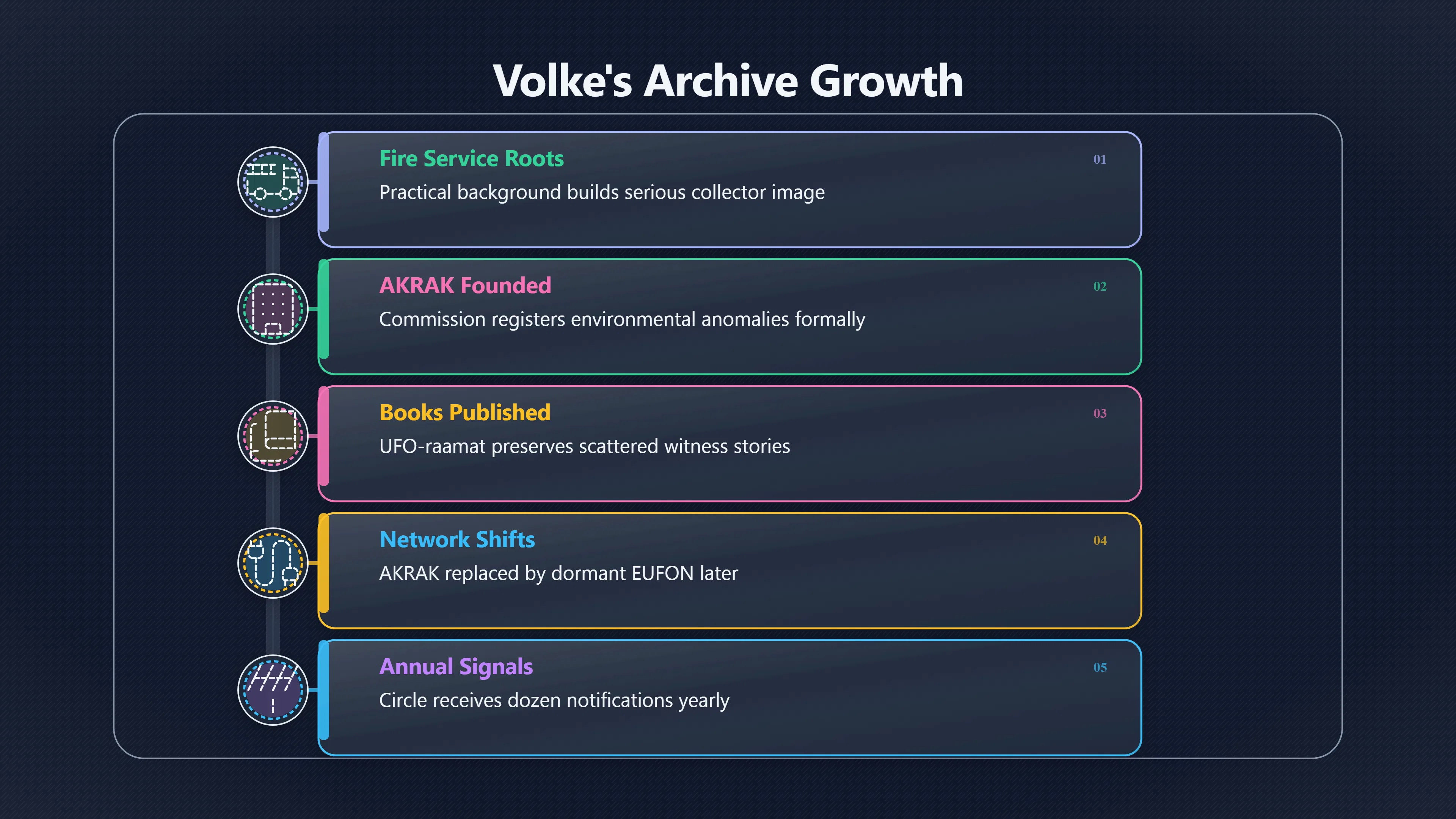
His background also mattered. Volke worked for decades in Tallinn’s fire service before later working at the National Library of Estonia. That combination gave him an image of practical seriousness rather than fringe theatricality. Estonian media frequently presented him not as a prophet or cult figure, but as a persistent collector of unusual reports. [Wikipedia]WikipediaIgor VolkeIgor Volke
This distinction shaped how UFO culture developed in Estonia. The movement remained relatively small and amateur-driven. It never acquired the large institutional structures seen in some bigger countries, nor did it generate a sustained political campaign for official disclosure. Instead, it revolved around enthusiasts gathering stories, comparing patterns and maintaining archives.
Turning isolated stories into a national archive
Volke’s importance came partly from scale. He accumulated witness material over many decades and repeatedly republished or updated that material in books and interviews. His works, including UFO-raamat, Ufopäevikud and later collections of anomalous-environment reports, helped preserve stories that otherwise would likely have disappeared into local oral history. [2Reraamatud (R&E INVEST GRUPP OÜ]reraamatud.eeR&E INVEST GRUPP OÜ)UFO-raamatUFO-raamat - Igor VolkeUFO-raamat - Igor Volke. €1.10. No tax. Publisher: Periodica. City: Tallinn… Estonia; condition: Used. 16 other…
Many reports concerned ordinary “lights in the sky”, but others included more elaborate narratives:
- glowing objects near forests or coastlines;
- alleged humanoid encounters;
- strange lights observed by groups rather than individuals;
- reports connected to military zones or isolated rural areas;
- stories later reinterpreted through alien-abduction language.
The archive therefore became part UFO catalogue and part social history of late Soviet Estonia. That is one reason folklorists became interested in the material even when they did not accept the literal truth of the claims.
AKRAK and the private collection model
Building a semi-formal research network
In 1985 Volke founded AKRAK, usually translated as the Commission for Registration and Analysis of Anomalous Environmental Phenomena. The organisation attempted to create a systematic method for gathering reports across Estonia. Witnesses submitted descriptions, drawings and location details, while members compared stories for recurring patterns. [Wikipedia]WikipediaEstonian Folklore ArchivesEstonian Folklore Archives
AKRAK operated partly through informal civic enthusiasm rather than scientific infrastructure. It reportedly worked for a period from Tallinn’s House of Engineers, which gave the project a veneer of technical seriousness during the final Soviet years. Yet the group remained dependent on volunteer effort and public participation rather than state funding or official investigative authority. [Wikipedia]WikipediaEstoniaEstonia is a developed country with a high-income advanced economy and Eurozone membership. It is a democratic unitary parliame…
That shaped the kind of evidence the organisation collected. AKRAK specialised in:
- witness interviews;
- handwritten case reports;
- maps and timelines;
- anecdotal descriptions of environmental anomalies;
- locally circulated rumours;
- amateur photographs.
It had little access to radar data, military records or professional instrumentation. As a result, the archive became rich in narrative detail but poor in independently verifiable physical evidence.
The transition from Soviet to post-Soviet Estonia
The collapse of the Soviet Union changed the environment that had originally sustained the movement. During the late Soviet period, paranormal subjects often carried an aura of hidden knowledge and intellectual rebellion. After independence, Estonian society became more integrated into Western media and scientific institutions, and public fascination with UFOs became less culturally exceptional.
Sources indicate that AKRAK gradually became inactive and was later replaced in part by EUFON, the Estonian UFO Network, which itself eventually became relatively dormant. [Wikipedia]WikipediaIgor VolkeIgor VolkeIgor Volke (19. jaanuar 1950 Jõgeva – 14. november 2024) oli eesti ufoloog. Igor Volke 12. aprillil 2014 Eesti Rahvusraamatu…
Yet the archive-building habit continued. Even in the 2020s, Volke told Estonian television that his circle still received roughly a dozen UFO-related notifications each year. Most were not considered compelling. Many involved blurred images or ambiguous lights that could not be verified. [ERR]eeter.err.eeufoloog igor volke saab siiani ca 12 ufo signaali aastasJuba 1960ndate lõpus tärganud huvi paranähtuste, eriti UFO-de vastu…Read more…
This continuity matters because it shows that Estonia’s UFO tradition survived not through spectacular revelations but through steady accumulation of testimony.
Why folklorists took the material seriously
UFO stories as modern folklore
One of the most important developments in Estonia’s UFO culture was the involvement of folklorists such as Mare Kõiva. Researchers at the Estonian Literary Museum and associated folklore institutions examined UFO reports not primarily as aerospace mysteries, but as modern legends and belief narratives. [Keel ja Kirjandus]keeljakirjandus.eeSource details in endnotes.
This approach changed the question from “Did aliens land?” to “Why do certain stories spread, persist and evolve?” In Estonia, that perspective was especially useful because the evidence base depended so heavily on oral and written testimony.
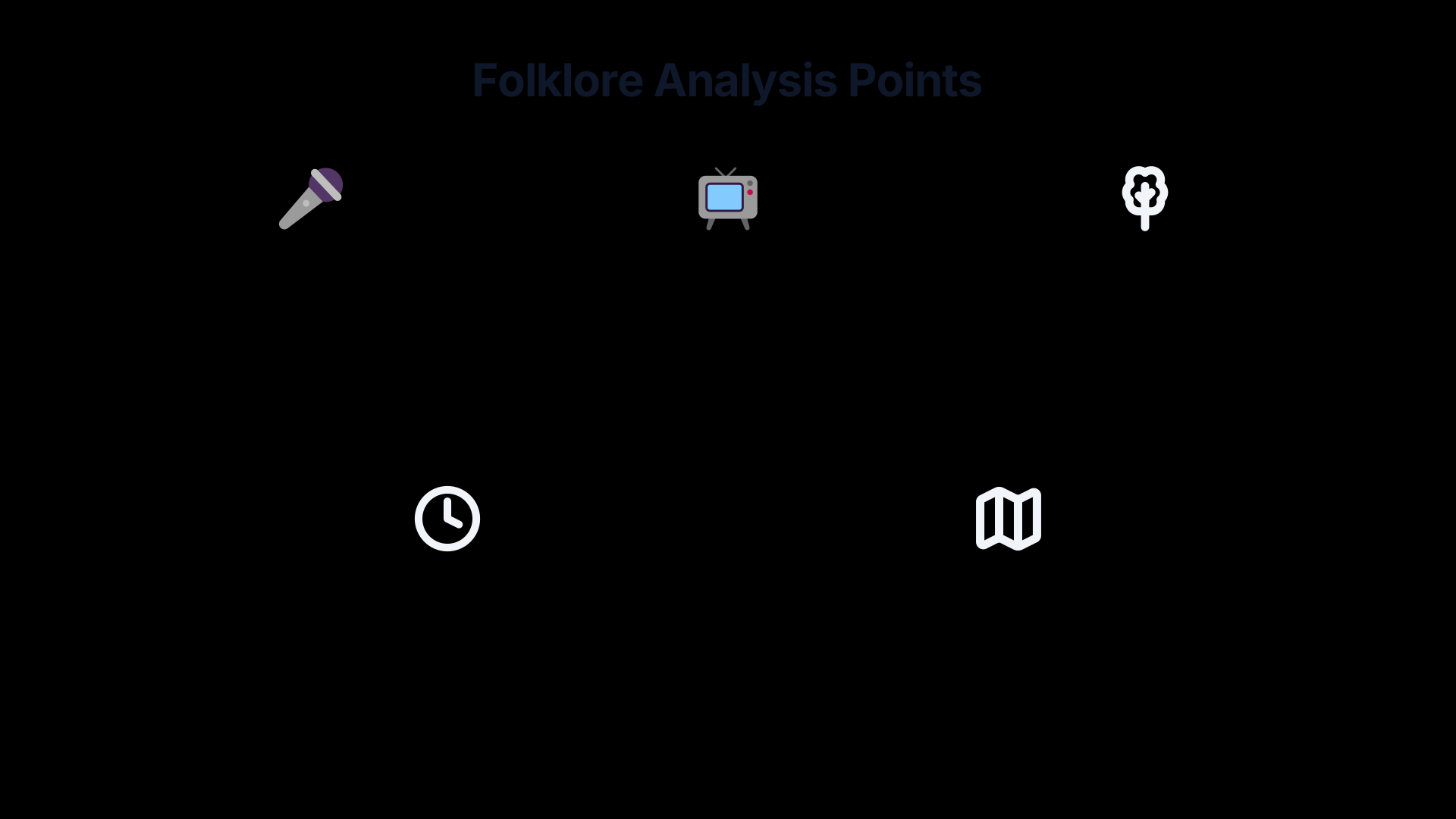
Folklore analysis highlighted several recurring features:
- witnesses often described experiences in emotionally vivid but technically vague language;
- stories absorbed imagery from television, films and international UFO culture;
- local geography shaped the narratives, especially forests, islands and sparsely populated coastal regions;
- memory distortion increased over time as stories were retold.
This did not mean every witness was dishonest. Instead, researchers argued that human recollection naturally reshapes ambiguous experiences into culturally meaningful narratives.
Media amplification in the 1990s
Post-Soviet television and newspapers played a major role in expanding Estonia’s UFO culture. Paranormal programming introduced international alien-abduction motifs and “close encounter” imagery to wider audiences. Folklore studies noted that people increasingly interpreted unusual experiences through the language of UFO culture once those themes became visible in media. [Keel ja Kirjandus]keeljakirjandus.eeSource details in endnotes.
Volke became a recognisable media figure during this era. His interviews and television appearances reinforced the idea that Estonia possessed its own hidden catalogue of unexplained events. This did not create a mass movement, but it gave the country a coherent UFO narrative that linked isolated local stories into a national tradition.
That feedback loop is important historically:
- Witnesses saw UFO stories in media.
- They reinterpreted ambiguous experiences through that framework.
- Collectors archived those stories.
- Media then reported the archive itself as evidence of a continuing mystery.
The process helped sustain Estonian ufology even when few cases produced strong physical evidence.
Why testimony is not the same as proof
The evidential limits of private archives
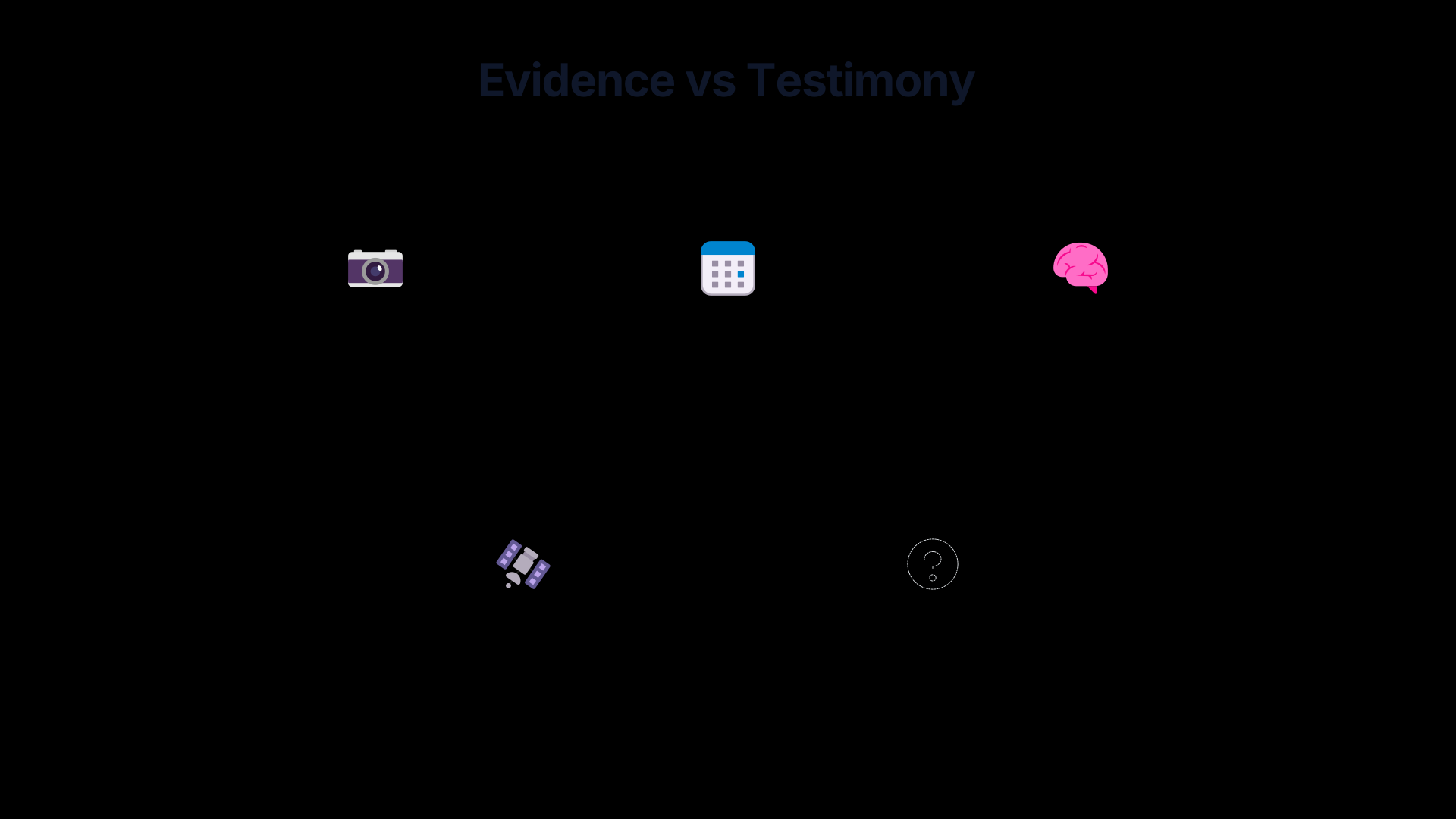
The strongest criticism of Estonia’s UFO collectors is straightforward: most cases rely entirely on testimony. Photographs are often poor quality, dates can be uncertain, and multiple versions of the same event sometimes circulated over time. Even sympathetic observers acknowledged these weaknesses. [Para-web]para-web.orgPara-webEstonian UFO-cases15 Feb 2010 —… Mare Kõiva (a folklorist?) are not so reliable. The major problem comes out of inaccurate dat…
This is especially important when evaluating dramatic claims such as close encounters or humanoid sightings. A compelling narrative can preserve the sincerity of a witness without establishing that the event occurred exactly as described.
The problem becomes sharper with older cases because:
- original notes may be incomplete;
- memories shift over decades;
- retellings introduce new details;
- stories become mixed with folklore and popular culture.
As a result, Estonia’s UFO archive is historically valuable but scientifically uneven.
The difference between unexplained and extraterrestrial
Volke himself often occupied an ambiguous position. He clearly believed that some cases deserved serious attention, yet many reports remained unresolved simply because there was insufficient information to identify them conclusively. “Unexplained” therefore did not automatically mean alien spacecraft.
Modern astronomical and aerospace awareness has also reduced the mystery surrounding many sightings. Events once interpreted as extraordinary can now frequently be linked to:
- satellite flares;
- rocket launches and re-entry debris;
- military aircraft;
- meteors and bolides;
- unusual cloud formations;
- atmospheric optical effects.
Recent Estonian media coverage has repeatedly shown how quickly dramatic sky events can move from “possible UFO” to ordinary explanation once timing and trajectory data are checked. This contrast makes older archives harder to evaluate retrospectively because investigators often lacked access to the same reference data available today.
What Estonia’s private UFO archives still reveal
Even without proof of extraterrestrial visitation, Estonia’s private UFO collections remain culturally important. They document how ordinary people interpreted uncertainty during periods of political and social change. Soviet secrecy, rapid post-independence media expansion and imported Western paranormal culture all shaped the stories that collectors preserved.
Volke’s archive also captured regional texture that might otherwise have vanished. Rural sightings from forests, islands and small settlements reveal how local geography and isolation affected belief formation. In that sense, Estonia’s UFO record overlaps with broader studies of folklore, memory and vernacular religion rather than existing solely within aerospace speculation. [Keel ja Kirjandus]keeljakirjandus.eeSource details in endnotes.
That may ultimately be the most durable legacy of Estonia’s private UFO collectors. They preserved a body of testimony that says less about confirmed alien craft than about how Estonians described mystery, uncertainty and unusual experience across several generations.
Amazon book picks
Further Reading
Books and field guides related to Who Collected Estonia's UFO Stories?. Use these as the next step if you want deeper reading beyond the article.
The UFO Experience
Focuses on case collection, witness reports and investigative methods.
Passport to Magonia
Mirrors the testimony-collection approach used by Estonian UFO archivists.
Endnotes
-
Source: Wikipedia
Title: Igor Volke
Link: https://en.wikipedia.org/wiki/Igor_Volke -
Source: eeter.err.ee
Title: ufoloog igor volke saab siiani ca 12 ufo signaali aastas
Link: https://eeter.err.ee/1059661/ufoloog-igor-volke-saab-siiani-ca-12-ufo-signaali-aastasSource snippet
Juba 1960ndate lõpus tärganud huvi paranähtuste, eriti UFO-de vastu...Read more...
-
Source: reraamatud.ee
Title: (R&E INVEST GRUPP OÜ)UFO-raamat
Link: https://reraamatud.ee/en/esotericism/2019–ufo-raamat-igor-volke-.htmlSource snippet
UFO-raamat - Igor VolkeUFO-raamat - Igor Volke. €1.10. No tax. Publisher: Periodica. City: Tallinn... Estonia; condition: Used. 16 other...
-
Source: Wikipedia
Title: Estonian Folklore Archives
Link: https://en.wikipedia.org/wiki/Estonian_Folklore_Archives -
Source: para-web.org
Link: https://www.para-web.org/showthread.php?tid=4729Source snippet
Para-webEstonian UFO-cases15 Feb 2010 —... Mare Kõiva (a folklorist?) are not so reliable. The major problem comes out of inaccurate dat...
-
Source: Wikipedia
Link: https://en.wikipedia.org/wiki/EstoniaSource snippet
EstoniaEstonia is a developed country with a high-income advanced economy and Eurozone membership. It is a democratic unitary parliame...
-
Source: Wikipedia
Title: Igor Volke
Link: https://et.wikipedia.org/wiki/Igor_VolkeSource snippet
Igor VolkeIgor Volke (19. jaanuar 1950 Jõgeva – 14. november 2024) oli eesti ufoloog. Igor Volke 12. aprillil 2014 Eesti Rahvusraamatu...
Published: november 2024
-
Source: estonia.ee
Link: https://estonia.ee/Source snippet
EstoniaEstonia is a progressive European nation and the world's most digitally advanced society. It blends liberal democracy and a Nordic...
-
Source: keeljakirjandus.ee
Link: https://www.keeljakirjandus.ee/ee/archives/37487 -
Source: eea.europa.eu
Link: https://www.eea.europa.eu/en/europe-environment-2025/countries/estoniaSource snippet
| Country profiles | Europe's environment 2025 (EEA)28 Sept 2025 — The Estonia country profile provides a concise overview of key trends...
-
Source: GOV.UK
Link: https://www.gov.uk/foreign-travel-advice/estoniaSource snippet
travel advice10 Apr 2026 — FCDO travel advice for Estonia. Includes safety and security, insurance, entry requirements and legal differences...
-
Source: keeljakirjandus.ee
Link: https://www.keeljakirjandus.ee/wp-content/uploads/sites/13/2024/11/U.VALK_.pdfSource snippet
UFO-d ja anomaaliad kogemusjuttudesIgor Volke. Eesti anomaalsete kesk konna nähtuste Xfailid (kogutud aasta... Eesti folkloristi kasse t...
-
Source: britannica.com
Link: https://www.britannica.com/place/EstoniaSource snippet
Estonia | Culture, Map, People, History, & FactsEstonia, country in northeastern Europe, the northernmost of the three Baltic states...
Additional References
-
Source: globalroadwarrior.com
Link: https://www.globalroadwarrior.com/estonia/environmental-issues.html -
Source: european-union.europa.eu
Link: https://european-union.europa.eu/principles-countries-history/eu-countries/estonia_enSource snippet
– EU country | European UnionEstonia is a parliamentary republic. Its prime minister, who is the head of government, is nominated by the...
-
Source: keskkonnaamet.ee
Link: https://keskkonnaamet.ee/en -
Source: banktrack.org
Link: https://www.banktrack.org/manage/ems_files/download/environmental_problems_in_the_estonian_oil_shale_industry/environmentalproblems_oilshale.pdfSource snippet
f carbon dioxide and other gases; the groundwater regime, and often also the water quality...
-
Source: oecd.org
Title: estonia 8133b0e9 en
Link: https://www.oecd.org/en/publications/environment-at-a-glance-country-notes_59ce6fe6-en/estonia_8133b0e9-en.htmlSource snippet
Environment at a Glance: Estonia30 Jun 2025 — Estonia has notably decreased its greenhouse gas emissions (GHG), mainly due to an overall...
-
Source: agronomy.emu.ee
Link: https://agronomy.emu.ee/vol08Spec2/p08s208.pdfSource snippet
A serious problem is past pollution caused by industrial...
-
Source: youtube.com
Title: Experts Finally Solved the Baltic Sea Anomaly Mystery
Link: https://www.youtube.com/watch?v=IcuQLNSYwGASource snippet
For deep insights into the late researcher's decades of archival collections and public impact, check out this featured podcast episode o...
-
Source: instagram.com
Link: https://www.instagram.com/reel/DRCG6mJiFEm/Source snippet
ooksul. Nende põhjal valmis kogumik „Eesti anomaalsete...
-
Source: visitestonia.com
Link: https://visitestonia.com/enSource snippet
and look forward to a fascinating future.Read more...
-
Source: goodreads.com
Title: 11793506 ufop evikud
Link: https://www.goodreads.com/book/show/11793506-ufop-evikudSource snippet
Ufopäevikud by Igor VolkeIgor Volke was an Estonian ufologist and researcher of environmental anomalies. In 1985 he founded the organizat...
Topic Tree