Within EgyptUFOs
Did Abydos Hieroglyphs Really Show Modern Aircraft?
Focuses on the Abydos temple 'helicopter' hieroglyph and explains how overlapping inscriptions can create modern aircraft illusions.
On this page
- The palimpsest effect in inscriptions
- Common pareidolia examples
- Egyptological explanations versus UFO claims
Page outline Jump by section
Introduction
The so-called “Abydos helicopter” is one of the most widely circulated ancient-Egypt UFO claims. Images from the Temple of Seti I at Abydos appear, at first glance, to show a helicopter, submarine and jet-like craft carved into stone thousands of years ago. In UFO and ancient-astronaut culture, the relief is often presented as evidence that the ancient Egyptians possessed advanced technology or received outside knowledge. Egyptologists and archaeologists, however, overwhelmingly regard the image as a textbook case of pareidolia combined with a damaged palimpsest inscription rather than evidence of lost machines or extraterrestrial contact. [Wikipedia]WikipediaTemple of Seti I (AbydosTemple of Seti I (Abydos [Wikipedia]WikipediaHelicopter hieroglyphs - WikipediaThe helicopter hieroglyphs is a name given to part of an Egyptian hieroglyph carving from the Temple…
 What makes the Abydos case important is not simply whether the carving resembles a helicopter. It is that the resemblance emerges through a known physical process: overlapping royal inscriptions altered over time and partially eroded. The result demonstrates how modern viewers can project familiar contemporary shapes onto fragmentary ancient imagery, especially when the setting already carries strong associations with mystery and hidden knowledge.
Why the Abydos “Helicopter” Became Famous
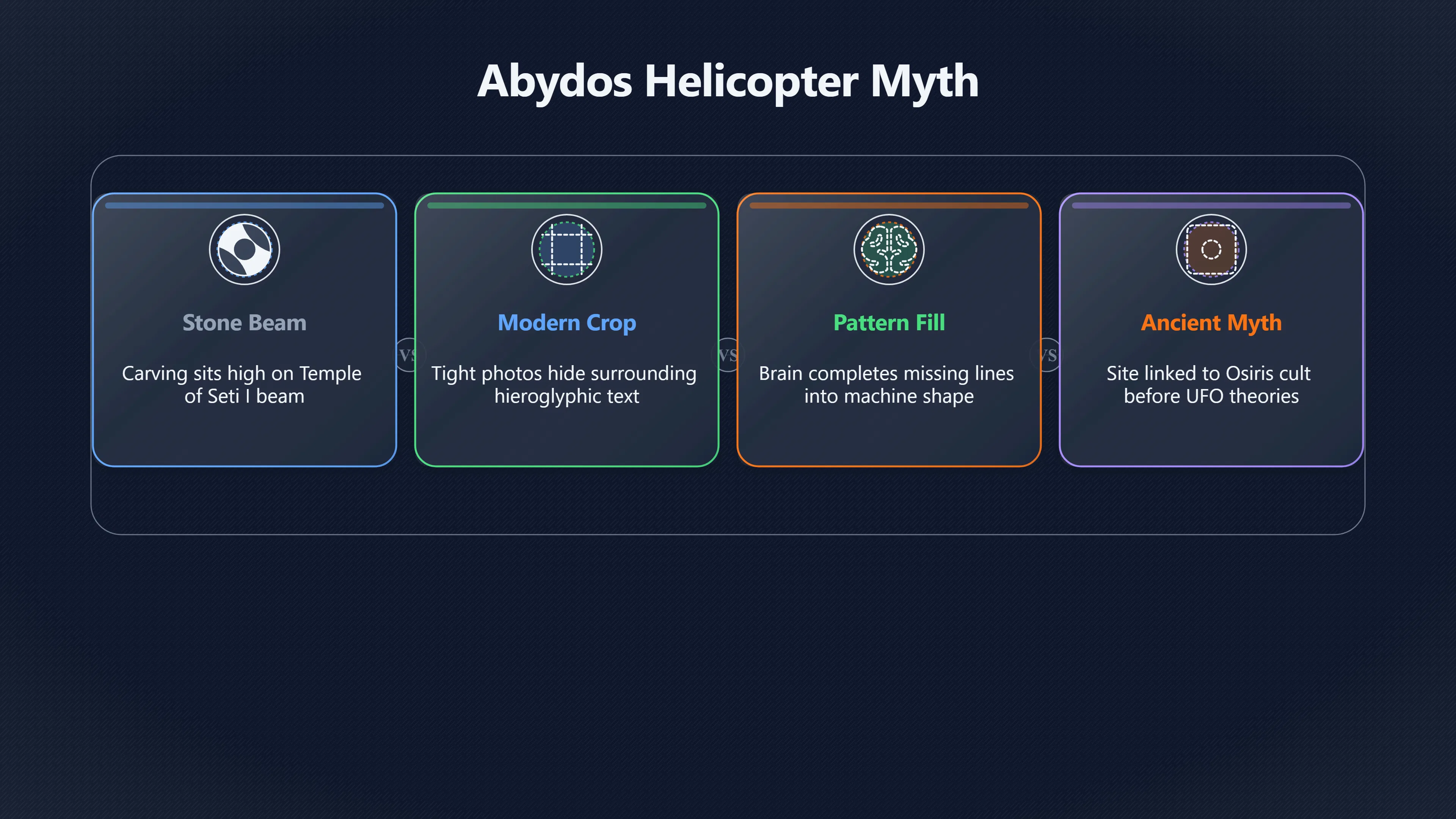
The carving sits high on a beam in the Temple of Seti I at Abydos, one of ancient Egypt’s most important religious sites. Abydos itself was a major cult centre associated with Osiris and royal ritual long before modern UFO theories existed. [Encyclopedia Britannica]britannica.comThe site, located in the low desert west of the Nile River.Read moreEncyclopedia BritannicaAbydos | Egypt, Map, History, & FactsAbydos, prominent sacred city and one of the most important archaeological si… [Penn Museum]penn.museumMuseum AbydosAbydos - Expedition MagazineBy about 2000 B.C. the original god of Abydos, the dog-shaped funerary deity Khentamenty, had been absorbed b…
The image became especially popular during the late twentieth century through fringe archaeology books, television documentaries and early internet forums. Photographs cropped tightly around the damaged section made the effect appear even more striking. To many viewers, the central shape looked uncannily like a helicopter fuselage with rotor blades above it. Nearby marks were interpreted as submarines, airships or futuristic aircraft.
Several factors amplified the claim:
- The carvings are genuinely ancient.
- The shapes appear visually recognisable to modern audiences.
- The relief is difficult to examine closely in person because of its position.
- Cropped images remove surrounding hieroglyphic context.
- Egypt already occupies a central place in ancient-astronaut mythology.
The result was a compelling visual meme: a single photograph seemingly bypassing the need for deeper historical analysis.
The Palimpsest Effect Behind the Illusion
The mainstream Egyptological explanation is neither speculative nor especially mysterious. The inscription is understood as a palimpsest: an older carved text that was modified and overwritten by a later one. [Madain Project]madainproject.comMadain ProjectHelicopter HieroglyphsThe so-called helicopter-hieroglyph, a palimpsest relief, is a result two overlapping inscriptions, t… [Wikipedia]WikipediaOpen source on wikipedia.org.
How overlapping inscriptions created the shapes
The original inscription was carved during the reign of Seti I. Later, under Ramesses II, parts of the text were plastered over and recarved with a revised royal titulary. Over centuries, the plaster filling deteriorated and fell away. What remains visible today is a partial overlap of both inscriptions at once. [Wikipedia]WikipediaAbydos, EgyptAbydos, EgyptOne of the oldest cities of ancient Egypt, and also of the eighth nome in Upper Egypt. It is located about 11 kilometres… [Madain Project]madainproject.comMadain ProjectHelicopter HieroglyphsThe so-called helicopter-hieroglyph, a palimpsest relief, is a result two overlapping inscriptions, t…
This matters because Egyptian hieroglyphs are highly structured symbolic forms. When two different carved symbol systems partially survive in the same space, the resulting merged shapes can look unlike either original inscription.
The “helicopter” effect appears because:
- parts of Seti I’s inscription remain visible;
- parts of Ramesses II’s replacement text survive;
- erosion removes connective boundaries;
- human pattern recognition fills in missing lines.
Rather than depicting a machine, the carving effectively combines fragments from different historical moments into one accidental composite image.
Why the illusion looks convincing
The illusion succeeds because the human brain excels at recognising familiar shapes quickly, even when information is incomplete. This is especially true for silhouettes associated with strong visual identities, such as aircraft. [Psychology Today]psychologytoday.comPareidolia | Psychology Today United KingdomPareidolia is a phenomenon wherein people perceive likenesses on random images—such as faces…
Once a viewer is told “this looks like a helicopter”, the brain tends to stabilise the interpretation. The mind begins organising ambiguous lines into a coherent modern object. This process is difficult to reverse after the first impression.
Importantly, the effect depends heavily on selective framing. Wider photographs showing the full architectural setting and neighbouring inscriptions make the “machine” appearance less persuasive because the carving becomes recognisably part of a damaged textual register rather than an isolated illustration.
Pareidolia and Why Humans See Machines in Ancient Art
Pareidolia is the tendency to perceive meaningful images in ambiguous visual information. Common examples include seeing faces in clouds, animals in rock formations or human expressions in everyday objects. Psychologists describe it as a normal feature of perception rather than a disorder. [EBSCO]ebsco.comEBSCOPareidolia | Health and Medicine | Research StartersPareidolia is a psychological phenomenon where people perceive familiar patterns… The Abydos case is especially powerful because it combines pareidolia with expectation and cultural familiarity.
Modern technology shapes interpretation
Ancient Egyptians obviously did not carve helicopters as recognisable twentieth-century engineering objects. Yet modern observers live in a world saturated with aircraft imagery. Rotor blades, cockpits and streamlined fuselages are instantly recognisable visual patterns.
Because of this, viewers often interpret ambiguous shapes through modern technological categories instead of ancient symbolic systems. A damaged hieroglyph cluster therefore becomes mentally reorganised into something contemporary.
The same cognitive tendency appears elsewhere in UFO culture:
- rock formations interpreted as faces; [psychologytoday.com]psychologytoday.comPareidolia | Psychology Today United KingdomPareidolia is a phenomenon wherein people perceive likenesses on random images—such as faces…
- blurred lights interpreted as structured craft;
- erosion marks interpreted as artificial construction;
- overlapping textures interpreted as hidden symbols.
In each case, the observer contributes part of the meaning.

Why Egypt attracts this kind of interpretation
Egyptian monuments are particularly vulnerable to pareidolic interpretation because they are visually dense and culturally loaded. Hieroglyphs already appear symbolic and mysterious to many non-specialists. Monumental stone carving also survives in incomplete states, encouraging imaginative reconstruction.
Within UFO culture, Egypt functions almost as a symbolic shortcut for hidden ancient knowledge. This predisposes some viewers to interpret ambiguity in extraordinary ways before examining ordinary explanations.
Egyptological Explanations Versus UFO Claims
The divide between Egyptological interpretation and UFO-oriented interpretation is not mainly about whether the carving resembles something modern. Even many sceptics acknowledge that the shape superficially resembles a helicopter. The disagreement concerns causation and evidential standards.
The Egyptological position
Egyptologists point to several converging facts:
- the carving exists within a known royal inscription sequence;
- overwriting inscriptions was historically common;
- erosion patterns match the palimpsest explanation;
- no supporting evidence exists for ancient aircraft technology;
- nearby inscriptions remain entirely consistent with New Kingdom religious and royal formulae. [Wikipedia]WikipediaTemple of Seti I (AbydosTemple of Seti I (Abydos [Madain Project]madainproject.comeating a palimpsest-like effect of…Read more…
Importantly, the explanation does not require hypothetical lost civilisations or extraterrestrial intervention. It relies on documented inscription practices already known throughout Egyptian archaeology.
The UFO and ancient-astronaut interpretation
Ancient-astronaut proponents usually argue that the resemblance is too precise to be accidental. Some claim the Abydos relief forms part of a broader pattern of anomalous ancient imagery allegedly depicting advanced technology.
However, the argument faces major evidential weaknesses:
- there is no corroborating textual description of aircraft;
- no associated technology exists archaeologically;
- the interpretation depends on selective visual resemblance;
- the imagery changes depending on lighting and photograph quality;
- reconstructed versions often exaggerate machine-like features.
The claim also suffers from hindsight bias. Modern viewers interpret the shape as a helicopter only because helicopters already exist in their cultural vocabulary. Earlier societies without helicopters would likely not have seen the same thing.
Common Misunderstandings About the Abydos Relief
Several misconceptions repeatedly appear in online discussions and documentaries.
“The carving is a single intact image”
It is not. The image results from overlapping inscriptions and surface damage. The illusion depends on partial survival and erosion rather than a clean, intentional design. [Wikipedia]WikipediaHelicopter hieroglyphs - WikipediaThe helicopter hieroglyphs is a name given to part of an Egyptian hieroglyph carving from the Temple… [Wikipedia]WikipediaOpen source on wikipedia.org.
“Archaeologists cannot explain it”
The explanation has existed for decades and is broadly accepted within Egyptology. The palimpsest interpretation is neither new nor controversial among specialists.
“The resemblance is impossible by chance”
Pareidolia regularly produces striking recognisable forms from ambiguous information. Humans see meaningful patterns extremely easily, particularly faces, animals and machines. [PMC]pmc.ncbi.nlm.nih.govPMCPareidolia in a Built Environment as a ComplexPMCby C Wang · 2022 · Cited by 22 — Pareidolia is a psychological phenomenon that perceives a dedifferentiated sensory stimulus as indica…
“The Egyptians depicted many futuristic vehicles”
Most examples circulated online rely on heavily cropped photographs, low-resolution images or imaginative tracing overlays. When examined in context, the shapes usually resolve into ordinary hieroglyphic damage, erosion or artistic conventions.
What the Abydos Case Reveals About UFO Evidence
The Abydos inscriptions remain important within the broader Egypt-UFO discussion because they demonstrate how compelling visual claims can emerge from weak foundations.
The carving is not merely an isolated misunderstanding. It illustrates several recurring problems in UFO interpretation:
- ambiguous visual evidence;
- selective framing;
- modern assumptions projected onto older material;
- repetition through popular media;
- weak distinction between resemblance and proof.
Unlike some modern UFO sightings, the Abydos case is not primarily a mystery of missing data. The underlying mechanism is fairly well understood. The debate persists largely because the image is emotionally and visually persuasive.
For that reason, the “Abydos helicopter” has become less significant as archaeological evidence than as a case study in perception itself. The relief shows how quickly the human mind can transform damaged historical material into a modern technological narrative, especially in a setting already associated with mystery, antiquity and speculation about hidden knowledge.
Amazon book picks
Further Reading
Books and field guides related to Did Abydos Hieroglyphs Really Show Modern Aircraft?. Use these as the next step if you want deeper reading beyond the article.

A Terrible Mistake
Explains how archaeological anomalies become UFO narratives and addresses claims like Abydos.
The complete pyramids
Provides archaeological context that counters speculative interpretations of Egyptian monuments.
Clancy 2 boxed set
Directly connects ancient Egypt with extraterrestrial interpretations similar to the Abydos claim.
Chariots of the gods?
Provides the broader ancient-alien framework that popularized interpretations like the Abydos helicopter.
Endnotes
-
Source: Wikipedia
Title: Temple of Seti I (Abydos)
Link: https://en.wikipedia.org/wiki/Temple_of_Seti_I_%28Abydos%29 -
Source: Wikipedia
Link: https://en.wikipedia.org/wiki/Helicopter_hieroglyphsSource snippet
Helicopter hieroglyphs - WikipediaThe helicopter hieroglyphs is a name given to part of an Egyptian hieroglyph carving from the Temple...
-
Source: britannica.com
Title: The site, located in the low desert west of the Nile River.Read more
Link: https://www.britannica.com/place/Abydos-ancient-city-EgyptSource snippet
Encyclopedia BritannicaAbydos | Egypt, Map, History, & FactsAbydos, prominent sacred city and one of the most important archaeological si...
-
Source: penn.museum
Title: Museum Abydos
Link: https://www.penn.museum/sites/expedition/abydos/Source snippet
Abydos - Expedition MagazineBy about 2000 B.C. the original god of Abydos, the dog-shaped funerary deity Khentamenty, had been absorbed b...
-
Source: Wikipedia
Link: https://en.wikipedia.org/wiki/Pareidolia -
Source: ebsco.com
Link: https://www.ebsco.com/research-starters/health-and-medicine/pareidoliaSource snippet
EBSCOPareidolia | Health and Medicine | Research StartersPareidolia is a psychological phenomenon where people perceive familiar patterns...
-
Source: pmc.ncbi.nlm.nih.gov
Title: PMCPareidolia in a Built Environment as a Complex
Link: https://pmc.ncbi.nlm.nih.gov/articles/PMC9103170/Source snippet
PMCby C Wang · 2022 · Cited by 22 — Pareidolia is a psychological phenomenon that perceives a dedifferentiated sensory stimulus as indica...
-
Source: Wikipedia
Title: Abydos, Egypt
Link: https://en.wikipedia.org/wiki/Abydos%2C_EgyptSource snippet
Abydos, EgyptOne of the oldest cities of ancient Egypt, and also of the eighth nome in Upper Egypt. It is located about 11 kilometres...
-
Source: abydos.org
Link: https://abydos.org/Source snippet
Abydos ArchaeologyThe mission of Abydos Archaeology is to advance knowledge about ancient Egypt's most sacred site—home of Egypt's first...
-
Source: youtube.com
Title: HOW TO READ EGYPTIAN HIEROGLYPHS (and the Abydos Kinglists)
Link: https://www.youtube.com/watch?v=JckR7_7xuW8Source snippet
Abydos Helicopter...
-
Source: youtube.com
Title: Abydos Helicopter
Link: https://www.youtube.com/watch?v=QQBxl_TlY48 -
Source: madainproject.com
Link: https://madainproject.com/helicopter_hieroglyphsSource snippet
Madain ProjectHelicopter HieroglyphsThe so-called helicopter-hieroglyph, a palimpsest relief, is a result two overlapping inscriptions, t...
-
Source: psychologytoday.com
Link: https://www.psychologytoday.com/gb/basics/pareidoliaSource snippet
Pareidolia | Psychology Today United KingdomPareidolia is a phenomenon wherein people perceive likenesses on random images—such as faces...
-
Source: madainproject.com
Link: https://madainproject.com/temple_of_seti_i_%28abydos%29Source snippet
eating a palimpsest-like effect of...Read more...
-
Source: isida-project.org
Link: https://isida-project.org/egypt_april_2018/rmss2_en.htmSource snippet
The Temple of Ramesses II - ISIDA ProjectOn the southern half of the surviving wall of the Temple Court one can see a preserved part of a...
Additional References
-
Source: tripadvisor.com
Link: https://www.tripadvisor.com/Attraction_Review-g1051491-d4060390-Reviews-Abydos-Sohag_Sohag_Governorate_Nile_River_Valley.htmlSource snippet
Abydos, SohagThe Temple of Seti I is located in Abydos which is 1.5 hours from Sohag. It's very well preserved. The most famous attractio...
-
Source: egypt-museum.com
Link: https://egypt-museum.com/helicopter-hieroglyphs/Source snippet
Helicopter Hieroglyphs... Abydos are not depictions of futuristic machines, but the result of a palimpsest. This explanation may upset th...
-
Source: facebook.com
Link: https://www.facebook.com/Egypt.Museum/posts/the-so-called-helicopter-hieroglyphs-high-upon-the-walls-of-the-temple-of-seti-i/1232529125569341/Source snippet
Egypt MuseumThe term "Helicopter Hieroglyphs" refers to a modern interpretation of a set of certain ancient Egyptian reliefs, found in th...
-
Source: msu-anthropology.github.io
Link: https://msu-anthropology.github.io/daea/sites/ramesses-ii.htmlSource snippet
Ramesses II Cenotaph Temple at AbydosRamesses II Temple is made of beautiful pink and black granite with painted limestone walls. The tem...
-
Source: academia.edu
Link: https://www.academia.edu/145219775/Anatomy_of_a_Palimpsest_The_Not_So_Strange_Case_of_the_Abydos_HelicopterSource snippet
The Not-So-Strange Case of the Abydos HelicopterA detailed discussion of a palimpsest, i.e. re-carved, inscription of Sety I and Ramesses...
-
Source: medium.com
Link: https://medium.com/weeds-wildflowers/what-is-pareidolia-7d98ce6cd570Source snippet
What is Pareidolia?. Finding shapes in different thingsOur brains have evolved to recognize familiar patterns, for survival reasons. This...
-
Source: dokumen.pub
Link: https://dokumen.pub/download/the-great-dedicatory-inscription-of-ramesses-ii-a-solar-osirian-tractate-at-abydos-9004170308-9789004170308.htmlSource snippet
“completed the decoration only after his father's death and at a time when he had adopted his final...Read more...
-
Source: ub.edu
Link: https://www.ub.edu/ipoa/wp-content/uploads/2021/07/20172AuOrCosta.pdfSource snippet
in the decoration of the temples constructed by him at Abydos and Gurna and the Great Hypostyle...Read more...
-
Source: egyptianmuseum.org
Title: New Kingdom Monuments Abydos – The Temple of Seti Built ca
Link: https://egyptianmuseum.org/explore/new-kingdom-monuments-abydos-the-temple-of-setiSource snippet
1279 BCE... The Temple of Seti in Abydos (300 miles south of Cairo) was constructed by Seti I and his son, Rameses II. Seti was a pharao...
-
Source: hub.jhu.edu
Title: The Hub The science behind why we see faces in nature
Link: https://hub.jhu.edu/magazine/2024/winter/pareidolia-faces-in-nature/Source snippet
The HubThe science behind why we see faces in nature - JHU HubAs humans, we're hardwired to discern such recognizable and often meaningfu...
Topic Tree