What Is Really Behind Namibia's UFO Stories?
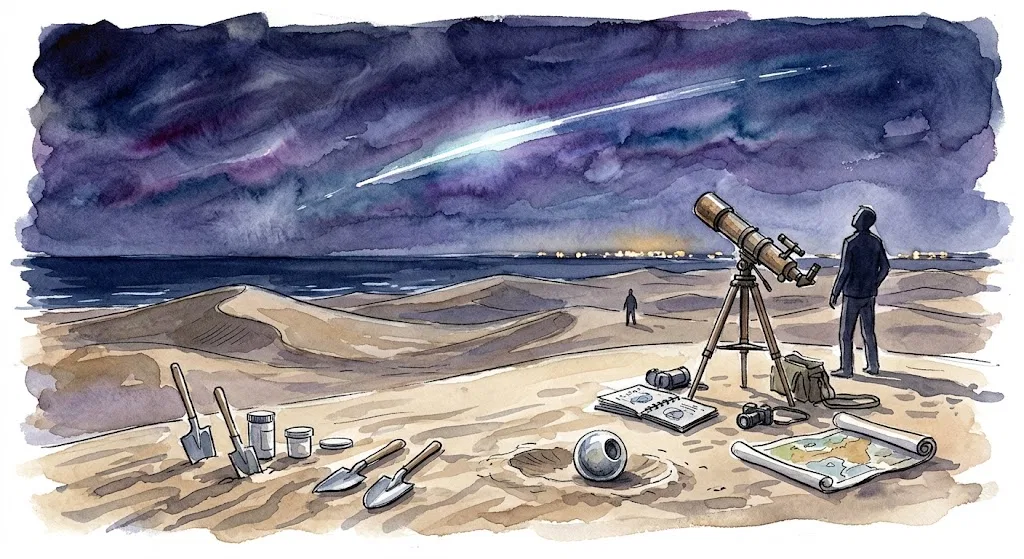
Namibia has a small but revealing UFO record: not a catalogue of well-documented alien encounters, but a pattern of coastal lights, desert fireballs, isolated witness reports, and one memorable “space ball” that was almost certainly human-made space debris.
Page outline Jump by section
Introduction
Namibia has a small but revealing UFO record: not a catalogue of well-documented alien encounters, but a pattern of coastal lights, desert fireballs, isolated witness reports, and one memorable “space ball” that was almost certainly human-made space debris. The strongest available evidence points towards ordinary but dramatic sky phenomena — meteors, possible re-entering debris, aircraft, lanterns, atmospheric effects, and misread objects in exceptionally dark skies — rather than confirmed extraterrestrial craft. That does not make the subject worthless. It makes Namibia a useful case study in how UFO narratives form in a country with huge open horizons, sparse population, world-class night skies, a long Atlantic coastline, and limited official public archiving of unexplained aerial reports.
The key distinction is between “unidentified” and “extraordinary”. Several Namibian cases were genuinely unidentified at the time witnesses reported them, but none found in the available public record rises to the level of confirmed non-human technology. Local journalism, civilian UFO databases, and space-debris reporting provide the most useful evidence base, while official Namibian UFO investigation records appear sparse or unavailable in public form.
Why Namibia produces memorable sky reports
Namibia is unusually well suited to skywatching. Much of the country is dry, sparsely populated, and far from heavy light pollution. NamibRand Nature Reserve, in the south-west Namib Desert, is recognised by DarkSky International as one of the naturally darkest accessible places on Earth, while NamibRand’s own dark-sky material notes its Gold Tier International Dark Sky Reserve status and its importance as Africa’s first such reserve. [DarkSky International]darksky.orgDark Sky International Namib Rand Nature ReserveDark Sky International Namib Rand Nature Reserve
That darkness matters for UFO reports. It makes meteors, satellites, aircraft lights, rocket-stage re-entries, planets near the horizon, and atmospheric glow more visible and more emotionally striking. It also means that a witness can see something clearly enough to be startled, but not necessarily well enough to identify it. The NamibRand educational material describes moonless nights where thousands of stars, the Milky Way, the Magellanic Clouds, and zodiacal light can be visible to the naked eye; those same viewing conditions can make unfamiliar moving lights feel more dramatic than they would near a city. [NaDEET]nadeet.orgSource details in endnotes.
The regional pattern in public reports is also telling. The most source-supported Namibian UFO stories cluster around the coast — Walvis Bay, Usakos, Swakopmund-facing trajectories, and the Atlantic horizon — plus a handful of inland reports around Windhoek, Okahandja, and the north. The coast offers low horizons, maritime traffic, aircraft routes, sea rescue responses, and spectacular sunset or dawn lighting. Inland Namibia offers dark skies and long sightlines. Both environments can generate sincere but difficult-to-resolve reports.
The clearest chronology of public Namibian UFO cases
Namibia does not have a large public UFO archive comparable to the major United States or United Kingdom collections. The National UFO Reporting Center lists only six Namibia entries by location, which is a tiny dataset and should not be treated as a national incident total. It is better understood as an English-language, United States-based civilian database that happens to contain some Namibia reports. [NUFORC]nuforc.orgReports by LocationReports by Location
The cases below are the most useful public anchors because they are either locally reported, independently archived, or contain enough detail to assess.
1976, Walvis Bay: A report later cited by The Namibian from the Namib Times described a strange object over the Walvis Bay wilderness on 16 August 1976. The account said several people saw a brilliant object with a round feature beneath it, with light extensions and spark-like effects; some reportedly called it a “Space Monster”, and it faded after sunrise. The surviving version is not a primary newspaper scan in the sources reviewed here, so it should be treated as an archived historical report rather than a firmly documented official case. [The Namibian]namibian.com.naThe Namibian'UFO' sightings at coastThe Namibian'UFO' sightings at coast
May 2008, Usakos to the coast: The Namibian reported that residents of Usakos saw a fast, low object described as a “round ball with a long tail” moving towards Swakopmund. Multiple witnesses were quoted or named, and the report itself raised ordinary possibilities such as a shooting star or ball lightning. The description — fast, bright, tailed, silent, and brief — is highly compatible with a meteor or bolide, although the article did not establish a final explanation. [The Namibian]namibian.com.naThe Namibian'UFO' sightings at coastThe Namibian'UFO' sightings at coast
May 2009, Windhoek: A NUFORC report from Windhoek described a flame-coloured object, seen by an alleged 18 observers, moving from east to west and then apparently hovering or circling before fading. The witness said they called the local airport and were told no aircraft activity was recorded at that hour. This is a richer civilian report than most because it includes time, duration, witness count, motion, and an attempted airport check, but it remains a self-submitted account without independent instrument data. [NUFORC]nuforc.orgOpen source on nuforc.org.
October 2009, Walvis Bay: The Namibian reported a strange red light over Walvis Bay at about 18:30, with witness descriptions ranging from an explosion and red sky illumination to something crashing into the sea with a smoky trail. The Namibian Sea Rescue Institute searched for around three hours near the alleged crash site north-west of Pelican Point and found nothing. Defence Permanent Secretary Petrus Shivute rejected missile-launch speculation, and a meteorite was raised as another possible explanation. [The Namibian]namibian.com.naThe Namibian'UFO' sightings at coastThe Namibian'UFO' sightings at coast
November–December 2011, Omusati Region: This is Namibia’s most concrete “unidentified object” case, but it is not strong evidence for an alien craft. A hollow metallic sphere weighing just over 6 kg, with a circumference of about 110 cm, was found near Onamatunga after reported loud explosions. Namibia’s National Forensic Science Institute director Paul Ludik said the material was known to humans, appeared consistent with space-vehicle use, and was not radioactive, explosive, or biohazardous; he also explicitly dismissed speculation that it was part of a UFO in the extraterrestrial sense. [The Namibian]namibian.com.naThe Namibian'UFO' sightings at coastThe Namibian'UFO' sightings at coast
May 2025, Walvis Bay: A NUFORC entry described orange orbs over the eastern South Atlantic, viewed from land near Walvis Bay. The report itself includes the possible explanation “Chinese Lantern - Possible”, notes a low elevation angle over the horizon, and describes slow, repetitive movement rather than extreme performance. That makes it a good example of a case that is interesting as testimony but weak as anomalous evidence. [NUFORC]nuforc.orgOpen source on nuforc.org.

The Omusati “space ball” is the strongest physical case — and the least alien
The Omusati metallic sphere deserves special attention because it is the rare Namibian UFO-adjacent incident involving a recovered physical object. Unlike vague lights, it had a location, material, mass, crater, official handling, and named forensic commentary. The object was found roughly 18 metres from its impact crater, after reports of explosions between 15 and 20 November 2011, and Namibian police and forensic officials examined it. [The Namibian]namibian.com.naThe Namibian'UFO' sightings at coastThe Namibian'UFO' sightings at coast
The most cautious reading is that it was probably space debris, possibly a pressure vessel or similar component from a spacecraft or rocket body. Space.com, Universe Today, and Phys.org all reported the incident as a mysterious metal sphere likely associated with space debris, while Universe Today specifically compared it with composite pressure vessels that can survive re-entry. [Space]space.comMysterious 'Space Ball' Crashes in NamibiaMysterious 'Space Ball' Crashes in Namibia [Universe Today]universetoday.comspherical object drops from the sky in namibiaspherical object drops from the sky in namibia
This case illustrates a central lesson for Namibia’s UFO record: the more physical the evidence becomes, the less exotic the explanation usually needs to be. The object was “from space” in the broad sense that it likely re-entered from orbit, but that does not mean it was extraterrestrial in origin. The European Space Agency’s re-entry safety guidance explains that human-made space objects, or parts of them, can survive re-entry and that re-entry safety includes risks from impacting debris, hazardous substances, and radioactive substances. [ESA Technology]technology.esa.intSource details in endnotes.
For readers comparing Namibia with sibling country pages in a wider UFO project, the Omusati case belongs beside southern African space-debris and meteor cases rather than beside close-encounter folklore. It is more like a recoverable aerospace debris event than a classic “craft seen in the sky” incident.
Coastal sightings: dramatic, public, and often meteor-like
The best local reporting comes from Namibia’s coast. The 2008 Usakos report and the 2009 Walvis Bay report both show the same pattern: multiple witnesses, striking light, public discussion, and no firm exotic evidence.
The 2008 Usakos event was described as a fast, low “round ball with a long tail” heading towards Swakopmund, lighting up the town but making no sound. Those details strongly resemble a bright meteor: a luminous head, a tail or trail, high apparent speed, short duration, and sudden public excitement. The article itself framed the possibilities in mundane terms before mentioning aliens, asking whether it might have been a shooting star or ball lightning. [The Namibian]namibian.com.naThe Namibian'UFO' sightings at coastThe Namibian'UFO' sightings at coast
The 2009 Walvis Bay event is more complex because witnesses described a red glow, a smoky trail, an apparent crash into the sea, and a loud thud or explosion. Yet the practical follow-up weakened the crash interpretation: sea rescue searched for hours and found nothing, port control saw a streak rather than a recovered object, and the defence ministry denied a missile launch. A meteor or re-entering fragment remains plausible, but the available article does not prove it. [The Namibian]namibian.com.naThe Namibian'UFO' sightings at coastThe Namibian'UFO' sightings at coast
These coastal cases should be classed as contested but probably natural or human-made, not debunked beyond doubt. They are useful because they show local witnesses reacting to real visual events, while the evidence trail stops before any extraordinary claim can be supported.
Inland reports: Windhoek, Okahandja, and the problem of single-source testimony
The inland Namibia reports in civilian databases are thinner than the coastal newspaper cases. NUFORC includes a 2009 Okahandja report of an orange light near the moon that reportedly moved erratically and disappeared, and a 2009 Windhoek report of a fireball-like object seen by several people. These reports preserve witness language, dates, shapes, and durations, but they are still self-submitted civilian records rather than verified investigations. [NUFORC]nuforc.orgOpen source on nuforc.org.
The Windhoek case is the stronger of the two because the witness claimed multiple observers and an airport check. Even so, the evidential gap remains large. There is no radar record in the public source, no photograph or video available for review, no named independent investigators, and no weather or satellite-track reconstruction attached to the report. The report is therefore best classified as unresolved testimony, not confirmed anomaly. [NUFORC]nuforc.orgOpen source on nuforc.org.
This is where Namibia differs from better-documented UAP cases in countries with military aviation archives, air-traffic-control releases, or formal public investigations. A Namibian witness can give a sincere and detailed account, but without corroborating records it is difficult to separate unusual aircraft, drones, lanterns, satellites, planets, meteors, and atmospheric effects from genuinely unexplained phenomena.
Official records and declassified material: the gap is part of the story
No substantial public Namibian government UFO archive emerged from the research pass behind this page. The publicly visible record is dominated by local journalism, civilian UFO databases, social media fragments, and space-debris reporting. That absence should not be overinterpreted. It does not prove official secrecy; it more simply means there is no easily accessible, dedicated national UFO record comparable to the United States’ UAP releases or the United Kingdom’s historical UFO files.
For comparison, the United States now has formal UAP record structures: the US National Archives says it has established Record Group 615 for UAP records under the 2024 National Defense Authorization Act, and the All-domain Anomaly Resolution Office states that it uses a scientific framework and has found no Department of Defense evidence of extraterrestrial technology. [National Archives]archives.govSource details in endnotes.
Those international records are useful for method, not as direct evidence about Namibia. They show how stronger UAP assessment depends on standardised reporting, sensor data, chain of custody, and careful classification of likely explanations. The 2021 US intelligence preliminary assessment set out broad explanatory categories for UAP, including airborne clutter, natural atmospheric phenomena, government or industry programmes, foreign systems, and an “other” category for unresolved cases. [DNI]dni.govPreliminary Assessment: Unidentified Aerial PhenomenaPreliminary Assessment: Unidentified Aerial Phenomena
Applied to Namibia, that framework pushes most cases into three practical bins: natural sky events, human-made aerospace activity or debris, and unresolved low-data reports. It does not justify treating low-data Namibian sightings as alien evidence.
Confirmed, contested, and debunked claims in Namibia
A clear evidence split is more useful than a dramatic ranking.
Confirmed or strongly supported: The Omusati sphere was a real recovered object, handled by Namibian authorities, with physical features and safety assessment reported by The Namibian. The best-supported explanation is human-made space debris, not a non-human craft. [The Namibian]namibian.com.naThe Namibian'UFO' sightings at coastThe Namibian'UFO' sightings at coast
Contested but plausible as ordinary phenomena: The 2008 Usakos and 2009 Walvis Bay cases involved multiple witnesses and local reporting, but their descriptions fit meteors, bolides, re-entry events, or atmospheric interpretations at least as well as anything exotic. The Walvis Bay sea-rescue search finding nothing is important because it weakens claims of an actual aircraft or object crashing into the ocean. [The Namibian]namibian.com.naThe Namibian'UFO' sightings at coastThe Namibian'UFO' sightings at coast
Unresolved but weakly evidenced: The Windhoek, Okahandja, and 2025 Walvis Bay NUFORC reports remain interesting as witness accounts, especially where there are multiple observers or an experienced maritime observer. But they lack public instrument data, independent investigation files, or recoverable physical evidence. NUFORC’s own 2025 Walvis Bay entry includes “Chinese Lantern - Possible”, showing that even the report record preserves a mundane candidate explanation. [NUFORC]nuforc.orgReports by LocationReports by Location
Debunked or effectively non-alien: The Omusati “space ball” was not debunked in the sense of being fake; it was real. What was debunked was the leap from “unidentified metal object” to extraterrestrial UFO. Namibian forensic commentary said its material was known to humans, and broader space-debris reporting explains why pressure vessels and other components can survive re-entry. [The Namibian]namibian.com.naThe Namibian'UFO' sightings at coastThe Namibian'UFO' sightings at coast
What Namibia adds to a wider UFO map
Namibia’s UFO material is valuable precisely because it is modest. It does not provide a famous close encounter, a government crash-retrieval claim, or a large official archive. Instead, it shows how a country with superb visibility and sparse public reporting can produce a handful of memorable cases that are easy to overstate if stripped from their local context.
The Namibian pattern also helps interpret neighbouring southern African material. Zimbabwe has a much more famous school-encounter tradition, South Africa has a larger aviation and media footprint, and Namibia’s record is more coastal, astronomical, and debris-oriented. In a country-by-country UFO project, Namibia therefore works best as the page that separates spectacular skywatching from strong anomaly evidence.
The fairest conclusion is that Namibia has credible reports of unidentified lights and objects, including one well-documented recovered space-debris incident, but no public case currently demonstrates extraterrestrial origin. The most useful way to read the Namibian record is not “nothing happened” or “aliens visited”, but “people saw striking things in unusually good skies, and the available evidence usually stops before the extraordinary claim begins.”
Amazon book picks
Further Reading
Books and field guides related to What Is Really Behind Namibia's UFO Stories?. Use these as the next step if you want deeper reading beyond the article.
The Hynek UFO Report
Useful for assessing sparse witness reports and unexplained lights.
The UFO Experience
Matches the page's emphasis on distinguishing unexplained events from ordinary causes.
Passport to Magonia
Explores how local environments and folklore shape UFO narratives.
Endnotes
-
Source: darksky.org
Title: Dark Sky International Namib Rand Nature Reserve
Link: https://darksky.org/places/namibrand-dark-sky-reserve/ -
Source: namibrand.com
Link: https://www.namibrand.com/dark-sky.html -
Source: nadeet.org
Link: https://nadeet.org/international-dark-sky-reserve -
Source: nuforc.org
Title: Reports by Location
Link: https://nuforc.org/ndx/?id=loc -
Source: nuforc.org
Link: https://nuforc.org/sighting/?id=70143 -
Source: nuforc.org
Link: https://nuforc.org/sighting/?id=189590 -
Source: space.com
Title: Mysterious ‘Space Ball’ Crashes in Namibia
Link: https://www.space.com/14028-namibia-space-ball-orbital-debris.html -
Source: phys.org
Title: 2011 12 space ball namibia
Link: https://phys.org/news/2011-12-space-ball-namibia.html -
Source: technology.esa.int
Link: https://technology.esa.int/page/re-entry-safety -
Source: nuforc.org
Link: https://nuforc.org/sighting/?id=78063 -
Source: archives.gov
Link: https://www.archives.gov/research/topics/uaps -
Source: dni.gov
Title: Preliminary Assessment: Unidentified Aerial Phenomena
Link: https://www.dni.gov/files/ODNI/documents/assessments/Prelimary-Assessment-UAP-20210625.pdf -
Source: media.defense.gov
Title: DOPSR 2024 0263 AARO HISTORICAL RECORD REPORT VOLUME 1 2024
Link: https://media.defense.gov/2024/Mar/08/2003409233/-1/-1/0/DOPSR-2024-0263-AARO-HISTORICAL-RECORD-REPORT-VOLUME-1-2024.PDF -
Source: conference.sdo.esoc.esa.int
Link: https://conference.sdo.esoc.esa.int/proceedings/sdc3/paper/58/SDC3-paper58.pdf -
Source: reentry.esoc.esa.int
Link: https://reentry.esoc.esa.int/ -
Source: conference.sdo.esoc.esa.int
Link: https://conference.sdo.esoc.esa.int/proceedings/sdc3/paper/111/SDC3-paper111.pdf -
Source: nuforc.org
Link: https://nuforc.org/sighting/?id=194936 -
Source: namibrand.com
Link: https://www.namibrand.com/ -
Source: archive.org
Title: Jul 12 1978, Financial Times, #27582, UK (en) djvu.txt
Link: https://archive.org/stream/FinancialTimes1978UKEnglish/Jul%2012%201978%2C%20Financial%20Times%2C%20%2327582%2C%20UK%20%28en%29_djvu.txt -
Source: namibian.com.na
Title: The Namibian’UFO’ sightings at coast
Link: https://www.namibian.com.na/ufo-sightings-at-coast/ -
Source: namibian.com.na
Title: The Namibian’UFO’ has Walvis Bay buzzing
Link: https://www.namibian.com.na/ufo-has-walvis-bay-buzzing/ -
Source: namibian.com.na
Title: The Namibian Metal ball from space falls in Omusati Region
Link: https://www.namibian.com.na/metal-ball-from-space-falls-in-omusati-region/ -
Source: universetoday.com
Title: spherical object drops from the sky in namibia
Link: https://www.universetoday.com/articles/spherical-object-drops-from-the-sky-in-namibia -
Source: reddit.com
Link: https://www.reddit.com/r/UFOs_Archive/comments/1pyuzdt/africa_namibia_walvis_bay_1976_ufo_multiple/ -
Source: youtube.com
Link: https://www.youtube.com/watch?v=yIsPbysinKw -
Source: Wikipedia
Title: Space debris
Link: https://en.wikipedia.org/wiki/Space_debris -
Source: spaceacademy.net.au
Link: https://www.spaceacademy.net.au/watch/debris/reentryhaz.htm -
Source: issibern.ch
Link: https://www.issibern.ch/wp-content/uploads/SPATIUM52.pdf -
Source: spaceinafrica.com
Title: falling space debris incident reported in ethiopia
Link: https://spaceinafrica.com/2025/01/14/falling-space-debris-incident-reported-in-ethiopia/
Additional References
-
Source: youtube.com
Title: Unexplained Light in the Desert | Alien Encounters: Fact or Fiction
Link: https://www.youtube.com/watch?v=l_sAu_KK-NMSource snippet
Aliens, Seals and Landing on the Moon | We DID NOT Expect This...
-
Source: youtube.com
Title: Aliens, Seals and Landing on the Moon | We DID NOT Expect This
Link: https://www.youtube.com/watch?v=B54lhh9Dtn4Source snippet
Unearthly Encounters | ALIEN ABDUCTION: THE STRANGEST UFO CASE FILES...
-
Source: war.gov
Link: https://www.war.gov/ufo/ -
Source: energy.gov
Link: https://www.energy.gov/nnsa/uapufo-resources-and-documents -
Source: youtube.com
Title: The Impact Crater in Namibia; Roter Kamm Crater
Link: https://www.youtube.com/watch?v=TSLjUoOdmDcSource snippet
Unexplained Light in the Desert | Alien Encounters: Fact or Fiction...
-
Source: war.gov
Title: department of defense releases the annual report on unidentified anomalous phen
Link: https://www.war.gov/News/Releases/Release/Article/3964824/department-of-defense-releases-the-annual-report-on-unidentified-anomalous-phen/ -
Source: dkiapcss.edu
Link: https://dkiapcss.edu/wp-content/uploads/2023/06/N2644-A-Comparative-Survey-of-Security-Approaches-Toward-Unexplained-Aerial-Phenomena-Across-the-Indo-Pacific.pdf -
Source: facebook.com
Link: https://www.facebook.com/lifesbiggestquestionsofficial/posts/a-metal-sphere-that-levitatesfound-in-ancient-ruinsancient-sphere-mystery-discov/1195421209273410/ -
Source: facebook.com
Link: https://www.facebook.com/kalenjinsonline/posts/a-metallic-object-fell-from-the-sky-in-kapsabet-alarming-the-residents-of-st-mar/1060154986209199/ -
Source: scribd.com
Link: https://www.scribd.com/document/852968363/23-F-0922-4
Topic Tree
Follow this branch
Related pages 192
- Afghanistan UAP
- AlbanianUFOs
- Algeria UFOs
- Antigua UFOs
- Monaco UFOs
- +187 more in sidebar