Within ComorosUFOs
Could Comoros UFOs Be Meteors or Satellites?
Exploring meteors, satellites, and atmospheric events often mistaken for UFOs over Comoros.
On this page
- Meteors and fireballs
- Satellite trains and re entries
- Local environmental factors
Page outline Jump by section
Introduction
Over the islands of the Union of the Comoros, people sometimes look skyward and see lights, streaks or glows that catch their attention. Without clear photographic records, official reports, or systematic local documentation of unidentified aerial phenomena, many such observations remain unexplained in the public record — but that does not mean they are inexplicable. A suite of natural and ordinary astronomical events can account for many “unusual” sky phenomena that might otherwise be read as mysterious. This page explores the natural mechanisms most likely to produce bright or unexpected lights over Comorian skies, including meteors and fireballs, the passage of satellites and space debris reflecting sunlight, and environmental factors that affect how these events appear from the ground.

Meteors, Fireballs and Atmospheric Light Streaks
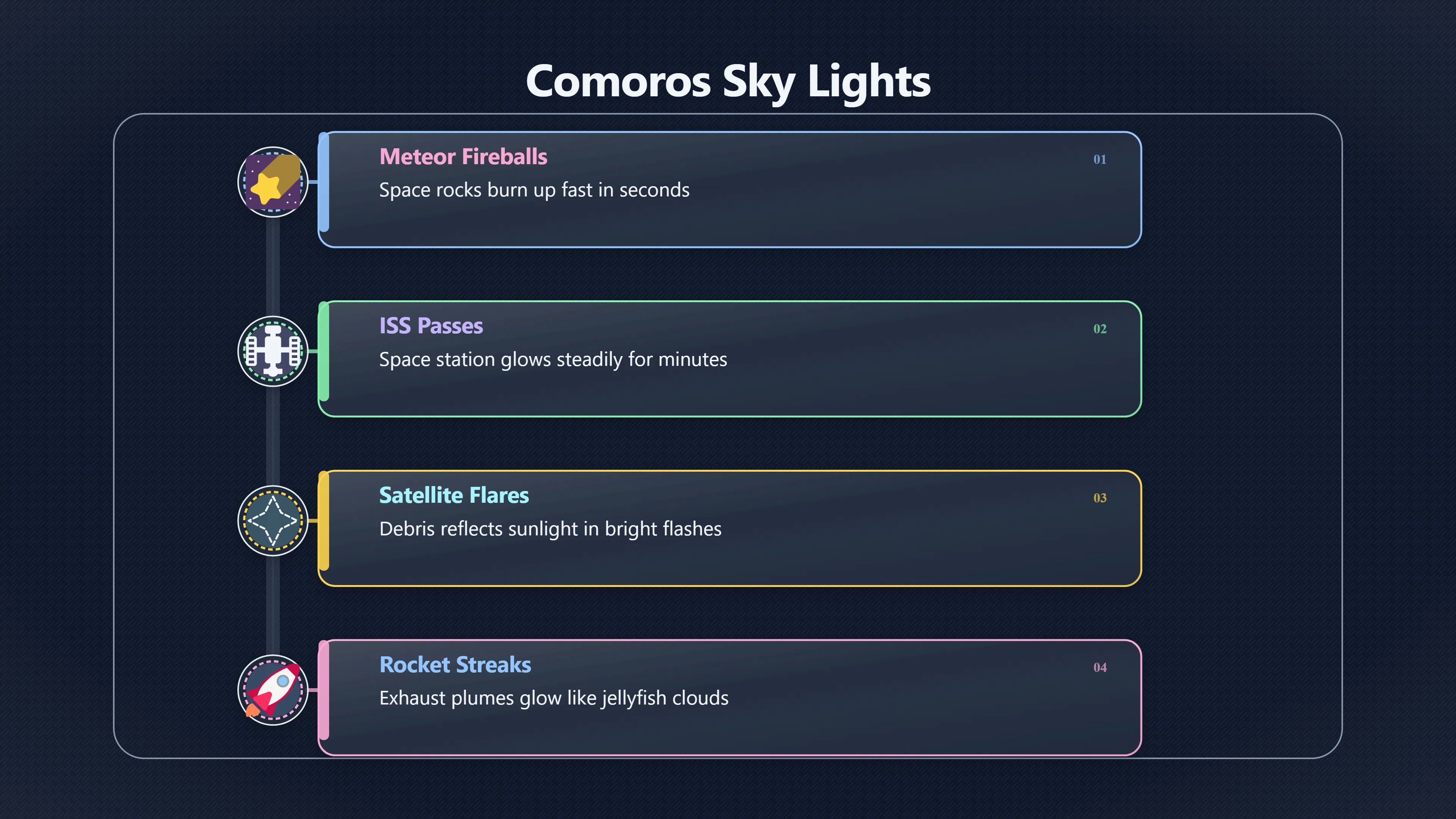
One of the most common natural sources of sudden bright lights in the sky is the passage of a meteoroid through Earth’s atmosphere. When small bits of rock or metal from space enter at high speed, friction with the air causes them to heat up and produce a flash of light visible from the ground — a meteor or “shooting star”. When such a streak is especially bright, perhaps outshining Venus, it is classified as a fireball. Fireballs are rare compared with faint meteors, but they occur all over the globe and can be visible for a few seconds as they burn up high above the Earth. [International Meteor Organization]imo.netInternational Meteor Organization Fireballs | IMOInternational Meteor Organization Fireballs | IMO
From Comoros’ tropical latitude, these events would appear against a near-equatorial night sky; even a single bright meteor can draw attention if it crosses the sky rapidly and unexpectedly. Meteors are most likely to be seen during known meteor showers (e.g., the Perseids in August or Geminids in December), but sporadic fireballs unrelated to major showers occur year-round. [ScienceInsights]scienceinsights.orgScience Insights What Just Happened in the Sky? Meteor, Satellite, or MoreScienceInsightsWhat Just Happened in the Sky? Meteor, Satellite, or More - ScienceInsightsMarch 18, 2026…
Meteor events are brief, typically lasting only a few seconds, and often leave a fading trail in their wake. If an observer hears a delayed sonic boom or sees fragmentation, that further supports a meteoric explanation. Persistent glowing or multi‑second trails that move slowly are generally not meteors. [meteor.asu.cas.cz]meteor.asu.cas.czHow to identify a bolide | Meteor physics group OndřejovJanuary 7, 2025…
Satellites, Space Debris and Steady Moving Lights
Not all bright objects in the sky move quickly. Artificial satellites orbit Earth at various altitudes, and when they reflect sunlight — especially shortly after dusk or before dawn — they can be visible as bright, steadily moving points of light. The International Space Station (ISS) is the most prominent example: at around 400 km altitude, it often appears as a bright, steadily moving “star” tracing a path across the sky over several minutes. [astronomy]astronomy.org.ggmeteoblueAstronomy Seeing Comoros - meteoblue nomy Section of La Société
In addition to the ISS, thousands of smaller satellites circle Earth. Many of these — including large constellations like SpaceX’s Starlink — produce what astronomers call satellite flares: brief increases in brightness when sunlight reflects directly off a satellite’s surface toward an observer. Some of these flashes can be surprisingly bright and could be mistaken for unusual aerial phenomena unless one checks satellite pass predictions for the specific time and location. [Wikipedia]WikipediaSatellite flareSatellite flare
The key feature of satellites is their relatively slow, steady path: unlike meteors, which flash and vanish in seconds, satellites are visible for minutes and maintain a consistent trajectory across the sky. [ScienceInsights]scienceinsights.orgScience Insights What Just Happened in the Sky? Meteor, Satellite, or MoreScienceInsightsWhat Just Happened in the Sky? Meteor, Satellite, or More - ScienceInsightsMarch 18, 2026…

Re‑Entering Space Junk and Rocket Streaks
A subset of aerospace phenomena comes from defunct satellites or rocket bodies that re‑enter Earth’s atmosphere. As they descend, they can produce bright streaks of light that linger or break apart in ways that resemble natural fireballs. These events are not bright meteors in the classical sense but are still natural in cause — the result of man‑made debris interacting with the atmosphere. Such re‑entries are tracked by space agencies when significant, but small pieces can be visible without prior notice. [meteor.asu.cas.cz]meteor.asu.cas.czHow to identify a bolide | Meteor physics group OndřejovJanuary 7, 2025…
Additionally, rocket launches — even those thousands of kilometres away — can create high‑altitude exhaust plumes that, when illuminated by sunlight against a dark sky, form glowing clouds or “jellyfish” shapes. Observers distant from the launch site may interpret these unfamiliar forms as anomalous lights. [ScienceInsights]scienceinsights.orgScience Insights What Just Happened in the Sky? Meteor, Satellite, or MoreScienceInsightsWhat Just Happened in the Sky? Meteor, Satellite, or More - ScienceInsightsMarch 18, 2026…
Local Environmental and Optical Factors
Finally, atmospheric conditions influence how celestial light is seen from the surface. Comoros’ tropical climate can produce layers of humidity, thin high clouds or cirrus features that refract or scatter light, altering the apparent colour, speed or shape of an object. Light from satellites or meteors seen through such layers can appear diffused or elongated. Wind‑borne dust or humidity gradients near dusk and dawn can also create shimmering effects around bright points. While meteorological charts for Comoros show typical equatorial sky conditions, these local factors are important in interpreting how events are perceived against a backdrop of humid air and changing cloud cover. [meteoblue]meteoblue.comAstronomy Seeing ComorosmeteoblueAstronomy Seeing Comoros - meteoblue…
Understanding What You Saw
To differentiate between these natural explanations, several observational clues help:
- Duration – meteors/fireballs disappear in seconds; satellites last minutes. [ScienceInsights]scienceinsights.orgScience Insights What Just Happened in the Sky? Meteor, Satellite, or MoreScienceInsightsWhat Just Happened in the Sky? Meteor, Satellite, or More - ScienceInsightsMarch 18, 2026…
- Trail – a glowing, fading trail suggests a fireball; steady path without a trail suggests a satellite. [Wikipedia]WikipediaSatellite flareSatellite flare
- Brightness pattern – sudden flashes or flares can indicate satellite glints; a smooth, steady brightness with movement across the sky suggests an orbiting object. [skyandtelescope.org]skyandtelescope.orgSpace Satellits in Orbit | When and Where to See ThemSpace Satellits in Orbit | When and Where to See Them
- Time of night – many satellites are visible only shortly after sunset or before sunrise as they reflect sunlight. [skymaps.com]skymaps.comObserving Earth SatellitesDecember 1, 2000…
By paying attention to these features, observers in Comoros can distinguish ordinary astronomical and aerospace phenomena from genuinely unexplained sightings. Understanding the mechanics behind meteors, satellites, space debris and atmospheric effects demystifies many spectacular lights in the sky and situates “unusual” sightings within well‑documented natural processes.
Amazon book picks
Further Reading
Books and field guides related to Could Comoros UFOs Be Meteors or Satellites?. Use these as the next step if you want deeper reading beyond the article.
Meteor Showers and their Parent Comets
Directly relevant to meteors and fireballs discussed on the page.
The Practical Astronomer
Helps identify satellites, planets, and atmospheric phenomena.
Endnotes
-
Source: scienceinsights.org
Title: Science Insights What Just Happened in the Sky? Meteor, Satellite, or More
Link: https://scienceinsights.org/what-just-happened-in-the-sky-meteor-satellite-or-more/Source snippet
ScienceInsightsWhat Just Happened in the Sky? Meteor, Satellite, or More - ScienceInsightsMarch 18, 2026...
Published: March 18, 2026
-
Source: meteor.asu.cas.cz
Title: How to identify a bolide | Meteor physics group Ondřejov
Link: https://meteor.asu.cas.cz/en/meteor/Source snippet
January 7, 2025...
Published: January 7, 2025
-
Source: Wikipedia
Title: Satellite flare
Link: https://en.wikipedia.org/wiki/Satellite_flare -
Source: meteoblue.com
Title: Astronomy Seeing Comoros
Link: https://www.meteoblue.com/en/weather/outdoorsports/seeing/comoros_comoros_921929Source snippet
meteoblueAstronomy Seeing Comoros - meteoblue...
-
Source: skyandtelescope.org
Title: Space Satellits in Orbit | When and Where to See Them
Link: https://skyandtelescope.org/observing/celestial-objects-to-watch/space-satellites/ -
Source: skymaps.com
Link: https://skymaps.com/articles/n0012.htmlSource snippet
Observing Earth SatellitesDecember 1, 2000...
Published: December 1, 2000
-
Source: imo.net
Title: International Meteor Organization Fireballs | IMO
Link: https://www.imo.net/observations/fireballs/fireballs/ -
Source: astronomy.org.gg
Link: https://astronomy.org.gg/other/iss -
Source: astronomy.org.gg
Link: https://www.astronomy.org.gg/more/issSource snippet
Monthly Sky | Astronomy Section of La Société GuernesiaiseWHAT TO SEE & WHEN Here you can find information on; * Today's weather forecast...
-
Source: rmg.co.uk
Title: Sign up SATELLITES Artificial satellites are human-mad
Link: https://www.rmg.co.uk/stories/space-astronomy/astronomy-naked-eyeSource snippet
Astronomy without a telescope: what can I see in the night sky?NEVER MISS A SHOOTING STAR Sign up to our space newsletter for exclusive a...
Additional References
-
Source: scientificamerican.com
Link: https://www.scientificamerican.com/article/spy-satellites-confirmed-our-discovery-of-the-first-meteor-from-beyond-the-solar-system/Source snippet
April 12, 2022 — April 12, 2022 6 min read Add Us On GoogleAdd SciAm Spy Satellites Confirmed Our Discovery of the First Meteor from beyo...
Published: April 12, 2022
-
Source: sciencedirect.com
Link: https://www.sciencedirect.com/science/article/pii/S0019103526001521Source snippet
AMOS global meteor network: Instrumentation, procedures, accuracy validation and results - ScienceDirectICARUS Volume 454, August 2026, 1...
Published: August 2026
-
Source: lens.monash.edu
Title: comet rocket space junk or meteor heres how to tell your fireballs apart
Link: https://lens.monash.edu/comet-rocket-space-junk-or-meteor-heres-how-to-tell-your-fireballs-apart/Source snippet
Here’s how to tell your fireballs apart - Monash LensMay 16, 2025 — COMET, ROCKET, SPACE JUNK OR METEOR? HERE’S HOW TO TELL YOUR FIREBALL...
Published: May 16, 2025
-
Source: curtin.edu.au
Title: Finding faint fireballs in the dark desert sky | Curtin University
Link: https://www.curtin.edu.au/news/finding-faint-fireballs-dark-desert-sky/Source snippet
September 6, 2018 — FINDING FAINT FIREBALLS IN THE DARK DESERT SKY Updated 23 June 2023 Originally published by Kitty Drok on 06 Septembe...
Published: September 6, 2018
-
Source: theskylive.com
Link: https://theskylive.com/guide?geoid=1092341Source snippet
The Sky Tonight from Mvouni, Comoros | TheSkyLiveHome » The Sky Tonight » Mvouni, Comoros THE SKY TONIGHT FROM MVOUNI, COMOROS This page...
-
Source: rmg.co.uk
Title: What was the bright object I saw in the sky last night?
Link: https://www.rmg.co.uk/stories/topics/what-was-bright-object-i-saw-sky-last-nightSource snippet
| Royal Museums GreenwichDid you see a bright object in the sky, and are wondering what exactly it was you saw? Let's run through a few o...
-
Source: spacecentre.co.uk
Title: What was that bright light in the sky?
Link: https://www.spacecentre.co.uk/news/space-now-blog/what-was-that-bright-light-in-the-sky/Source snippet
Tom Lee CC BY-NC-ND 4.0 DEED WHAT WAS THAT BRIGHT LIGHT IN THE SKY? * 31st Jan 2023 * Author: Dhara Patel We often send things to space i...
-
Source: theskylive.com
Title: All times reported are in the I
Link: https://theskylive.com/guide?geoid=921713Source snippet
The Sky Tonight from Oussivo, Comoros | TheSkyLiveTHE SKY TONIGHT FROM OUSSIVO, COMOROS This page shows detailed information about tonigh...
-
Source: emeteornews.net
Title: Scott, Damir Šegon, and Denis
Link: https://www.emeteornews.net/2026/02/06/global-meteor-network-report-2025/Source snippet
Global Meteor Network report 2025 | eMetN Meteor JournalFebruary 6, 2026 — GLOBAL METEOR NETWORK REPORT 2025 Posted by Paul Roggemans | F...
Published: February 6, 2026
-
Source: earthsky.org
Title: Look up: It’s a satellite!
Link: https://earthsky.org/space/how-to-see-satellites-your-night-skySource snippet
| Human World | EarthSkyApril 8, 2018 — LOOK UP: IT’S A SATELLITE! Posted by EarthSky Voices and Image April 8, 2018 ImageThe ISS sees us...
Published: April 8, 2018
Topic Tree