Within Germany UFOs
Why Germany Has No UFO Office
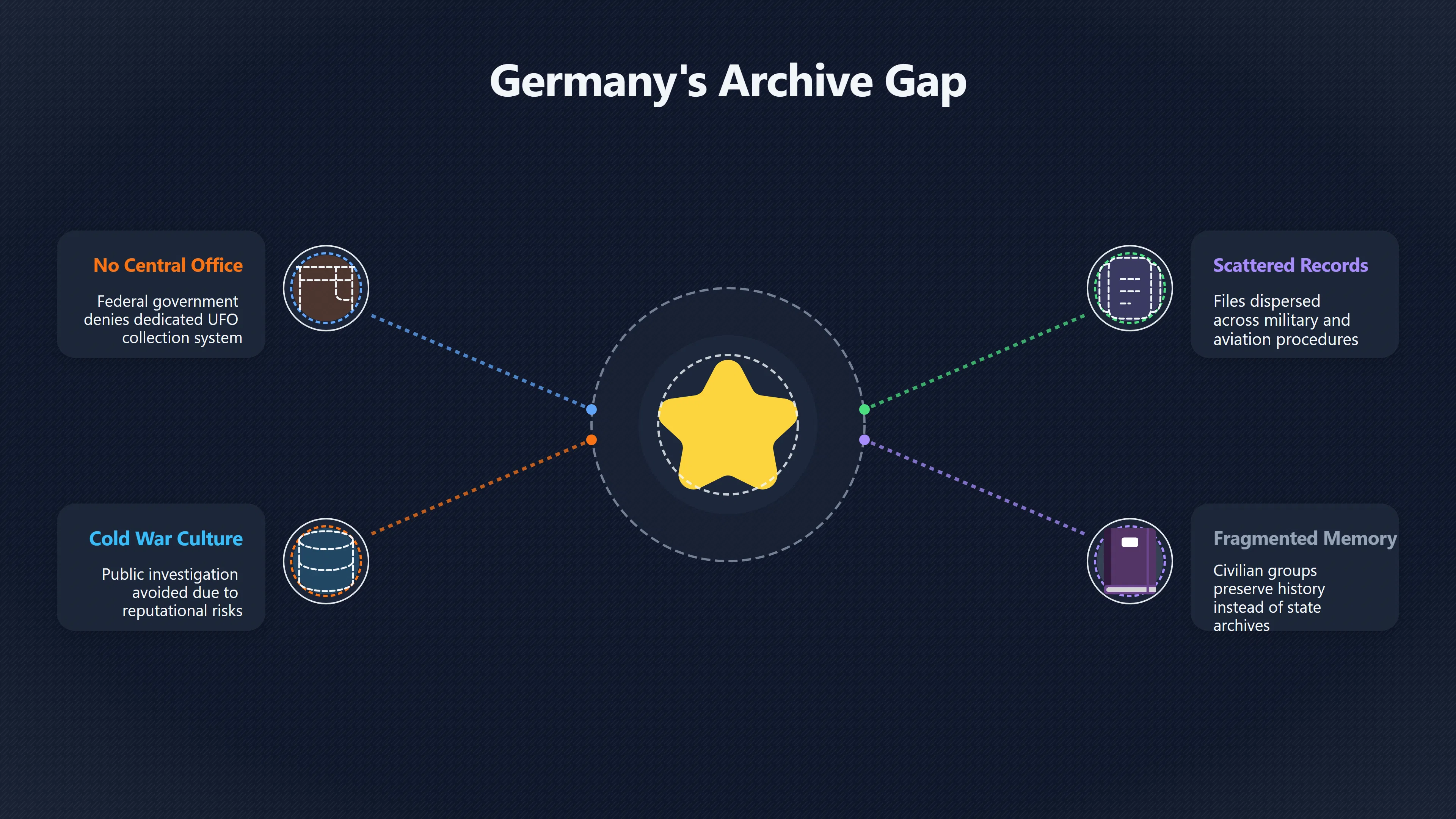
Germany's UFO story starts with what the federal state says it does not keep: a central public case archive.
On this page
- What the Bundestag papers actually say
- How Germany differs from France and the United States
- Why absence of a central archive changes the evidence trail
Page outline Jump by section
Introduction
Germany’s UFO debate is shaped less by spectacular government disclosures than by an institutional absence: the country has never created a permanent national UFO office, never maintained a publicly acknowledged central UFO archive, and never built a civilian investigation system comparable to France’s GEIPAN. That gap has had major consequences for how German UFO claims are documented, debated and remembered. Instead of a unified evidence trail, Germany’s record is scattered across parliamentary questions, military air-safety procedures, local police reports, media archives, private research groups and occasional court or freedom-of-information disputes.
 The result is a very different landscape from the United States or France. In Germany, the key question is often not “What did the government discover?” but “What records were never systematically collected in the first place?” Parliamentary papers from the Bundestag repeatedly stated that the federal government held no dedicated UFO programme or central collection of UFO files. [UAP Solutions]de.uap.solutionsUAP SolutionsDeutschland UAP, UFO/UAP Disclosure Briefing (DE)January 1, 2026 — Initial written questions probing whether the Bundeswehr… That position has become one of the defining features of Germany’s modern UFO history.
Why Germany Has No UFO Office
Germany’s federal structure partly explains the absence of a national UFO authority. Security, aviation monitoring, scientific research and police reporting are distributed across different institutions rather than concentrated in a specialised civilian body. Unlike France, which placed UFO analysis inside its national space agency, Germany never developed a long-term official framework for unidentified aerial phenomena.
The most frequently cited official position came through Bundestag parliamentary responses in 2008 and 2009. Members of parliament asked whether Germany possessed UFO files, participated in international UFO investigations, or maintained a body comparable to foreign programmes. The replies were narrow and bureaucratic rather than dramatic. The federal government stated that no office systematically collected UFO reports as a separate category and that there was no dedicated investigative programme. [UAP Solutions]de.uap.solutionsUAP SolutionsDeutschland UAP, UFO/UAP Disclosure Briefing (DE)January 1, 2026 — Initial written questions probing whether the Bundeswehr…
This distinction matters. German authorities did not claim that unusual aerial reports never occurred. Instead, they argued that such reports were handled inside ordinary military or aviation procedures. A radar anomaly, unidentified aircraft track or civilian sighting could be processed as an air-security issue without becoming part of a permanent “UFO archive”. In practice, this means many potentially relevant records would be dispersed, temporary or filtered through unrelated administrative systems.
The absence of a central office also reflects post-Cold War political culture. During the Cold War, West Germany occupied one of the most militarised airspaces in Europe. Unknown aerial activity could trigger defence concern, but public UFO investigation carried reputational risks associated with fringe speculation. Bundestag research papers later noted that unidentified objects could theoretically have mattered for military security during the East-West confrontation, while simultaneously maintaining that the government possessed no dedicated UFO research structure. [Deutscher Bundestag]bundestag.dewd 8 104 09 pdf dataDeutscher BundestagWD 8 – 3000 - 104/2009Wissenschaftliche Dienste. Ausarbeitung. WD 8 – 3000 - 104/2009. Seite 2. Die… Ufo-Forschung…
What the Bundestag Papers Actually Say
A major source of confusion in Germany comes from the distinction between Bundestag research papers and actual government investigative files.
In 2009, the Bundestag’s Scientific Services produced a paper titled “The Search for Extraterrestrial Life and the Implementation of UN Resolution A/33/426 on the Observation of Unidentified Flying Objects and Extraterrestrial Life Forms”. [Deutscher Bundestag]bundestag.dewd 8 104 09 pdf dataDeutscher BundestagWD 8 – 3000 - 104/2009Wissenschaftliche Dienste. Ausarbeitung. WD 8 – 3000 - 104/2009. Seite 2. Die… Ufo-Forschung… The document discussed SETI research, extraterrestrial life debates, the United Nations resolution on UFO observation, and how some countries approached UFO reporting. It also referenced international developments such as British and French releases of UFO files.
For UFO activists, the existence of the paper became evidence that the German state must secretly possess UFO archives. But the document itself did not demonstrate that. It was a parliamentary briefing paper assembled by research staff for legislators, not an operational intelligence archive or investigative database.
That distinction became politically important after campaigners attempted to obtain wider access to Bundestag materials through transparency laws and court actions. German media coverage later noted that expectations of hidden revelations far exceeded the actual contents of the released material. [UAP Solutions]de.uap.solutionsUAP SolutionsDeutschland UAP, UFO/UAP Disclosure Briefing (DE)January 1, 2026 — Initial written questions probing whether the Bundeswehr… Much of the public controversy therefore revolved around assumptions about secrecy rather than evidence of a concealed UFO programme.
The Bundestag papers do reveal several important institutional realities:
- Germany monitored airspace threats through conventional defence structures rather than through a UFO bureau.
- Parliament was aware of international UFO debates and foreign programmes.
- German authorities saw no reason to establish a dedicated civilian UFO investigation office.
- No publicly acknowledged federal archive comparable to GEIPAN existed.
Those points sound administrative, but they fundamentally shaped the German evidence trail.
How Germany Differs From France and the United States
The contrast with France is especially sharp. France’s GEIPAN, housed within the national space agency CNES, has operated in various forms since the 1970s and explicitly collects, analyses and archives reports of unidentified aerospace phenomena. [CNES]cnes.frCNESGEIPAN7 Jul 2025 — GEIPAN, the French UAP research and information group created by CNES in 1977, collects, analyses and archives inf… GEIPAN also publishes many case files online and uses a classification system that separates explained cases from unresolved ones.
Germany chose the opposite path. No comparable civilian archive exists, and no equivalent public portal allows researchers to examine standardised national case files. As a result, France developed an institutional memory for unusual aerial reports, while Germany developed a fragmented patchwork.
The United States followed yet another route. American UFO history became intertwined with military secrecy, classified aerospace testing and intelligence bureaucracy. Programmes such as Project Blue Book and later UAP investigations created large archival footprints even when official conclusions were sceptical. Germany never produced a similar public infrastructure.
This difference changes the entire tone of national UFO culture:
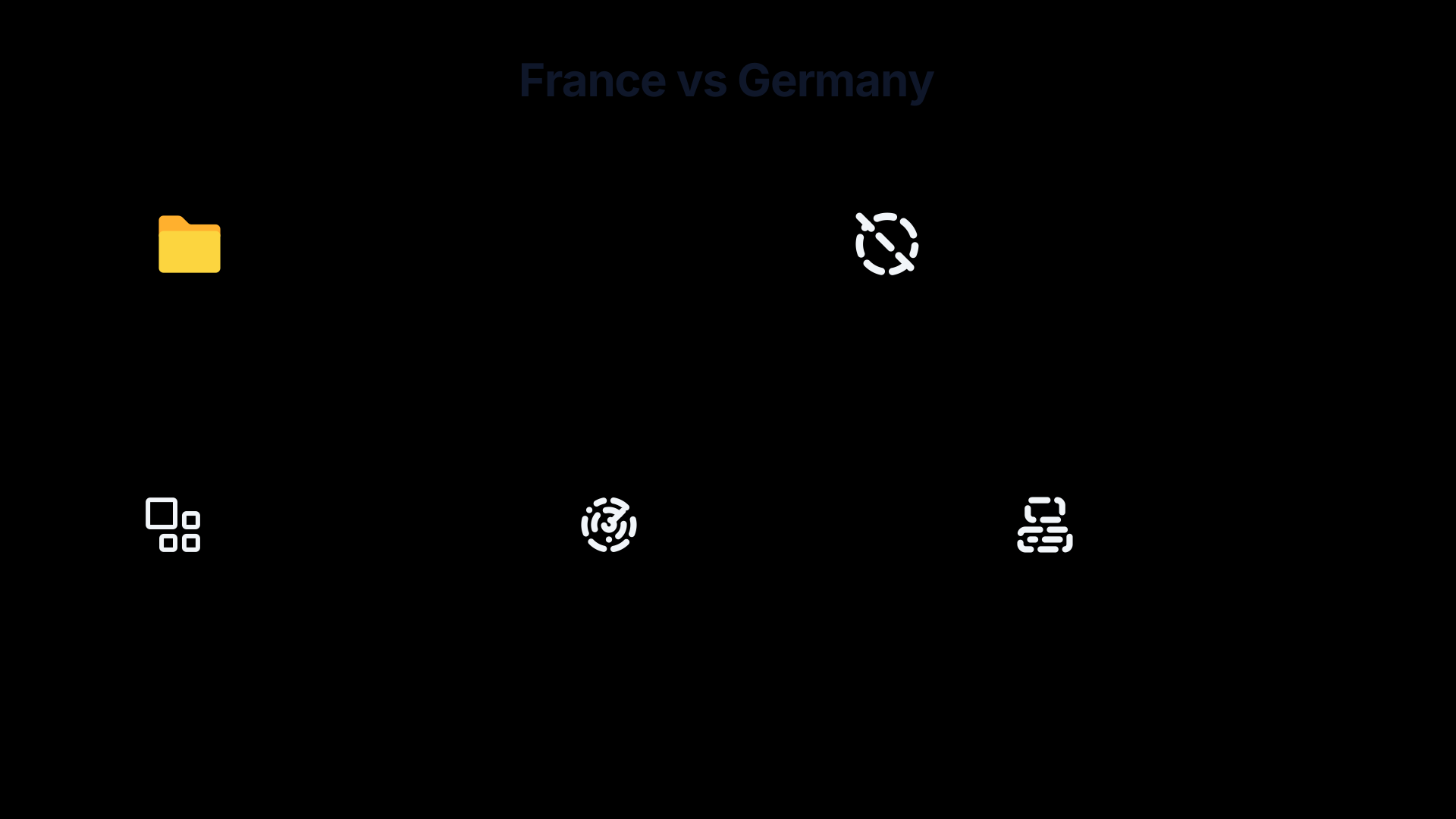
IssueGermanyFranceUnited StatesDedicated public UFO officeNoYes, GEIPANHistorically yes in several formsCentralised archiveNo acknowledged national archiveExtensive archived case systemLarge military and intelligence archive traditionPublic reporting systemFragmentedFormal civilian reportingMixed military and civilian channelsDominant debateMissing recordsCase analysisSecrecy and disclosure
Germany therefore became unusually dependent on non-state actors. Civilian groups, journalists and regional investigators preserved much of the country’s UFO reporting history because the state never built a visible national repository.
Why the Missing Archive Changes the Evidence Trail
The absence of a central archive does not simply reduce transparency. It changes the kind of evidence that survives.
In countries with long-running official systems, researchers can compare decades of standardised reports. They can analyse reporting frequency, geographic clusters, witness categories, radar involvement and explanation rates. Germany lacks that continuity. Cases are often preserved only if journalists, local researchers or witnesses independently documented them.
Several consequences follow from this institutional gap.
Cases become media-driven
Without a formal archive, media attention strongly influences which incidents survive in public memory. A dramatic regional sighting may become famous because newspapers covered it extensively, while equally unusual reports disappear if no journalist pursued them.
This creates survivorship bias. Germany’s “known” UFO history may reflect publicity rather than evidential strength.
Local police and aviation records are difficult to trace
A sighting reported to local police, air-traffic authorities or military units may enter ordinary administrative systems under categories unrelated to UFOs. Records can later be deleted under standard retention schedules or become difficult to identify because they were never labelled as UFO incidents.
The practical effect is fragmentation rather than dramatic suppression. Researchers encounter incomplete chains of evidence instead of sealed master files.
Private groups fill the institutional vacuum
Germany’s civilian UFO networks became unusually important because they preserved reports the state did not systematically collect. Organisations such as CENAP focused heavily on identifying conventional explanations and often reported high resolution rates for sightings. That sceptical investigative culture differs from the public image many people associate with UFO organisations.
Yet private archives have limitations:
- methodologies vary;
- long-term preservation is inconsistent;
- access depends on volunteers;
- cases may lack official corroboration.
The result is a decentralised national memory rather than a state-backed historical record.

The Legal and Transparency Disputes Around UFO Files
Germany’s archive gap generated a second debate: whether the absence of records reflected genuine non-collection or hidden classification.
This argument intensified after parliamentary questions and legal disputes in the late 2000s and early 2010s. Campaigners argued that intelligence or military bodies must possess UFO-related material even if no dedicated office existed. Sceptics countered that ordinary defence monitoring does not automatically create a coherent UFO archive.
Part of the confusion came from the way bureaucracies classify information. A military radar anomaly might be archived under air-defence operations, aviation safety or unidentified aircraft tracking rather than “UFO”. That means a government can truthfully deny operating a UFO office while still possessing scattered documents involving unexplained aerial events.
However, no publicly verified evidence has emerged showing that Germany maintained a secret programme equivalent to Project Blue Book or modern American UAP task forces. The stronger evidence supports a narrower conclusion: Germany historically treated unidentified aerial incidents as routine administrative or security matters instead of building a specialised public UFO bureaucracy. [UAP Solutions]de.uap.solutionsUAP SolutionsDeutschland UAP, UFO/UAP Disclosure Briefing (DE)January 1, 2026 — Initial written questions probing whether the Bundeswehr…
Germany’s Archive Gap Shapes Public Belief
The absence of a national archive has produced two opposite interpretations inside German UFO culture.
One interpretation sees the lack of records as evidence that there is little of substance behind German UFO claims. Without a central body preserving strong cases, many sightings dissolve into anecdote, rumour or media mythology.
The other interpretation treats the missing archive itself as suspicious. For some UFO researchers, Germany’s Cold War role, NATO integration and sophisticated defence infrastructure make total archival absence implausible. In this view, the decentralisation of records hides the true scale of state knowledge.
Neither interpretation fully resolves the issue because the institutional structure itself prevents easy verification. Germany’s system leaves researchers with fragments instead of a continuous official history.
That may be the most important point about Germany’s UFO record. The defining feature is not a famous disclosure event or a legendary state investigation. It is the administrative vacuum between scattered sightings and permanent national documentation. In Germany, the archive gap is itself the story.
Amazon book picks
Further Reading
Books and field guides related to Why Germany Has No UFO Office. Use these as the next step if you want deeper reading beyond the article.
The Hynek UFO Report
Addresses archival records, investigations, and disclosure debates.
The Report on Unidentified Flying Objects
Examines official handling of UFO reports and recordkeeping.
UFOs
Focused on official records, government responses, and institutional transparency.
Endnotes
-
Source: de.uap.solutions
Link: https://de.uap.solutions/Source snippet
UAP SolutionsDeutschland UAP, UFO/UAP Disclosure Briefing (DE)January 1, 2026 — Initial written questions probing whether the Bundeswehr...
Published: January 1, 2026
-
Source: bundestag.de
Title: wd 8 104 09 pdf data
Link: https://www.bundestag.de/resource/blob/406336/741fdc9b7e96b9346e4e3414225b2835/wd-8-104-09-pdf-data.pdfSource snippet
Deutscher BundestagWD 8 – 3000 - 104/2009Wissenschaftliche Dienste. Ausarbeitung. WD 8 – 3000 - 104/2009. Seite 2. Die... Ufo-Forschung...
-
Source: cnes.fr
Link: https://cnes.fr/en/projects/geipanSource snippet
CNESGEIPAN7 Jul 2025 — GEIPAN, the French UAP research and information group created by CNES in 1977, collects, analyses and archives inf...
-
Source: bundestag.de
Link: https://www.bundestag.de/resource/blob/408356/32b7d8a6d5868d7a585ba0b2488010c7/WD-11-148-09-pdf.pdfSource snippet
WD 11 – 148/09Die GEIPAN favorisiert offiziell keine Erklä- rung von UFO-Phänomenen. Neben der Datensammlung und Analyse versucht die GEI...
-
Source: Wikipedia
Link: https://en.wikipedia.org/wiki/GEIPANSource snippet
GEIPANGEIPAN is clearly focused on UFO study, but UAP (PAN in French) is meant to cover a much broader area than UFO (OVNI in French)...
Additional References
-
Source: ghil.ac.uk
Link: https://www.ghil.ac.uk/events/all-eventsSource snippet
All EventsHe has also served as an expert witness in two Bundestag hearings on reparative justice in citizenship law.... Aliens in the C...
-
Source: cnes-geipan.fr
Link: https://www.cnes-geipan.fr/en/missions-methodes-et-resultatsSource snippet
Mission & Geipan | GEIPANThe GEIPAN's work is also scrutinized and criticized by some UFO blogs and associations who are pros of the alie...
-
Source: mediafreedomcoalition.org
Link: https://mediafreedomcoalition.org/wp-content/uploads/2023/04/Report-on-Providing-Safe-Refuge-to-Journalists-at-Risk.pdfSource snippet
Report on Providing Safe Refuge to Journalists at RiskThis section of the Report only refers to the parole available to aliens outside th...
-
Source: reddit.com
Link: https://www.reddit.com/r/todayilearned/comments/1qa0lyb/til_that_france_has_a_dedicated_unit_to_finding/Source snippet
TIL that France has a dedicated unit to finding UFO's. The...What's provable is that the vast majority of UFO sightings involve no alien...
-
Source: euaa.europa.eu
Link: https://www.euaa.europa.eu/sites/default/files/publications/asylum-procedures-ja_en.pdfSource snippet
PROCEDURES AND THE PRINCIPLE OF NON...This analysis has been developed by a process having two components: an editorial team (ET) of jud...
-
Source: assets.publishing.service.gov.uk
Link: https://assets.publishing.service.gov.uk/media/62d012dbd3bf7f285f60c889/The_Antarctic_Treaty_43rd_Measures_CP_726.pdfSource snippet
Antarctic Treaty – CP 726In accordance with Article IX, paragraph 4, of the Antarctic Treaty, the Measures adopted at Consultative Meetin...
-
Source: cidob.org
Link: https://www.cidob.org/sites/default/files/2025-05/ADMIGOV%20Deliverable_2021_2.7_0.pdfSource snippet
The 2003 Act on Aliens furthermore introduced a short-stay residence permit on special grounds.Read more...
-
Source: eiop.or.at
Title: Eurodac: A Solution Looking for a Problem?
Link: https://eiop.or.at/eiop/pdf/2006-006.pdfSource snippet
by JP Aus · 2006 · Cited by 73 — Abstract. This study accounts for the emergence of a supranational biometric control regime in Europe. T...
-
Source: bundesregierung.de
Title: Website of the Federal Government
Link: https://www.bundesregierung.de/breg-enSource snippet
19 Apr 2026 — Latest information, background knowledge, videos and services: Find out more about the political work and...
-
Source: europarl.europa.eu
Title: IPOL STU(2017)583124 EN
Link: https://www.europarl.europa.eu/RegData/etudes/STUD/2017/583124/IPOL_STU%282017%29583124_EN.pdfSource snippet
was legally not possible, since the Alien Act (Vreemdelingenwet) in which the API...Read more...
Topic Tree