Within Eswatini UFOs
When a Sky Mystery Was a Meteorite
The 1970 Dwaleni meteorite fall shows how dramatic natural sky events can look extraordinary without being spacecraft.
On this page
- What happened at Dwaleni
- Why meteorites can sound like UFOs
- How recovered evidence changes a case
Page outline Jump by section
Introduction
The Dwaleni meteorite fall of October 1970 is one of the most important sky events ever recorded in Eswatini’s public history because it demonstrates how dramatic aerial phenomena can appear extraordinary while still having a completely natural explanation. Witnesses in the south-west of the country reported loud explosions, streaking light and frightening atmospheric effects over the Nhlangano area. In another context, such descriptions could easily have entered local folklore as a “mystery craft” or unexplained flying object. Instead, physical fragments were recovered and scientifically classified as meteorites. [LPI]lpi.usra.eduLPIMeteoritical Bulletin: Entry for DwaleniAbbreviation: There is no official abbreviation for this meteorite. Observed fall: Yes Year fe… [meteorites.asu.edu]meteorites.asu.eduPage 19 - Buseck Center for Meteorite StudiesDwaleni is an ordinary (H4-6) chondrite that fell the morning of October 12, 1970, near Nhla…
 That makes Dwaleni especially valuable when discussing UFO claims in Eswatini. It is not simply a meteorite story. It is a reality check about how human observers experience sudden sky events, how limited information can produce extraordinary interpretations, and how recovered evidence can transform an apparent mystery into a documented scientific case.
When a Sky Mystery Was a Meteorite
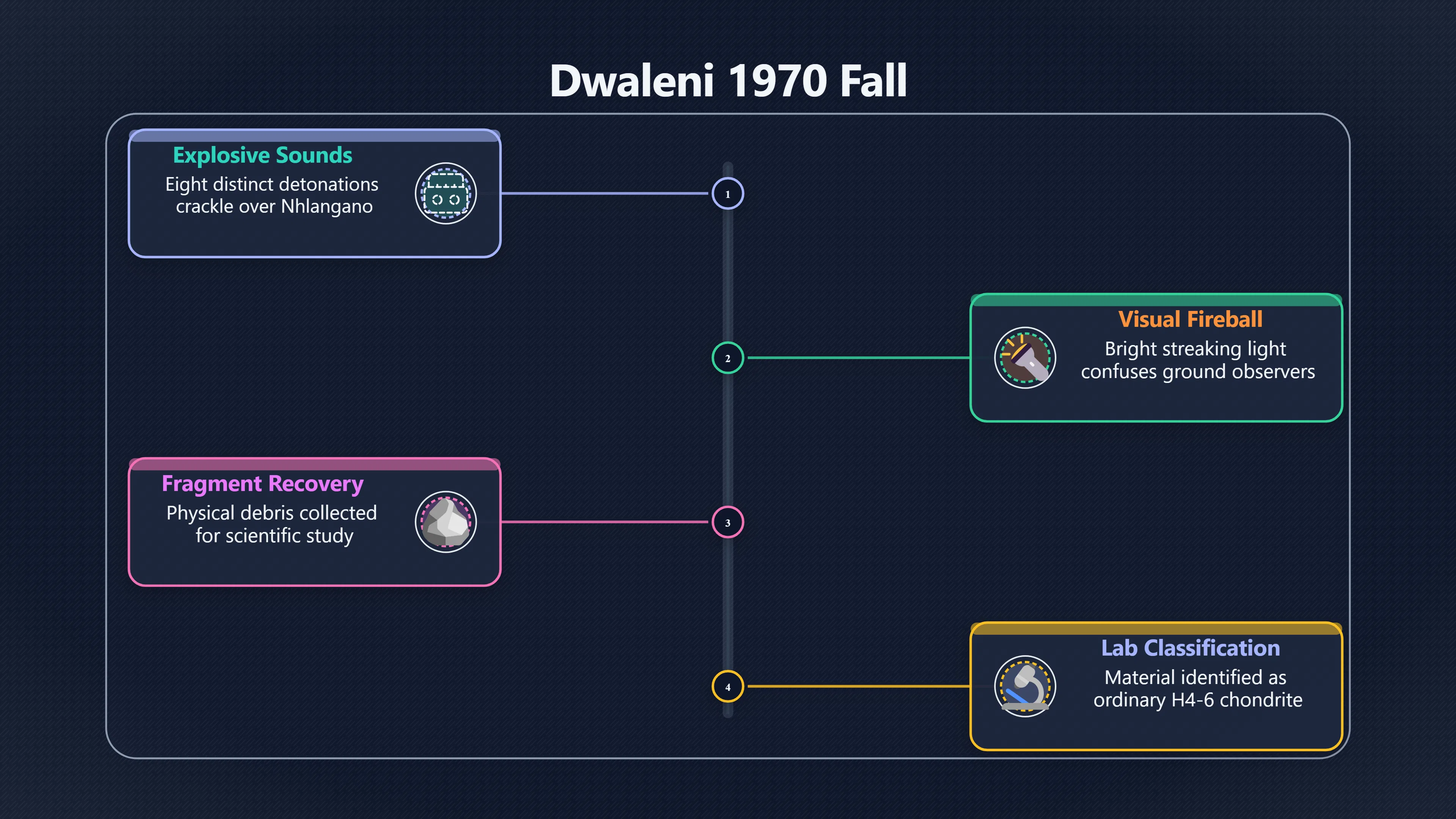
The event took place near Dwaleni and Nhlangano in what was then Swaziland, now Eswatini, on 12 October 1970. The fall was dramatic enough to be remembered as a regional aerial disturbance rather than a quiet astronomical event. The Meteoritical Bulletin, the internationally recognised catalogue for officially accepted meteorites, lists Dwaleni as an observed fall with a recovered mass of 3.23 kilograms. [LPI]lpi.usra.eduBulletin: Search the DatabaseThe primary function of this database is to provide authoritative information about meteorite names, initial…
Accounts associated with the fall describe multiple explosive sounds during atmospheric breakup. The Buseck Center for Meteorite Studies summarises reports from the original Meteoritical Bulletin as including “eight distinct explosions”, “crackling explosions”, and “staccato reports” over south-western Swaziland. [meteorites.asu.edu]meteorites.asu.eduBuseck Center for Meteorite Studies1 Oct 2018 — Dwaleni is an ordinary (H4-6) chondrite that fell the morning of October 12, 1970, near N…
Those details matter because they closely resemble elements commonly found in UFO narratives:
- Sudden appearance of an object in the sky.
- Bright light or fireball effects.
- Loud aerial detonations.
- Confusion about the object’s direction and speed.
- A short, intense event leaving witnesses uncertain about what they saw.
Without recovered fragments, the Dwaleni incident could easily have remained an unresolved “strange object” story passed between witnesses. Instead, meteorite material was collected, studied and formally classified as an ordinary chondrite, specifically an H4-6 type meteorite. [LPI]lpi.usra.eduLPIMeteoritical Bulletin: Entry for DwaleniAbbreviation: There is no official abbreviation for this meteorite. Observed fall: Yes Year fe…
This is one reason Dwaleni stands apart from many UFO reports in Eswatini and neighbouring regions. The event produced hard physical evidence that could be independently analysed rather than relying solely on memory or anecdote.
Why Meteorites Can Sound Like UFOs
Meteorite falls are often more frightening and confusing than people expect. A large meteoroid entering Earth’s atmosphere can produce effects that seem artificial or threatening to observers on the ground.
The sound problem
One of the strongest reasons people misinterpret meteorite falls is the sound profile. Witnesses often hear booming explosions, sharp cracks or rolling thunder-like effects. Dwaleni reportedly produced repeated detonations rather than a single bang. [meteorites.asu.edu]meteorites.asu.eduPage 19 - Buseck Center for Meteorite StudiesDwaleni is an ordinary (H4-6) chondrite that fell the morning of October 12, 1970, near Nhla…
To a witness with no clear visual reference, that can resemble:
- Aircraft explosions.
- Military activity.
- Mechanical engine failure.
- Weapons testing.
- An unknown craft breaking apart.
Modern fireball research confirms that meteorite entries frequently generate sonic booms and fragmentation sounds as objects disintegrate under atmospheric pressure. [SciELO]scielo.org.zaSciELOAn investigation of the 27 July 2018 bolide and meteorite…by RL Gibson · 2021 · Cited by 2 — Despite meteorite debris being foun…
The visual confusion
Meteorites can also create misleading visual impressions. Depending on angle, weather and time of day, witnesses may report:
- Glowing spheres.
- Structured lights.
- Zig-zag movement caused by perspective distortion.
- Colour changes.
- Objects that appear to hover briefly before disappearing.
Human observers are poor at estimating distance and velocity in the sky, especially at night or during unexpected events. A meteor breaking apart high in the atmosphere may appear close enough to be an aircraft-sized object when it is actually tens of kilometres overhead.
That is relevant to Eswatini’s broader UFO record because the country’s most-discussed unidentified case — the later Nhlangano sphere report from 1992 — also involved a glowing aerial object in the same southern region. The Dwaleni event provides a documented example of how spectacular but natural sky phenomena can occur in that landscape.

Memory turns brief events into stories
Meteorite falls are sudden. Witnesses often have only a few seconds to process what they are seeing. Afterwards, memories become shaped by discussion, retelling and expectation.
This is important in UFO analysis because the emotional intensity of a rare sky event can make recollections grow more dramatic over time. The Dwaleni case avoided much of that ambiguity because physical fragments anchored the event to laboratory science rather than oral reconstruction alone.
How Recovered Evidence Changes a Case
The most important lesson from Dwaleni is not merely that a meteorite fell. It is that physical evidence fundamentally changes how an aerial mystery is evaluated.
From witness testimony to laboratory analysis
Many UFO reports depend entirely on eyewitness accounts. Those accounts may be sincere, detailed and emotionally convincing while still remaining impossible to verify independently.
Dwaleni moved beyond that stage because researchers recovered actual meteorite material. The fragments were examined and entered into the Meteoritical Bulletin database, which functions as the authoritative international registry for recognised meteorites. LPI [Meteoritical Society]meteoritical.orgMeteoritical SocietyThe Meteoritical BulletinThe Meteoritical Bulletin contains listings of all newly recognized and reclassified meteori…
Once laboratory classification occurred, the debate changed completely:
- The object’s composition could be measured.
- Its mineral structure could be studied.
- Its extraterrestrial origin could be confirmed scientifically.
- Competing speculative explanations lost plausibility.
That evidential chain is what many UFO cases lack.
Physical traces matter more than dramatic descriptions
Dwaleni also illustrates a broader investigative principle: dramatic witness descriptions alone do not determine what an event actually was.
A spectacular event may still have a mundane or natural explanation. Conversely, a quiet event with recoverable evidence may be scientifically more important than a sensational story without evidence.
For UFO researchers and sceptics alike, Dwaleni is useful precisely because it demonstrates how a genuinely unusual sky event can move from mystery to explanation once recoverable material exists.
Why this case remains credible
Dwaleni remains one of the strongest documented aerial events connected to Eswatini because it meets several standards often absent from local UFO claims:
FeatureDwaleni meteorite fallMultiple witnessesYesApproximate location knownYesDate establishedYesPhysical material recoveredYesScientific classificationYesInternational catalogue entryYesExplained natural causeYes
That combination makes the case historically important even though it is not a UFO in the extraterrestrial sense.
Dwaleni’s Place in Eswatini’s UFO Landscape
Eswatini has a sparse public UFO archive compared with larger countries. There are very few officially investigated cases, little declassified material and only scattered civilian reports.
In that context, Dwaleni serves as an important calibration point. It reminds researchers that not every dramatic sky event belongs in the same category. Some incidents remain unexplained because evidence is weak. Others become solved cases because physical proof survives.
The Dwaleni meteorite fall therefore occupies a special position in Eswatini’s aerial mystery history:
- It was genuinely dramatic.
- It generated confusion and alarm.
- It involved extraordinary sights and sounds.
- It was fully compatible with natural processes.
- It left behind evidence that could be tested.
That last point is what separates it from folklore, rumour and many later UFO stories. Rather than encouraging speculation about hidden spacecraft, Dwaleni demonstrates how science can resolve an apparently mysterious event once observable material exists.
Amazon book picks
Further Reading
Books and field guides related to When a Sky Mystery Was a Meteorite. Use these as the next step if you want deeper reading beyond the article.
Meteor Showers and their Parent Comets
Provides scientific background on bright atmospheric entries.
Endnotes
-
Source: lpi.usra.edu
Link: https://www.lpi.usra.edu/meteor/metbull.php?code=7755Source snippet
LPIMeteoritical Bulletin: Entry for DwaleniAbbreviation: There is no official abbreviation for this meteorite. Observed fall: Yes Year fe...
-
Source: meteorites.asu.edu
Link: https://meteorites.asu.edu/category/meteorites/page/19Source snippet
Page 19 - Buseck Center for Meteorite StudiesDwaleni is an ordinary (H4-6) chondrite that fell the morning of October 12, 1970, near Nhla...
Published: October 12, 1970
-
Source: meteorites.asu.edu
Link: https://meteorites.asu.edu/meteorites/dwaleniSource snippet
Buseck Center for Meteorite Studies1 Oct 2018 — Dwaleni is an ordinary (H4-6) chondrite that fell the morning of October 12, 1970, near N...
Published: October 12, 1970
-
Source: meteoritical.org
Link: https://meteoritical.org/publications/meteoritical-bulletinSource snippet
Meteoritical SocietyThe Meteoritical BulletinThe Meteoritical Bulletin contains listings of all newly recognized and reclassified meteori...
-
Source: lpi.usra.edu
Link: https://www.lpi.usra.edu/meteor/Source snippet
Bulletin: Search the DatabaseThe primary function of this database is to provide authoritative information about meteorite names, initial...
-
Source: scielo.org.za
Link: https://scielo.org.za/scielo.php?pid=S0038-23532021000200021&script=sci_abstractSource snippet
SciELOAn investigation of the 27 July 2018 bolide and meteorite...by RL Gibson · 2021 · Cited by 2 — Despite meteorite debris being foun...
Published: July 2018
-
Source: Wikipedia
Title: Meteorite fall
Link: https://en.wikipedia.org/wiki/Meteorite_fallSource snippet
Meteorite fallA meteorite fall, also called an observed fall, is a meteorite collected... Dwaleni, 12 October 1970, Swaziland · Shise...
Published: October 1970
-
Source: meteoritic.com
Link: https://meteoritic.com/pages/new-meteorites-analyzed-and-classified-at-the-laboratory-for-meteorite-analysis-and-classificationSource snippet
Meteorite Classifications & ResearchMeteoritical Bulletin 113. Meteoritical Bulletin...
Additional References
-
Source: youtube.com
Link: https://www.youtube.com/watch?v=a9CBZjO3Y2ASource snippet
EC Meteorite | Much to learn about origins of existence from a...A meteor hit the Earth's atmosphere and landed right here on the Easter...
-
Source: geocoleccion.com
Link: https://www.geocoleccion.com/classificationSource snippet
Laboratory will make several analysis and later, a scientist committee will review all...Read more...
-
Source: mindat.org
Link: https://www.mindat.org/feature-935103.htmlSource snippet
Dwaleni, SwazilandDwaleni, Swaziland. Type: Populated place - a city, town, village, or other... Meteorites. Erratics. Extraterrestrial...
-
Source: facebook.com
Link: https://www.facebook.com/groups/swaicsa/posts/1654508625399688/Source snippet
okkeveld meteorite is a carbonaceous chondrite that fell in many pieces...Read more...
-
Source: facebook.com
Link: https://www.facebook.com/groups/2427538690888656/posts/3478838002425381/Source snippet
's not attracted to a magnet and not conducive but quite heavy...
-
Source: insu.hal.science
Title: science The Meteoritical Bulletin, No
Link: https://insu.hal.science/insu-03863070/documentSource snippet
110by J Gattacceca · 2022 · Cited by 43 — Abstract–Meteoritical Bulletin 110 contains the 2802 meteorites approved by the Nomenclature. C...
-
Source: youtube.com
Title: What is the Meteoritical Bulletin Database?
Link: https://www.youtube.com/watch?v=zCooecg-z5sSource snippet
Meteorite Hangout...0:00 Welcome to the highest quality weekly meteorite education. Today we feature information about the Meteoritical...
-
Source: youtube.com
Title: Watch: Meteor Causes Thunderous Boom Over Ohio and Pennsylvania
Link: https://www.youtube.com/watch?v=DArrBIFdzhISource snippet
2 Bright Fireball Captured on Camera Over B.C. and Washington...
-
Source: youtube.com
Title: Bright Fireball Captured on Camera Over B.C. and Washington
Link: https://www.youtube.com/watch?v=dob3lFFURzASource snippet
3 Meteorites Explained | How to Find & Own a Piece of the Universe...
-
Source: youtube.com
Title: Meteorites Explained | How to Find & Own a Piece of the Universe
Link: https://www.youtube.com/watch?v=rbHwjnmfeH8Source snippet
4 What Happens When Large Meteorites Fall to Earth?...
Topic Tree