What Really Happened in Bolivia's UFO Files?
Bolivia has a lively UFO tradition, but the evidence is uneven.
Page outline Jump by section
Introduction
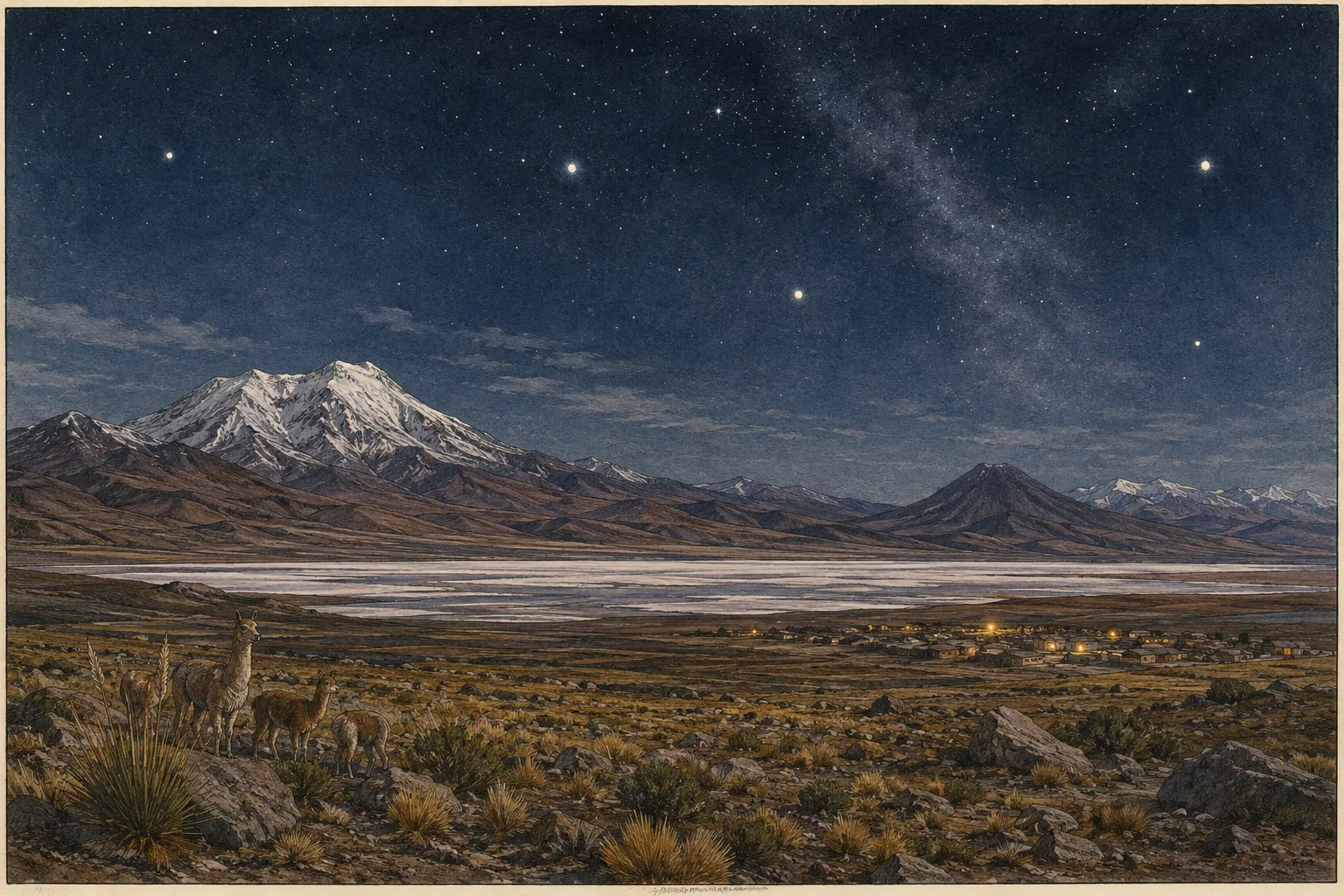
Bolivia’s geography helps explain why the subject has such regional texture. The country combines the high Andes and Altiplano, Lake Titicaca, salt flats, mountain valleys and eastern lowlands, giving witnesses very different sky conditions and sightlines. Local UFO writers often name the Andean region, Lake Titicaca, Illimani, the Altiplano, Amazonian areas and archaeological sites as sighting zones, but those are claims from ufological circles rather than a verified official map. [Encyclopedia Britannica]britannica.comEncyclopedia Britannica Bolivia | History, Geography, Culture, PeopleEncyclopedia Britannica Bolivia | History, Geography, Culture, People [Relief Central]relief.unboundmedicine.comRelief Central Bolivia | World FactbookRelief Central Bolivia | World Factbook
What counts as reliable in the Bolivian UFO record?
The first problem is that Bolivia does not appear to have a public, centralised national UFO archive comparable to some better-known military or civil-agency collections elsewhere. A Bolivian interview with ufologist Pablo Santa Cruz explicitly says there is “no official record” while also asserting that thousands of sightings exist and that his “Proyecto Ovni” had recorded around 100 confirmed sightings since 2012, with 20 having some documentary support. That combination is important: it gives a local claim of scale, but it is not the same as an audited public database, a military case file, or a scientific catalogue. [Urgentebo]urgente.bobo Hay "pruebas" de Ovnis en Bolivia | Urgentebobo Hay "pruebas" de Ovnis en Bolivia | Urgentebo
The best evidence tiers for Bolivia look like this:
Higher-value material includes declassified or archival references, recovered physical debris that can be compared with known aerospace hardware, dated newspaper reporting, and multi-witness reports with independent documentation. The CIA’s reading-room listing for “Bolivia Reports Conflict on Details of Fallen Object” is relevant because it shows that foreign intelligence channels noticed reports of an unidentified object falling in Bolivia near the Argentine border, even though that does not validate the most dramatic later versions of the story. [CIA]cia.govOpen source on cia.gov.
Medium-value material includes NUFORC entries and local press interviews. These preserve dates, locations and witness language, but they are mostly self-reported and often lack the original footage, laboratory results or follow-up investigation needed to decide between aircraft, balloons, satellites, astronomical objects, drones, hoaxes and genuinely unexplained events. NUFORC’s Bolivia page lists reports from Cochabamba, La Paz, Tiwanaku, Reyes/Santa Rosa, Lake Titicaca, Montero, Potosí and El Alto, but that list is a reporting index, not a verified incident register. [nuforc.org]nuforc.orgNUFOR C Reports for Country BoliviaNUFOR C Reports for Country Bolivia
Lower-value material includes retellings that add dramatic claims without primary support: “crash retrieval” narratives, alien-occupant stories, social-media reposts and accounts that rely on unnamed foreign agents or missing debris. These may be culturally important, but they should not be treated as confirmed evidence unless they can be tied to contemporary records, witnesses, photographs, chain-of-custody evidence or identifiable official documents.

The Tarija crash story: Bolivia’s signature contested case
The best-known Bolivian UFO case is the alleged crash near Tarija on 6 May 1978, often located around the El Taire or El Zaire mountain area near the Argentine border. Modern UFO retellings describe a cylindrical object, fire, an impact or explosion, large numbers of witnesses and a later recovery by foreign personnel. The durable core of the case is simpler and more cautious: reports circulated in the region that an unidentified object had fallen in Bolivian territory near Argentina, and a declassified CIA entry records conflicting details about a fallen object. [CIA]cia.govOpen source on cia.gov. [CIA]cia.govOpen source on cia.gov.
The case matters because it shows the split between documentation and legend. The CIA record is evidence that officials or broadcasters were aware of a reported fall; it is not, by itself, evidence of an alien craft. Later versions add claims about NASA assistance, US recovery teams, extraordinary witness numbers and removed wreckage. Some of those claims may have roots in local press or radio reports, but the public evidence still lacks the essentials that would lift the incident above “contested”: verified debris, a full official Bolivian investigation file, named investigators, consistent contemporary witness statements, and technical analysis. [ufoac.com]ufoac.comthe most reliable ufo case in south america. bolivian ufo crash of 1978the most reliable ufo case in south america. bolivian ufo crash of 1978
For readers comparing this page with sibling branches in a broader country-by-country UFO project, Tarija belongs in the same category as other “crash retrieval” stories that have an intriguing documentary trace but a weak physical record. It is stronger than a purely oral legend because a declassified US document exists; it is weaker than a solved debris case because no publicly verified object has been matched to the event.
The 1979 metallic spheres: a better lesson in how UFO cases get solved
A separate Bolivian episode from 10 August 1979 is more instructive because it points towards a conventional explanation. Reports and later space-debris cataloguing describe fireball sightings over Bolivia and northern Chile, followed by the discovery of two metallic spheres in Bolivia, including locations in Santa Cruz Department. A satellite-observation re-entry list connects the event to 1979-072B, the Delta rocket second stage associated with the Westar 3 launch, and notes titanium spheres recovered at Bolivian sighting locations. [satobs.org]satobs.orgVisually Observed Natural Re entries latest draftVisually Observed Natural Re entries latest draft
This case is valuable because it resembles a UFO incident at the witness level: a bright object crosses the sky, debris is found, newspapers report a mystery, and foreign technical interest follows. Yet the physical description of spherical tanks is exactly the kind of thing expected from space hardware surviving re-entry. A space-debris compilation by Paul Maley also summarises the Bolivian 1979 spheres and says satellite tracker Ted Molczan presented a strong circumstantial case that the objects came from the Delta 149 second stage that launched Westar 3. [PAUL D. MALEY WEB PAGES]pauldmaley.comSource details in endnotes.
That does not make every Bolivian sighting “just space junk”. It does show why debris cases need orbital data, object recovery records and metallurgical analysis before extraordinary conclusions are drawn. The 1979 case is the Bolivian file that most clearly demonstrates the value of sceptical reconstruction: once a date, trajectory, hardware type and debris form line up, the mystery becomes a recoverable aerospace event rather than an alien-crash claim.
The 2001 multi-city report and the problem of missing media
One of the most striking modern entries in the public civilian record is a NUFORC report for 29 March 2001, describing an oval object allegedly seen over La Paz, Cochabamba and Potosí for several hours. The report claims thousands of citizens saw it, says the press suggested a globe from Brazil, and states that television cameras in Cochabamba recorded images. NUFORC’s own note is cautious: it had heard of the alleged event but had not seen the cited evidence. [nuforc.org]nuforc.orgOpen source on nuforc.org.
This is a useful example of a “promising but unresolved” case. The report has named cities, a date, a duration, a press explanation and a claim of media documentation. But without accessible broadcast footage, original newsroom files, camera metadata, witness triangulation or physical trace analysis from Potosí, the case remains suspended between mass-sighting claim and unverified report. It is precisely the kind of incident where a local archive search could change the assessment.
The alleged explanation of a balloon or globe is plausible enough to matter. Large balloons, advertising inflatables, research balloons and drifting objects can appear slow, bright, oddly shaped and persistent, especially when seen from different urban viewpoints. That does not prove the 2001 object was a balloon; it means the claimed multi-city duration and press reaction should be tested against wind, altitude, launch records and video before calling it anomalous.
Where Bolivian sightings cluster in public reports
The available public record suggests several recurring Bolivian zones, but each source has different weaknesses. Local ufological interviews emphasise the Andes, Lake Titicaca, Mount Illimani, the Altiplano, Amazonian areas, Tiwanaku, Samaipata, the Salar de Uyuni, the Valley of the Moon near La Paz, and cities such as Sucre and Oruro. NUFORC’s smaller English-language public list, meanwhile, includes entries from Cochabamba, La Paz, Tiwanaku, the Reyes/Santa Rosa jungle region, Lake Titicaca’s Island of the Sun, Montero in Santa Cruz Department, Agua de Castilla in Potosí Department, Achumani and El Alto. [Urgentebo]urgente.bobo Hay "pruebas" de Ovnis en Bolivia | Urgentebobo Hay "pruebas" de Ovnis en Bolivia | Urgentebo
The regional pattern is interesting, but it should not be overread. The Andes and Altiplano produce expansive horizons, dark skies away from cities, bright planets, satellite passes and dramatic atmospheric conditions. The eastern lowlands around Santa Cruz add different possibilities: aircraft, agricultural lights, drones, storms and fast-growing urban reporting networks. Bolivia’s varied terrain and climate make it especially easy for the same broad label, “UFO”, to cover very different observation problems. [Encyclopedia Britannica]britannica.comEncyclopedia Britannica Bolivia | History, Geography, Culture, PeopleEncyclopedia Britannica Bolivia | History, Geography, Culture, People
A cautious regional reading would say:
- La Paz, El Alto and the Altiplano produce reports tied to high-elevation sky visibility, bright celestial objects, moving lights and mountain backdrops.
- Lake Titicaca and Tiwanaku have strong symbolic appeal, which can amplify attention around ambiguous sightings.
- Cochabamba and Potosí appear in the notable 2001 multi-city NUFORC report, but the supporting media remains hard to verify publicly.
- Santa Cruz Department appears in both the 1979 space-debris sphere case and later reports from Montero and Santa Cruz city, making it important for both solved and contested material.
- Tarija remains the centre of Bolivia’s best-known crash narrative, but the public evidence still falls short of confirming a recovered anomalous craft.
Modern reports: more data, not necessarily better evidence
Recent NUFORC entries show how the Bolivian record has moved into a digital-reporting era. A 2025 El Alto report describes moving stars and a luminous sphere seen at about 04:10, with one observer, a 15-minute duration and claims of unusual personal effects. A Montero report, submitted in 2025 for an event dated 4 August 2020, describes a triangular object with lights at each point, allegedly appearing daily around 19:00 for about two minutes and observed by seven people. [nuforc.org]nuforc.orgOpen source on nuforc.org.
These entries are worth preserving, but they also show the limits of self-report databases. The El Alto report includes subjective elements such as “missing time” and bodily marks, which require a very different level of evidence from a simple light-in-the-sky claim. The Montero report’s repeated timing is potentially testable: daily appearances at the same hour could be checked against aircraft routes, satellite passes, drones, kites, local lights, weather and astronomical visibility. Without that follow-up, the reports remain leads rather than conclusions. [nuforc.org]nuforc.orgOpen source on nuforc.org.
This is where modern UAP investigation standards are useful even outside the United States. NASA’s UAP material stresses the need for better data sources and environmental context, while AARO’s public case imagery shows that some reports can be resolved as balloons or closed as not anomalous, while others remain unresolved because the data is insufficient. Applied to Bolivia, the lesson is straightforward: a report becomes stronger when it includes precise time, location, direction, elevation angle, duration, raw video, camera metadata, weather, aircraft and satellite checks, and independent witnesses. [NASA Science]science.nasa.govSource details in endnotes.
Local ufology and the reliability gap
Bolivia’s UFO culture includes local investigators, television segments, social-media claims and esoteric interpretations. The Pablo Santa Cruz interviews are useful because they document what one prominent local ufological current claims: thousands of sightings, around 100 cases recorded during “Proyecto Ovni”, key zones in the Andes and Amazonia, and emblematic incidents in Tarija, Cochabamba and Santa Cruz. They are also a warning sign, because the same interviews mix sighting claims with highly speculative ideas about Nazi technology, hidden extraterrestrial bases and global control. [Urgentebo]urgente.bobo Hay "pruebas" de Ovnis en Bolivia | Urgentebobo Hay "pruebas" de Ovnis en Bolivia | Urgentebo
That does not mean every local report should be dismissed. Local witnesses and regional journalists may preserve details that never enter international databases. But source reliability has to be separated from cultural colour. A strong Bolivian UFO case would not become strong because it fits a grand theory; it would become strong because multiple independent records converge on the same event and ordinary explanations have been seriously tested.
A practical reliability split for Bolivia is therefore:
Confirmed or strongly explained: the 1979 metallic-sphere episode is best treated as a space-debris case unless new evidence overturns the Westar 3/Delta-stage correlation. [satobs.org]satobs.org1979 072B1979 072B
Contested: the 1978 Tarija crash story has a real documentary hook but lacks publicly verified physical evidence and a complete investigation record. [CIA]cia.govOpen source on cia.gov.
Unresolved but weakly documented: the 2001 La Paz/Cochabamba/Potosí report and many NUFORC entries contain interesting claims but need original media, independent corroboration and conventional checks. [nuforc.org]nuforc.orgOpen source on nuforc.org.
Low-confidence or folkloric: alien-occupant stories, hidden-base claims and social-media reposts without original documentation should be treated as part of Bolivian UFO culture rather than evidence of anomalous craft.
How to read Bolivia’s UFO history without flattening it
The most honest conclusion is that Bolivia’s UFO record is neither empty nor evidentially settled. It contains one famous contested crash narrative, at least one instructive space-debris case, scattered civilian reports, and a strong regional folklore of unusual lights around highland, lake, archaeological and lowland settings. What it does not yet have, in the public domain, is a robust national archive that lets readers move cleanly from witness claim to investigation to conclusion.
That makes Bolivia a useful country page in a wider UFO project precisely because it resists the two easy extremes. It is too well-attested in reports and archives to dismiss as mere internet invention, but too thin in verified physical and official evidence to support the stronger claims often made about it. The best reading is case-by-case: Tarija remains a historical mystery with a documentary trace; the 1979 spheres show how a dramatic “fallen object” can become identifiable space debris; the 2001 multi-city report is a potentially important but under-documented media case; and recent reports show that the Bolivian UFO tradition is still active, especially where geography, sky visibility and local expectation meet.
Endnotes
-
Source: cia.gov
Link: https://www.cia.gov/readingroom/document/0005515665 -
Source: satobs.org
Title: Visually Observed Natural Re entries latest draft
Link: https://www.satobs.org/reentry/Visually_Observed_Natural_Re-entries_latest_draft.pdf -
Source: nuforc.org
Title: NUFOR C Reports for Country Bolivia
Link: https://nuforc.org/subndx/?id=cBolivia -
Source: britannica.com
Title: Encyclopedia Britannica Bolivia | History, Geography, Culture, People
Link: https://www.britannica.com/place/Bolivia -
Source: cia.gov
Link: https://www.cia.gov/readingroom/docs/DOC_0000015258.pdf -
Source: ufoac.com
Title: the most reliable ufo case in south america. bolivian ufo crash of 1978
Link: https://ufoac.com/the-most-reliable-ufo-case-in-south-america.-bolivian-ufo-crash-of-1978.html -
Source: satobs.org
Title: 1979 072B
Link: https://www.satobs.org/reentry/1979-072B/1979-072B.html -
Source: nuforc.org
Link: https://nuforc.org/sighting/?id=17133 -
Source: nuforc.org
Link: https://nuforc.org/sighting/?id=190004 -
Source: nuforc.org
Link: https://nuforc.org/sighting/?id=186728 -
Source: science.nasa.gov
Link: https://science.nasa.gov/uap/ -
Source: aaro.mil
Link: https://www.aaro.mil/UAP-Cases/Official-UAP-Imagery/ -
Source: ia601405.us.archive.org
Link: https://ia601405.us.archive.org/28/items/B-001-014-055/B-001-014-055.pdf -
Source: ia802901.us.archive.org
Title: Extraordinary Encounters
Link: https://ia802901.us.archive.org/19/items/ExtraordinaryEncounters_201809/Extraordinary%20Encounters.pdf -
Source: ia600507.us.archive.org
Title: Messengers of Deception UFO Contacts and Cults, Jacques Vallée (1979)
Link: https://ia600507.us.archive.org/1/items/MessengersOfDeceptionUFOContactsAndCultsJacquesValle1979/Messengers%20of%20Deception%20UFO%20Contacts%20and%20Cults%2C%20Jacques%20Vall%C3%A9e%20%281979%29.pdf -
Source: ia601904.us.archive.org
Link: https://ia601904.us.archive.org/30/items/429171208-searching-for-the-string-selected-writings-of-john-a-keel-john-a-keel/429171208-Searching-for-the-String-Selected-Writings-of-John-a-Keel-John-a-Keel.pdf -
Source: archive.org
Link: https://archive.org/stream/vallee-jacques-revelations_202012/Vall%C3%A9e%20Jacques%20-%20Revelations_djvu.txt -
Source: archive.org
Title: Official UFO Mar1977 djvu.txt
Link: https://archive.org/stream/OfficialUFOMar1977/Official_UFO-Mar1977_djvu.txt -
Source: archive.org
Link: https://archive.org/stream/NewZealandUFO/AIR-39-3-3-Volume-2-Parts-1-and-2-1956-1979_djvu.txt -
Source: archive.org
Title: 412589424 Ufos and the Extraterrestrial Contact Movement v1 djvu.txt
Link: https://archive.org/stream/412589424-ufos-and-the-extraterrestrial-contact-movement-v-1/412589424-Ufos-and-the-Extraterrestrial-Contact-Movement-v1_djvu.txt -
Source: archive.org
Link: https://archive.org/stream/B-001-014-055/B-001-014-055_djvu.txt -
Source: ia803205.us.archive.org
Title: MESSAGGERI DI ILLUSIONI text
Link: https://ia803205.us.archive.org/22/items/messaggeri-di-illusioni/MESSAGGERI%20DI%20ILLUSIONI_text.pdf -
Source: archive.org
Title: 12 December 1981 djvu.txt
Link: https://archive.org/stream/73-magazine-1981-12/12_December_1981_djvu.txt
Published: December 1981 -
Source: nuforc.org
Link: https://nuforc.org/sighting/?id=192046 -
Source: nuforc.org
Link: https://nuforc.org/ndx/?id=loc -
Source: nuforc.org
Link: https://nuforc.org/sighting/?id=16994 -
Source: satobs.org
Link: https://www.satobs.org/seesat/Apr-2014/0264.html -
Source: aaro.mil
Link: https://www.aaro.mil/ -
Source: science.nasa.gov
Title: uap independent study team final report
Link: https://science.nasa.gov/wp-content/uploads/2023/09/uap-independent-study-team-final-report.pdf -
Source: nasa.gov
Title: update nasa shares uap independent study report names director
Link: https://www.nasa.gov/news-release/update-nasa-shares-uap-independent-study-report-names-director/ -
Source: britannica.com
Link: https://www.britannica.com/video/Map-scenes-Altiplano-Peru-Lake-Titicaca/-16365 -
Source: kids.britannica.com
Link: https://kids.britannica.com/kids/article/Bolivia/345651 -
Source: cia.gov
Link: https://www.cia.gov/readingroom/docs/DOC_0005515665.pdf -
Source: change.org
Link: https://www.change.org/p/save-projectbluebook-sign-the-petition-to-join-the-show-s-35-000-supporters-discoveryplus-tntdrama-paramountplus-savebluebook-ufotwitter/u/29014421 -
Source: relief.unboundmedicine.com
Title: Relief Central Bolivia | World Factbook
Link: https://relief.unboundmedicine.com/relief/view/The-World-Factbook/563029/all/Bolivia -
Source: urgente.bo
Title: bo Hay “pruebas” de Ovnis en Bolivia | Urgentebo
Link: https://www.urgente.bo/noticia/hay-pruebas-de-ovnis-en-bolivia -
Source: pauldmaley.com
Link: https://pauldmaley.com/sd3/ -
Source: geofactbook.com
Link: https://geofactbook.com/countries/bolivia -
Source: zenodo.org
Link: https://zenodo.org/records/1205624 -
Source: ebsco.com
Link: https://www.ebsco.com/research-starters/geography-and-cartography/bolivia -
Source: play.google.com
Link: https://play.google.com/store/apps/details?hl=es_BO&id=com.luisfilipeloureiro.meteorhunter
Additional References
-
Source: youtube.com
Title: Understanding the History of Tiwanaku and Andean Megaliths
Link: https://www.youtube.com/watch?v=t1i42Wq-73MSource snippet
These videos provide relevant context on Bolivia's unique geographic landscape, often cited in regional folklore, and explore the archaeo...
-
Source: youtube.com
Title: Mysterious Andean Mountain Sightings and Folklore
Link: https://www.youtube.com/watch?v=qT2a_96N6JkSource snippet
Understanding the History of Tiwanaku and Andean Megaliths...
-
Source: youtube.com
Title: Exploring the World’s Largest Mirror in Bolivia
Link: https://www.youtube.com/watch?v=YIPJPaJKjd8Source snippet
Ancient Aliens: The Gateway of the Gods at Puma Punku...
-
Source: facebook.com
Link: https://www.facebook.com/Cosmicenigmaexplorers/posts/bolivias-enigmatic-ufo-ovni-encounter-a-night-to-remember-a-glimpse-into-the-vas/252306024618302/ -
Source: facebook.com
Link: https://www.facebook.com/eldiabolivia/posts/opini%C3%B3n-ingenier%C3%ADa-social-alien%C3%ADgenahttpseldiacomboswce346f8feld%C3%ADabolivia/1444011274435748/ -
Source: facebook.com
Link: https://www.facebook.com/bolivisionaldiascz/videos/ald%C3%ADaparanormal-ovnis-en-santa-cruz-la-experiencia-paranormal-de-ricardo-un-jove/1062921902240367/ -
Source: facebook.com
Link: https://www.facebook.com/ELGUADALUPANODIARIODIGITALINFORMA/videos/ovnis-en-el-salar-de-uyuni-de-bolivia/420208862910382/ -
Source: facebook.com
Link: https://www.facebook.com/100067957207144/posts/bolivia-100-ufo-fly-overs-in-two-yearsbolivia-100-ufo-fly-overs-in-two-yearsby-d/10159507424746433/ -
Source: instagram.com
Link: https://www.instagram.com/dayal.media/reel/DX9pgw1ssjo/?hl=ru -
Source: instagram.com
Link: https://www.instagram.com/p/DNH70GgtdZ_/?hl=en
Topic Tree
Follow this branch
Related pages 192
- Afghanistan UAP
- AlbanianUFOs
- Algeria UFOs
- Antigua UFOs
- Monaco UFOs
- +187 more in sidebar