What Really Happened in Korea's UFO Cases?
UFO material from the Republic of Korea is best read as a layered record of sightings, military anxieties, private investigation and later debunking, rather than as a single coherent mystery.
Page outline Jump by section
Introduction
The clearest pattern is that South Korean UFO stories cluster around three settings: militarised airspace, dense urban skies and visible natural or aerospace events. Seoul’s security-sensitive skies produced one of the country’s most consequential incidents in 1976; Daejeon, Seoul and Gyeonggi supplied later photo and video claims; and recent “mystery lights” have often turned out to be rockets, meteors, balloons or digital artefacts. That makes the Republic of Korea a useful case study in how national security, public perception and evidence quality can turn ordinary ambiguity into lasting UFO folklore.
Why South Korean UFO reports are hard to assess
The Republic of Korea is not a country with a large, transparent official UFO archive comparable to the declassified United States Air Force Project Blue Book files. The available record is fragmented across local journalism, private research groups, television investigations, UFO databases, social media, foreign archives and occasional government statements when an event intersects with defence or public safety. The United States National Archives notes that Project Blue Book records were declassified and transferred for public review, but those files concern the American programme that ended in 1969, not a continuing South Korean state archive. Project Blue Book collected 12,618 reports, with 701 remaining “unidentified”, and concluded that it found no evidence that unidentified cases represented extraterrestrial vehicles or technology beyond contemporary science. [National Archives]archives.govNational Archives Project BLUE BOOKNational Archives Project BLUE BOOK
That distinction matters. A case can remain unidentified in a report without becoming evidence of alien craft. In the South Korean context, the best public sources often show that a claim passed through a familiar sequence: first, witnesses describe a light, object or formation; then local media label it a UFO; then private investigators or sceptics offer competing interpretations; and finally the case either fades, is explained, or survives as folklore because the original material was incomplete. The Korea Times’ 2011 Daejeon report, for example, quoted witnesses, local UFO researchers and an Air Force statement that there were no recorded flights or radar detections in the area, but it did not publish a final official identification. [The Korea Times]koreatimes.co.krThe Korea Times UFOs allegedly spotted in DaejeonThe Korea Times UFOs allegedly spotted in Daejeon
Private Korean UFO research has also played an unusually visible role. South Korean coverage has repeatedly named Maeng Seong-ryeol, a Woosuk University professor associated with Korean UFO research, and Seo Jong-han, director of a UFO analysis centre, as prominent investigators. Asia Economy described them as representative figures in a field with little formal government or academic support, while also showing how much of the Korean UFO record depends on private testimony, image analysis and investigator reputation rather than open state files. [아시아경제]
The Korean War cases: important, but not Republic of Korea civilian sightings
Some of the best-known “Korea UFO” reports come from the Korean War, especially United States military sightings in 1951 and 1952. They belong near a Republic of Korea page because they shaped UFO reporting over Korean airspace and later international discussion, but they should not be confused with a post-war South Korean civilian archive.
The most cited case is the January 1952 Wonsan-Sunchon report. Contemporary newspaper material preserved by Project 1947 says the United States Air Force disclosed that B-29 crew members had reported bright orange, globe-shaped objects, sometimes with bluish flashes, seen over Korea by crews from two bombers. One report described objects flying parallel to a B-29 over Wonsan for five minutes; another crew, from a different squadron, reported a similar sighting over Sunchon for about a minute. The report said senior officials had ordered a full investigation through military intelligence channels. [project1947.com]project1947.comSource details in endnotes.
The evidence is intriguing because it involves trained military witnesses, wartime aircraft and an official Air Force acknowledgement that an investigation was under way. It is also limited: the locations were in the northern half of the peninsula during war, the reports are mediated through press accounts and later UFO literature, and the available public material does not provide a settled physical explanation. Its value for the Republic of Korea page is therefore contextual. It shows that Korean airspace entered the international UFO record early, but it does not establish a South Korean institutional pattern of UFO investigation after the war.
A separate 1951 account involving United States soldiers in Korea has often circulated in UFO literature as a close encounter or “attack” story. The evidential status is weaker than the 1952 bomber reports because it relies heavily on later interviews and specialist UFO collections rather than a clear, contemporaneous, public official file. For readers comparing South Korea with sibling country branches in a broader UFO project, the Korean War material is best treated as a military-witness category: more structured than casual sightings, but still filtered through Cold War reporting, wartime stress and incomplete public documentation.
The 1976 Seoul incident: when a UFO report became a public-safety event
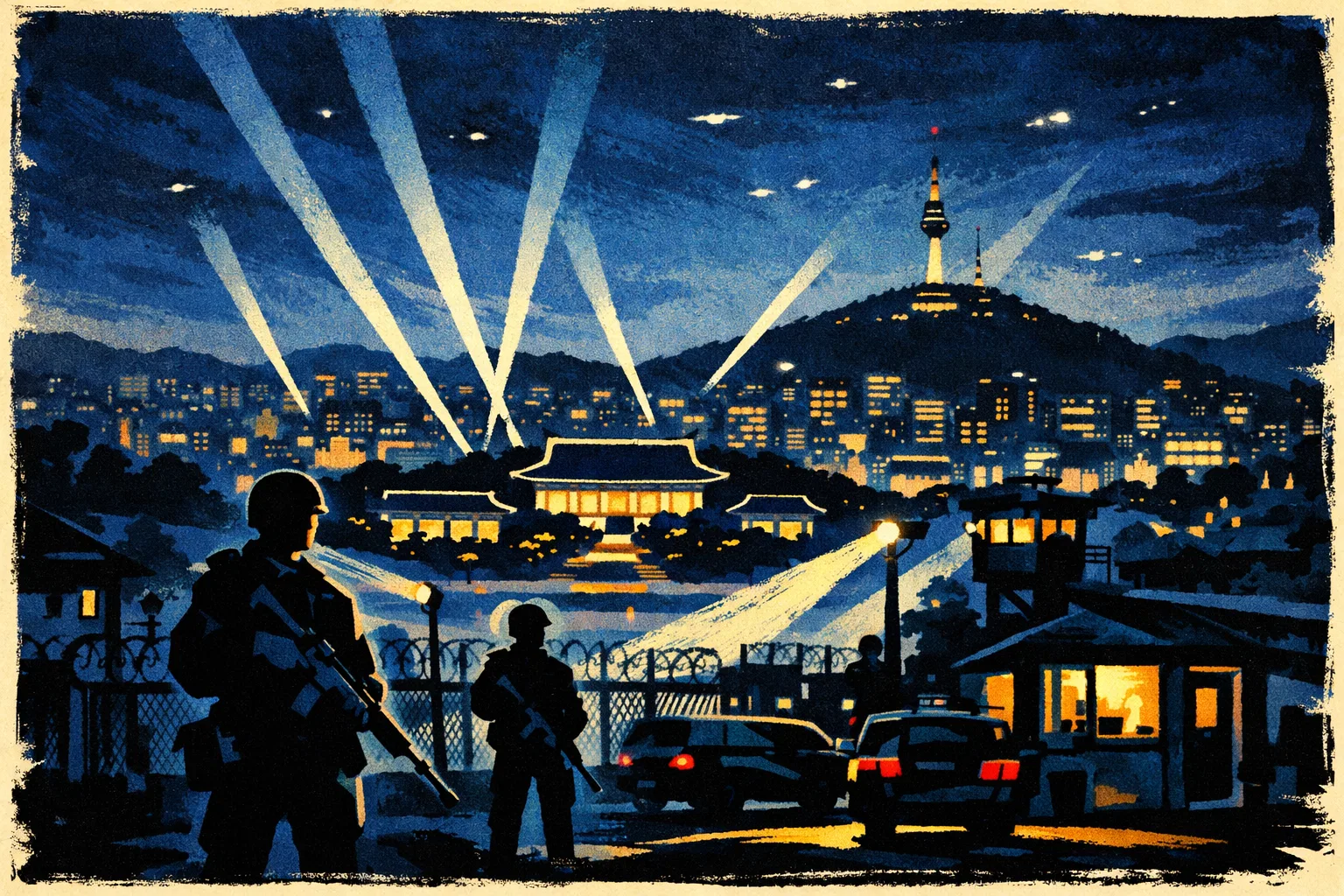
The most consequential Republic of Korea case is the October 1976 incident over Seoul, often remembered in local media as the Blue House UFO case. Its importance is not that it proves an extraordinary craft was present, but that the state response appears to have involved anti-aircraft fire over the capital, with civilian casualties later remembered by witnesses and revisited by investigative television.
Asia Business Daily’s English coverage of an SBS investigative programme reported that the broadcast examined anti-aircraft gunfire over Seoul in 1976 and included testimony from witnesses and victims. The article says the incident is remembered as involving gunfire directed at an unidentified flying object over Seoul, with casualties, but also as a case that was unusually quiet or buried. One witness recalled lights approaching the presidential compound area and anti-aircraft fire shortly afterwards; a victim who had been a high-school student described being struck in the shoulder after the gunfire stopped. [아시아경제]
This case sits at the intersection of UFO history and national security history. Seoul in 1976 was a heavily defended capital in an authoritarian period, close to the demilitarised zone and under acute concern about North Korean infiltration or aircraft incursions. That context makes several interpretations possible: an actual unidentified aircraft or formation; a misidentified authorised flight; an air-defence error; balloons or lights misread under tense conditions; or a classified event never fully explained in public. The surviving public record does not allow a confident identification.
Its evidential strength comes from the reported public response and injury claims, not from a clear image or recovered object. The strongest conclusion is narrow but important: a perceived aerial threat over Seoul appears to have triggered a serious military reaction, and the lack of a transparent, contemporaneous explanation helped turn the incident into one of South Korea’s most persistent UFO stories.
The 1995 Gapyeong photograph and the Korean private-research moment
The 1995 Gapyeong photograph is one of the best-known South Korean UFO claims because it combines a named press photographer, a rural setting and later private analysis. Asia Economy’s interview-based account says that on 4 September 1995, a Munhwa Ilbo photographer, Kim Sun-kyu, photographed an elderly rural couple during the autumn holiday season in Gapyeong, Gyeonggi Province, and an unidentified object appeared in the sky above them. The same account says Maeng Seong-ryeol later helped assess the photograph, with claims that the film had not been manipulated and that French aerospace-related UFO evaluators judged the object not to be an ordinary terrestrial object. [아시아경제]
This is a case where the reader should separate three questions. Was the image a simple digital fake? The argument for authenticity is stronger than in many modern internet clips because it involved film photography and a professional newspaper photographer. Was the object definitely extraordinary? That is much harder. A photograph can be genuine while the object remains a bird, insect, thrown object, processing artefact, distant aircraft or object at an uncertain scale. Was the later chain of evaluation fully open to independent review? Publicly accessible English-language documentation is thin.
The Gapyeong case also reveals a distinctive South Korean dynamic: private UFO researchers became mediators between witnesses, media and the public. A Weekly Kyunghyang review of a documentary about Korean UFO investigators describes the 1990s as a high point for the Korean UFO Research Association’s public activity, and notes that the famous Munhwa Ilbo photograph belonged to that era. It also argues that the spread of digital cameras and smartphones later produced a flood of low-quality UFO images, weakening rather than strengthening the private research scene. [주간경향]
Seoul, Daejeon and the urban-sky problem
Modern South Korean UFO reports are often urban reports: lights above apartment blocks, small objects caught in skyline photographs, formations seen above regional cities, or videos taken from aircraft. These cases are attractive because they occur in populated places, but they are also vulnerable to misidentification. Dense cities contain drones, aircraft, advertising balloons, lanterns, reflective debris, camera artefacts and weather balloons; the evidence is usually compressed, zoomed or taken at night.
The 2011 Daejeon case shows both sides of the problem. Witnesses reported around 20 bright objects travelling northeast in apparent formation, with pictures and clips circulating in local media. Korean UFO investigators described the sighting as unusual, and The Korea Times quoted an Air Force official saying there were no recorded flights or radar detections in the area at the time. [The Korea Times]koreatimes.co.krThe Korea Times UFOs allegedly spotted in DaejeonThe Korea Times UFOs allegedly spotted in Daejeon That makes the incident more interesting than a lone blurry clip, but not decisive. The absence of recorded flights is not the same as proof of an exotic object; it simply narrows some conventional explanations.
A separate Korea Times report from September 2011 described a tiny object photographed above downtown Seoul near Jongno. The witness sent the image to a UFO analysis centre, and Seo Jong-han argued that the object appeared distant rather than a nearby bird or insect, based on focus and blur comparisons. [The Korea Times]koreatimes.co.krThe Korea Times UFOs allegedly spotted in DaejeonThe Korea Times UFOs allegedly spotted in Daejeon Again, the case is unresolved in public rather than confirmed. It illustrates the limits of single-image analysis: focus, blur and apparent shape can help reject some explanations, but without distance, speed, independent witnesses or raw imaging data, they rarely settle the matter.
The 2012 aircraft-window video over South Korea is a useful counterexample because sceptical analysis was more direct. Live Science reported that a video of a white oval object filmed near Seoul showed signs that a visual-effects analyst considered suspicious, including amateur-looking motion blur and image “ghosting” inconsistent with a real three-dimensional object moving through the scene. [Live Science]livescience.comSource details in endnotes. This does not prove that every South Korean video is fake; it shows why video evidence must be examined technically rather than accepted because it “looks strange”.
Confirmed explanations: rockets, meteors, balloons and digital noise
The strongest South Korean UFO evidence may actually be the debunked cases, because they show how quickly plausible public fear can form around real but misunderstood sky events. The best recent example is the unannounced solid-fuel rocket test of 30 December 2022. AP reported that South Korea’s military confirmed a solid-fuel rocket test after the launch caused a brief scare, with people suspecting a UFO, a North Korean missile, a drone light show or a supernatural event. The Defence Ministry said it had not warned the public in advance because the launch involved sensitive military-security issues; emergency offices and police reportedly received hundreds of citizen reports. [AP News]apnews.comAP News South Korea's unannounced rocket launch causes UFO scare | AP NewsAP News South Korea's unannounced rocket launch causes UFO scare | AP News
This case is valuable because it has all the ingredients of a classic UFO flap: dramatic lights over a wide area, social-media amplification, a security-sensitive country, and no public warning. Yet the explanation was conventional and official. It also connects South Korean UFO perception to real defence developments: the same AP report notes that the launch was part of efforts to build space-based surveillance capability, with solid-fuel rockets seen as quicker and cheaper than liquid-fuel systems. [AP News]apnews.comAP News South Korea's unannounced rocket launch causes UFO scare | AP NewsAP News South Korea's unannounced rocket launch causes UFO scare | AP News
Meteors produce a similar pattern. In April 2026, Korea JoongAng Daily reported witness accounts from multiple areas of Korea of a large oval-shaped object burning as it fell from the sky, with dashcam footage showing a fiery trail and apparent fragmentation. The Korea Astronomy and Space Science Institute said the object was likely a meteor and explained that larger meteoroids can appear as bright fireballs as they burn in the atmosphere. [Korea Joongang Daily]koreajoongangdaily.joins.comKorea Joongang Daily Witnesses report 'fireball' falling from sky over KoreaKorea Joongang Daily Witnesses report 'fireball' falling from sky over Korea A comparable scientific pathway followed the 2014 Jinju meteorite: Dong-A Science reported that KASI and a Yonsei University team estimated a single fireball exploded over the Hamyang-Sancheong area, with fragments falling in Jinju, based on video footage gathered from across the country. [Donga Science]dongascience.comSource details in endnotes.
Balloon explanations also matter in Seoul. Weekly Kyunghyang discussed a 2020 controversy over a video above Gwanaksan, noting that a similar earlier case had been connected by reporting to a fine-dust observation balloon launched near Nakseongdae Park, while the UFO analysis centre initially leaned toward a UFO interpretation. The same article says a later broadcast reached a balloon conclusion for the disputed sighting. [주간경향] This is an important caution: in a country with heavy environmental monitoring, dense air traffic and frequent public events, ordinary airborne devices can look anomalous when filmed without context.
Region-level variation: why Seoul dominates, but not because it is uniquely strange
Seoul and the surrounding capital region dominate South Korean UFO reporting for obvious reasons: population density, media concentration, security sensitivity and constant camera coverage. A light over Seoul is more likely to be noticed, filmed, reported and politically interpreted than the same light over a rural mountain. The 1976 Blue House incident, the 2008 Gwanghwamun reference in later Korea Times coverage, the 2011 Jongno photo and the 2020 Gwanaksan balloon dispute all reinforce the same pattern: Seoul turns aerial ambiguity into public meaning faster than other regions. 아시아경제 [The Korea Times]koreatimes.co.krThe Korea Times UFOs allegedly spotted in DaejeonThe Korea Times UFOs allegedly spotted in Daejeon
Daejeon matters for a different reason. It is inland, scientifically and administratively significant, and less saturated by global media than Seoul. The 2011 Daejeon sighting gained attention because it involved multiple bright objects, photographs, video and an Air Force comment that no flights or radar contacts were recorded. That combination made it a stronger regional case than a casual internet post, even though it remained unresolved in public. [The Korea Times]koreatimes.co.krThe Korea Times UFOs allegedly spotted in DaejeonThe Korea Times UFOs allegedly spotted in Daejeon
Gyeonggi Province supplies the most famous still-photo case through Gapyeong and also benefits from proximity to Seoul’s media ecosystem. The 1995 Gapyeong photograph became nationally memorable partly because it was not just a rural witness story; it passed through a major newspaper, private analysis and later documentary discussion. [아시아경제]
The southern regions are more prominent in meteor and fireball evidence than in famous craft claims. Jinju became scientifically important because meteorite fragments were recovered after a widely observed 2014 fireball, while later fireball reports show how quickly natural atmospheric entries can be perceived as unidentified objects before astronomy institutions weigh in. [Donga Science]dongascience.comSource details in endnotes.
Archives and databases: useful leads, not final verdicts
International UFO databases contain South Korea entries, but they must be used carefully. The National UFO Reporting Center describes its databank as a large, independently collected set of public UFO and UAP witness reports, available for browsing by researchers and the public. [NUFORC]nuforc.orgData Bank | NUFORCData Bank | NUFORC Its country index for Korea includes only a small number of entries in the visible table, including older reports and a 1999 guard-duty sighting. [NUFORC]nuforc.orgReports for Country KoreaReports for Country Korea That is useful as a lead-finding tool, but it is not a verified national archive.
The same caution applies to online lists that claim many recent South Korean sightings. A report with no raw data, no named witnesses, no independent media corroboration and no official or technical follow-up should be treated as low-grade evidence, even if it is detailed. Conversely, a modest report with a named date, local media coverage, official comment and a plausible conventional explanation may be more valuable to researchers because it teaches how unidentified reports are generated and resolved.
For declassified material, United States sources are stronger for the Korean War era than for the Republic of Korea’s later domestic UFO history. Project Blue Book and related archives help contextualise early military sightings over Korea, but they do not substitute for South Korean defence records. For post-1970 South Korea, the most useful public materials are often local reporting, Korean-language investigations, astronomy institute comments and defence-ministry statements after explained scares.
Confirmed, contested and debunked claims
A practical way to read South Korea’s UFO record is to sort cases by evidence quality rather than by strangeness.
Confirmed or well-explained events include the 30 December 2022 rocket scare and the 2014 and 2026 meteor or fireball reports. In each case, the public initially encountered a dramatic aerial display, but official or scientific explanation followed: a solid-fuel rocket test in 2022, a meteorite-producing fireball in 2014, and a likely meteor in 2026. [AP News]apnews.comAP News South Korea's unannounced rocket launch causes UFO scare | AP NewsAP News South Korea's unannounced rocket launch causes UFO scare | AP News [Donga Science]dongascience.comOpen source on dongascience.com.
Contested but historically important cases include the 1976 Seoul incident, the 1995 Gapyeong photograph and the 2011 Daejeon formation. These have stronger public profiles than ordinary sightings, but none has a fully open, independently reproducible evidence package that would settle the identification. Their importance lies in witness volume, media attention, official response or private analysis, not in proof of exotic origin. [아시아경제+2아시아경제]
Likely debunked or weak claims include the 2012 aircraft video analysed by Live Science and many later internet claims about enormous hidden craft or anonymous underground facilities. The 2012 video attracted attention because it was visually dramatic, but technical analysis identified signs consistent with digital fakery. [Live Science]livescience.comSource details in endnotes. Claims about a huge immovable craft hidden in Korea have circulated online in recent years, but public versions generally rest on unnamed sources, speculative map interpretation and repetition through UFO media rather than verifiable documents, named witnesses, physical evidence or official acknowledgement.
What would make a South Korean UFO case stronger?
The Republic of Korea has the institutions needed to clarify many future cases: advanced air-defence monitoring, dense CCTV and dashcam coverage, professional astronomy, space-launch tracking and a technologically literate public. The weakness is not capability; it is public access. Most civilian UFO claims remain trapped between private enthusiasm and official silence unless an event becomes impossible to ignore.
A strong South Korean case would need more than a striking clip. The most useful evidence would include raw image or video files with metadata, multiple independent viewpoints, precise time and location, weather and astronomical checks, aircraft and drone exclusion, radar or air-traffic correlation, and a clear record of who handled the material. For fireballs, meteor-camera networks and astronomical institutes can often resolve the question. A 2017 South Korean meteor-detection project, initiated after the Jinju fireball, described a double-station optical-video system designed to determine three-dimensional meteor orbits, showing that the technical model for resolving some “UFO-like” events already exists. [arXiv]arxiv.orgSource details in endnotes.
The 2022 rocket scare also suggests a policy lesson. Defence secrecy may be justified for some launches, but unexplained public sky events in South Korea can quickly become interpreted through fears of North Korean missiles, drones or UFOs. Where security permits, delayed public explanation, clearer launch windows or post-event official notices can reduce misinformation without exposing sensitive details. [AP News]apnews.comAP News South Korea's unannounced rocket launch causes UFO scare | AP NewsAP News South Korea's unannounced rocket launch causes UFO scare | AP News

Bottom line for the Republic of Korea record
South Korea’s UFO history is not empty, but it is uneven. The country has a small number of notable incidents with real social or historical weight: the Korean War military reports, the 1976 Seoul air-defence incident, the 1995 Gapyeong photograph, the 2011 Daejeon formation and several modern scares that were later explained. It also has a much larger fringe of weak internet claims, recycled rumours and visually interesting but poorly documented videos.
The most defensible reading is neither blanket dismissal nor sensational belief. The Republic of Korea record shows that unidentified aerial reports can arise from genuine witness confusion, military secrecy, natural fireballs, aerospace tests, balloons, camera artefacts and, occasionally, cases that remain unresolved in public because the evidence is incomplete. For a country-level UFO project, South Korea is therefore most useful as a case study in evidence sorting: what looks mysterious at first sight may become mundane after official or scientific context, while a few historically significant incidents remain open mainly because the public record is too thin to close them.
Amazon book picks
Further Reading
Books and field guides related to What Really Happened in Korea's UFO Cases?. Use these as the next step if you want deeper reading beyond the article.
How UFOs Conquered the World
Explains how UFO traditions develop in different societies.
Endnotes
-
Source: archives.gov
Title: National Archives Project BLUE BOOK
Link: https://www.archives.gov/research/military/air-force/ufos -
Source: project1947.com
Link: https://www.project1947.com/fig/korea52a.htm -
Source: nuforc.org
Title: Data Bank | NUFORC
Link: https://nuforc.org/databank/ -
Source: nuforc.org
Title: Reports for Country Korea
Link: https://nuforc.org/subndx/?id=cKorea -
Source: arxiv.org
Link: https://arxiv.org/abs/1708.08196 -
Source: history.com
Title: When Dozens of Korean War GIs Claimed a UFO Made Them Sick
Link: https://www.history.com/articles/korean-war-us-army-ufo-attack-illness -
Source: nuforc.org
Link: https://nuforc.org/sighting/?id=196376 -
Source: nuforc.org
Link: https://nuforc.org/ndx/?id=loc -
Source: archive.org
Title: Brad Sparks Comprehensive Catalog of 1,600 Project Blue Book UFO Unknowns
Link: https://archive.org/download/BernardSieglerTechnicsAndTime1TheFaultOfEpimetheus/Brad%20Sparks%20-%20Comprehensive%20Catalog%20of%201%2C600%20Project%20Blue%20Book%20UFO%20Unknowns.pdf -
Source: shindonga.donga.com
Link: https://shindonga.donga.com/3/all/13/100794/1 -
Source: shindonga.donga.com
Link: https://shindonga.donga.com/3/06/13/109422/2 -
Source: shindonga.donga.com
Link: https://shindonga.donga.com/Library/3/22/13/100794/1 -
Source: koreatimes.co.kr
Title: The Korea Times UFOs allegedly spotted in Daejeon
Link: https://www.koreatimes.co.kr/southkorea/20110818/ufos-allegedly-spotted-in-daejeon -
Source: koreatimes.co.kr
Title: The Korea Times ‘UFO spotted in the sky above downtown Seoul’
Link: https://www.koreatimes.co.kr/business/tech-science/20110905/ufo-spotted-in-the-sky-above-downtown-seoul -
Source: livescience.com
Link: https://www.livescience.com/19613-ufo-south-korea.html -
Source: apnews.com
Title: AP News South Korea’s unannounced rocket launch causes UFO scare | AP News
Link: https://apnews.com/article/politics-south-korea-government-aerospace-technology-abe96197f899c94f9e9f5c02e407d367 -
Source: koreajoongangdaily.joins.com
Title: Korea Joongang Daily Witnesses report ‘fireball’ falling from sky over Korea
Link: https://koreajoongangdaily.joins.com/news/2026-04-25/national/socialAffairs/Witnesses-report-fireball-falling-from-sky-over-Korea/2577821 -
Source: dongascience.com
Link: https://www.dongascience.com/en/news/4122 -
Source: Wikipedia
Title: Project Blue Book
Link: https://en.wikipedia.org/wiki/Project_Blue_Book -
Source: facebook.com
Link: https://www.facebook.com/groups/1535003850420580/posts/1983817122205915/ -
Source: dongascience.com
Link: https://www.dongascience.com/en/news/4134 -
Source: dongascience.com
Link: https://www.dongascience.com/en/news/4077 -
Source: uapkorea.com
Link: https://uapkorea.com/about/ -
Source: ui.adsabs.harvard.edu
Link: https://ui.adsabs.harvard.edu/abs/arXiv%3A1708.08196 -
Source: apnews.com
Link: https://apnews.com/article/13515a718347c1e390056e592820e17f -
Source: koreajoongangdaily.joins.com
Link: https://koreajoongangdaily.joins.com/2022/12/30/national/socialAffairs/Space-luanch-alien/20221230192508623.html
Additional References
-
Source: youtube.com
Title: Secret ‘immovable’ UFO is ‘hiding in plain sight’ in purpose-built structure
Link: https://www.youtube.com/watch?v=VwG32hyp170Source snippet
UFO Video Goes Viral... Unidentified Objects Flying Over the Battlefield? [News Now] / YTN...
-
Source: youtube.com
Link: https://www.youtube.com/watch?v=q38c4_DxURkSource snippet
South Koreans spooked as secret rocket launch mistaken for UFO...
-
Source: youtube.com
Title: South Korea: UFO Was Military Rocket Test | VOA News
Link: https://www.youtube.com/watch?v=s3Zmm1uKchgSource snippet
South Korea's unannounced rocket launch causes a 'UFO Scare' | Oneindia News...
-
Source: cia.gov
Link: https://www.cia.gov/readingroom/docs/CIA-RDP81R00560R000100070026-7.pdf -
Source: cia.gov
Link: https://www.cia.gov/readingroom/document/cia-rdp90-00845r000100320006-6 -
Source: cia.gov
Link: https://www.cia.gov/library/abbottabad-compound/2D/2DE334239CCF768F6A9E0CFD1974455D_Crossing_The_Rubicon_Part_2.pdf -
Source: youtube.com
Title: South Koreans spooked as secret rocket launch mistaken for UFO
Link: https://www.youtube.com/watch?v=FFXvtcVIQTESource snippet
South Korea: UFO Was Military Rocket Test | VOA News...
-
Source: mufon.com
Link: https://mufon.com/research/ -
Source: nicap.org
Link: https://www.nicap.org/bluebook/bluelist.htm -
Source: nextspaceflight.com
Link: https://nextspaceflight.com/launches/details/8222/
Topic Tree
Follow this branch
Related pages 192
- Afghanistan UAP
- AlbanianUFOs
- Algeria UFOs
- Antigua UFOs
- Monaco UFOs
- +187 more in sidebar