Within Korea UFOs
Who Shaped Korea's UFO Evidence Trail?
South Korea's UFO record often runs through professors, analysis centres, documentaries and local media rather than open state archives.
On this page
- The role of named private researchers
- Television, newspapers and public credibility
- Limits of investigator led evidence
Page outline Jump by section
Introduction
In South Korea, the public history of UFO claims has often been shaped less by government disclosure than by a small circle of private investigators, university-affiliated researchers, television producers and media commentators. Unlike countries with large declassified UFO archives, the Republic of Korea developed a culture in which many major sightings entered public discussion through newspapers, documentary programmes, online communities and investigator-led analysis rather than through sustained official reporting.
 That structure gave unusual influence to a handful of figures who acted as interpreters of ambiguous photographs, witness testimony and video recordings. Their work helped keep UFO discussion visible in Korean public life, but it also exposed a recurring problem: when evidence is filtered through private researchers and media organisations, the credibility of a case can become closely tied to the reputation of the investigator rather than to independently verifiable records. The result is a UFO culture that has produced memorable cases and active public debate, while also generating persistent disputes over standards of proof.
Who became Korea’s best-known UFO investigators?
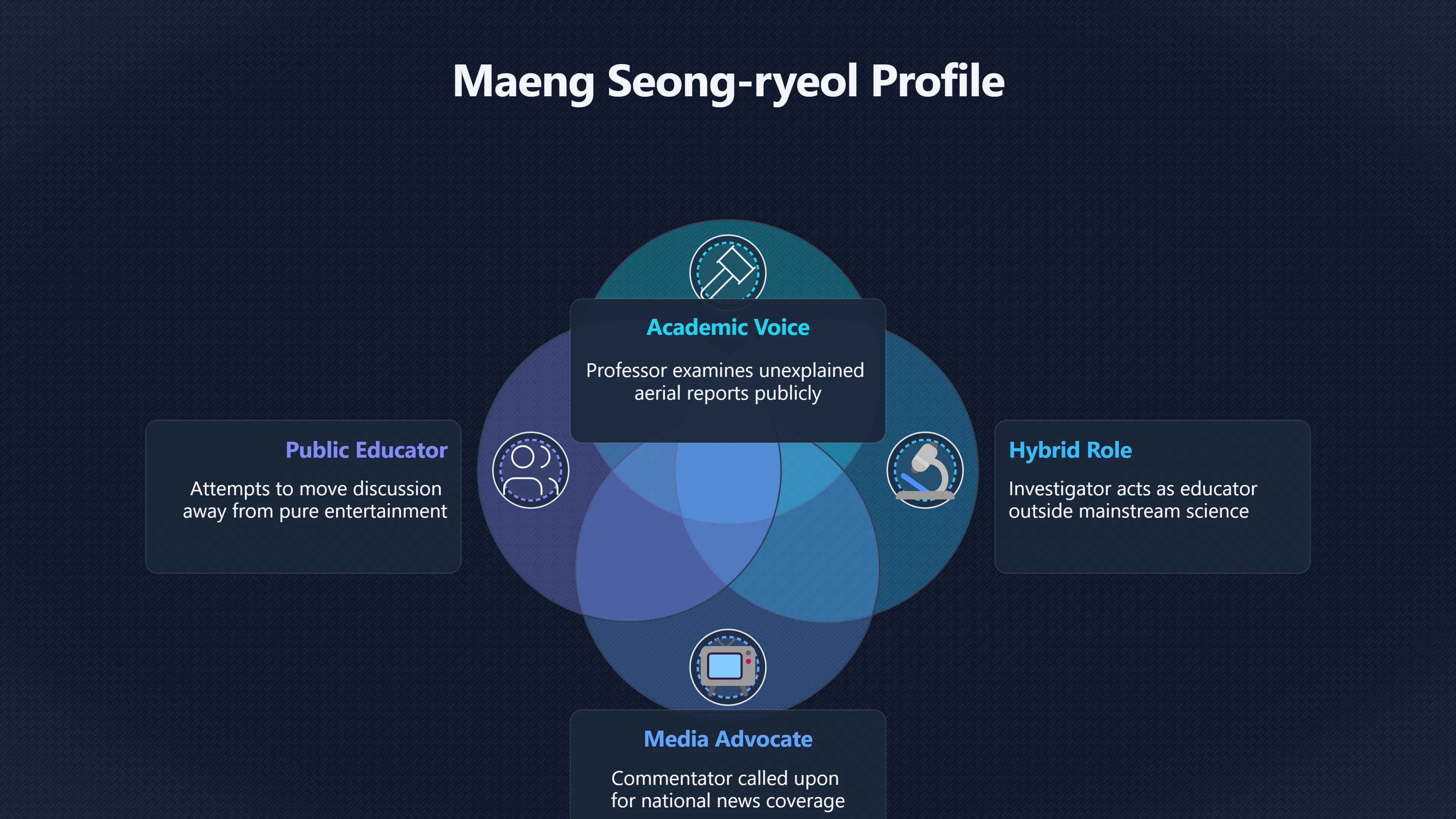
The most visible name in South Korean UFO research since the 1990s has been Maeng Seong-ryeol. Trained as a professor and frequently presented in Korean media as a scientific voice willing to examine unexplained aerial reports, Maeng became one of the country’s most recognisable public advocates for serious UFO investigation. Korean and international coverage repeatedly identified him as president of the Korean UFO Research Center and as a commentator called upon when unusual sightings reached national news. [The Korea Times]koreatimes.co.krufos allegedly spotted in daejeonThe Korea TimesUFOs allegedly spotted in Daejeon18 Aug 2011 —… Maeng Seong-ryeol, professor at Woosuk University and president of the…
What made Maeng distinctive was not simply his willingness to discuss extraterrestrial possibilities. He occupied a hybrid role that fit South Korea’s media environment: part academic, part public educator and part investigator. Documentary coverage of his work portrayed him as someone attempting to move UFO discussion away from pure entertainment while still operating outside mainstream scientific institutions. At the same time, the documentaries showed the social difficulty of that position. Researchers who publicly discussed UFOs often faced scepticism from both academics and the broader public, leaving them dependent on media exposure for visibility. [Dafílms]dafilms.comDafílmsUFO Sketch | watch onlineThis film introduces Professor MAENG Sunglyul at Woosuk University, the author of UFO Syndrome and a scie…
Another frequently cited figure was Seo Jong-han, who became known for analysing photographs and video footage submitted by witnesses. Korean reporting described him as someone who spent years studying foreign UFO literature and building expertise in image analysis because there was little established domestic infrastructure for UFO research. [Korea Joongang Daily]koreajoongangdaily.joins.comKorea Joongang Daily Keeping an eye trained on the skyKorea Joongang DailyKeeping an eye trained on the sky - Korea JoongAng DailySeptember 22, 2003 — 23 Sept 2003 — Seo began reading up on U…
The prominence of Maeng and Seo reveals an important feature of the South Korean UFO scene: expertise was often personalised. Instead of large institutions producing formal investigative reports, the public frequently encountered UFO analysis through identifiable individuals whose assessments circulated through newspapers, television interviews and internet discussions.
Why television became the main evidence archive
South Korea’s UFO culture developed alongside a highly competitive television industry. News programmes, current-affairs shows and documentaries became crucial platforms for presenting sightings to a national audience.
This mattered because many UFO reports involved evidence that was difficult for ordinary viewers to evaluate directly. Grainy footage, distant lights and eyewitness testimony rarely spoke for themselves. Television programmes therefore relied on investigators to explain what audiences were seeing. Researchers were invited to assess image quality, compare witness accounts and speculate about possible explanations.
As a result, television often served two functions at once:
- It publicised sightings.
- It acted as an informal validation system.
A case that appeared on national television gained a degree of legitimacy simply because producers considered it worthy of discussion. That did not mean the evidence was stronger, but it increased public visibility and encouraged additional witnesses to come forward.
The pattern became especially visible during the 2000s and early 2010s, when South Korean broadcasters devoted occasional segments to unexplained lights, unusual photographs and alleged encounters. Investigators appeared not merely as interview subjects but as intermediaries between raw sightings and public interpretation.
The influence of television also created a feedback loop. People who believed they had witnessed something unusual often contacted researchers first, hoping their material would eventually reach broadcasters. In this sense, private investigators became gatekeepers for what entered the national UFO conversation.
The Daejeon sightings and the rise of video-based credibility
One of the clearest examples of investigator-led evidence culture emerged during the widely reported Daejeon sightings in 2011.
Witnesses reported unusual luminous objects in the night sky, while photographs and video clips circulated through local media. Coverage quickly turned to recognised UFO researchers for interpretation. Maeng Seong-ryeol publicly commented on the rarity of the reported visual characteristics, while other investigators emphasised the perceived quality of the recordings. The South Korean Air Force reportedly stated that it had detected no related aircraft activity and had no radar confirmation, leaving the incident unresolved in public reporting. [The Korea Times]koreatimes.co.krufos allegedly spotted in daejeonThe Korea TimesUFOs allegedly spotted in Daejeon18 Aug 2011 —… Maeng Seong-ryeol, professor at Woosuk University and president of the…
The episode illustrates how credibility was increasingly attached to media evidence rather than solely to eyewitness testimony.
Earlier UFO stories often depended on personal accounts. By the 2000s, investigators and journalists placed greater emphasis on:
- Mobile-phone photographs.
- Consumer video recordings.
- Digital image enhancement.
- Frame-by-frame analysis.
- Multiple recordings from different locations.
This shift mirrored broader changes in South Korean society. As digital cameras and smartphones became common, investigators gained far more material to examine. Yet the apparent improvement in evidence quality introduced new problems. Digital footage could be compressed, altered, misunderstood or stripped of contextual information. Better imagery did not automatically produce better conclusions.
The Daejeon case therefore became representative of a recurring Korean pattern: relatively strong public documentation combined with limited independent verification. [The Korea Times]koreatimes.co.krufos allegedly spotted in daejeonThe Korea TimesUFOs allegedly spotted in Daejeon18 Aug 2011 —… Maeng Seong-ryeol, professor at Woosuk University and president of the…
Newspapers and the search for respectable witnesses
South Korean newspapers played a different role from television. Rather than presenting dramatic visual narratives, they often attempted to establish the social credibility of witnesses.
Reports commonly highlighted occupations, educational backgrounds or institutional affiliations. A sighting by military personnel, engineers, professors or government employees was frequently treated as more newsworthy than a claim from an anonymous observer. This reflected a broader tendency in Korean reporting culture to assess claims through the perceived reliability of the person making them.
Private UFO investigators benefited from this framework. Researchers with academic titles or organisational affiliations could function as credibility anchors within news stories. Their presence reassured editors that a report was not purely tabloid material.
Yet this approach had drawbacks. Credibility could become detached from evidence itself. Readers were sometimes asked to trust an investigator’s interpretation without access to the underlying data, full imagery or technical methodology. In practice, many Korean UFO stories became contests between competing authority figures rather than transparent examinations of evidence.
Internet communities changed the balance of power
The growth of online forums, blogs, video platforms and social media altered the position of traditional UFO investigators.
During the early internet era, researchers such as Seo Jong-han gained influence partly because they possessed specialist knowledge that was difficult for the public to access independently. By the 2010s and 2020s, online communities could perform their own investigations. Satellite imagery, flight-tracking services, astronomical databases and image-analysis tools became widely available.
This shift produced a more decentralised evidence culture.
Claims that once might have circulated unchallenged through television or newspapers increasingly faced immediate scrutiny. Internet users compared photographs with known aerospace facilities, checked launch schedules and searched historical imagery. The result was a faster cycle of claim and counter-claim.
The debate surrounding supposed hidden UFO structures in South Korea demonstrates this change. Online communities circulated images of unusual circular facilities and speculated that some concealed recovered craft. At the same time, aviation enthusiasts, military observers and sceptical researchers pointed to navigation systems, radar infrastructure and other conventional explanations. Discussions often became less about the original claim and more about whether investigators were applying adequate evidential standards. [Reddit]reddit.comAnyang-Si Locals' photos of speculated UFO buildingRedditAnyang-Si Locals' photos of speculated UFO buildingJuly 14, 2023 — r/aliens - A UFO Was Shot Down in China Yesterday? Some Chinese…
In this environment, the authority of traditional UFO researchers became less absolute. They remained influential voices, but they increasingly had to compete with crowdsourced investigation.
The recurring tension between investigation and entertainment
South Korean UFO culture has long existed near the boundary between serious inquiry and entertainment.
Popular media repeatedly borrowed UFO themes for films, television dramas and variety programming. Productions ranging from the romantic film Au Revoir, UFO to modern mystery series such as Glitch demonstrate how UFO imagery became embedded in broader Korean popular culture. [Wikipedia]WikipediaAu Revoir, UFOAu Revoir, UFO
This cultural visibility helped keep public interest alive. It also created difficulties for investigators seeking legitimacy.
When UFO stories appeared alongside paranormal entertainment, conspiracy programming or celebrity-centred discussion, audiences could struggle to distinguish between:
- Documented sightings.
- Speculative interpretation.
- Fictional storytelling.
- Deliberate hoaxes.
Researchers frequently argued that UFO reports deserved more serious examination, but they operated within a media environment that rewarded dramatic narratives and visual spectacle. Television producers naturally preferred unusual footage and mystery-driven storytelling over cautious methodological discussions.
The result was a persistent ambiguity. UFO investigators needed media attention to reach the public, yet the same media incentives sometimes encouraged sensational framing that weakened perceptions of credibility.

Why investigator-led evidence has clear limits
The strongest criticism of South Korea’s UFO research culture is not that investigators are necessarily wrong. It is that the available evidence is often difficult to verify independently.
Several structural problems recur across decades of reporting:
Limited official disclosure. South Korea has not produced a large publicly accessible UFO archive comparable to the most heavily studied foreign collections. Researchers therefore rely heavily on witness accounts, media reports and privately gathered material.
Weak chains of custody. Images and videos frequently reach investigators after being copied, compressed or redistributed, making forensic analysis more difficult.
Dependence on individual reputations. Cases are often evaluated according to who analysed them rather than through standardised investigative procedures.
Media selection bias. Dramatic cases receive attention while mundane explanations attract less coverage.
Incomplete resolution. Many reports remain publicly unresolved not because they demonstrate extraordinary phenomena but because available evidence is insufficient for a definitive conclusion.
These limitations help explain why South Korea’s UFO record contains relatively few cases that have achieved broad acceptance outside UFO research circles, despite decades of public fascination.
What Korea’s UFO evidence culture reveals
The South Korean experience shows how a UFO culture can develop without extensive state disclosure. In the absence of large official archives, private investigators, professors, journalists and broadcasters became the principal custodians of the country’s UFO narrative.
That arrangement produced a distinctive evidence trail. Instead of moving from government files to public review, many Korean UFO stories moved from witnesses to investigators, then through newspapers, documentaries and television. Researchers such as Maeng Seong-ryeol and Seo Jong-han became important because they offered continuity in a field where institutional records were limited and public attention was episodic. [Korea Joongang Daily]koreajoongangdaily.joins.comKorea Joongang Daily Keeping an eye trained on the skyKorea Joongang DailyKeeping an eye trained on the sky - Korea JoongAng DailySeptember 22, 2003 — 23 Sept 2003 — Seo began reading up on U… [The Korea Times]koreatimes.co.krufos allegedly spotted in daejeonThe Korea TimesUFOs allegedly spotted in Daejeon18 Aug 2011 —… Maeng Seong-ryeol, professor at Woosuk University and president of the…
The legacy of that system is mixed. It preserved reports that might otherwise have disappeared and encouraged public discussion of unexplained aerial phenomena. At the same time, it left many cases dependent on media framing, personal authority and fragmentary evidence. For readers examining the Republic of Korea’s UFO history, that may be the most important lesson: understanding the investigators is often as important as understanding the sightings themselves.
Amazon book picks
Further Reading
Books and field guides related to Who Shaped Korea's UFO Evidence Trail?. Use these as the next step if you want deeper reading beyond the article.
How UFOs Conquered the World
Explores the role of media and investigators in shaping cases.
Endnotes
-
Source: reddit.com
Title: Anyang-Si Locals’ photos of speculated UFO building
Link: https://www.reddit.com/r/aliens/comments/14zhue1/anyangsi_locals_photos_of_speculated_ufo_building/Source snippet
RedditAnyang-Si Locals' photos of speculated UFO buildingJuly 14, 2023 — r/aliens - A UFO Was Shot Down in China Yesterday? Some Chinese...
Published: July 14, 2023
-
Source: Wikipedia
Title: Au Revoir, UFO
Link: https://en.wikipedia.org/wiki/Au_Revoir%2C_UFO -
Source: Wikipedia
Title: Glitch (South Korean TV series)
Link: https://en.wikipedia.org/wiki/Glitch_%28South_Korean_TV_series%29 -
Source: reddit.com
Link: https://www.reddit.com/r/UFOB/comments/1srab9r/this_is_a_video_of_a_ufo_sighting_recorded_on/Source snippet
January 31, 2021, in Songdo International City, Incheon, South Korea. Video or Footage.Read more...
Published: January 31, 2021
-
Source: reddit.com
Link: https://www.reddit.com/r/aliens/comments/1blkqo1/did_greer_just_confirm_that_coultharts_so_big_it/ -
Source: Wikipedia
Title: Wonsan Sunchon UFO incident
Link: https://en.wikipedia.org/wiki/Wonsan-Sunchon_UFO_incidentSource snippet
Wonsan-Sunchon UFO incidentAir Force UFO experts argue that widespread reporting of the incident contributed to the 1952 UFO flap that...
-
Source: koreatimes.co.kr
Title: ufos allegedly spotted in daejeon
Link: https://www.koreatimes.co.kr/southkorea/20110818/ufos-allegedly-spotted-in-daejeonSource snippet
The Korea TimesUFOs allegedly spotted in Daejeon18 Aug 2011 —... Maeng Seong-ryeol, professor at Woosuk University and president of the...
-
Source: dafilms.com
Link: https://dafilms.com/film/12881-ufo-sketchSource snippet
DafílmsUFO Sketch | watch onlineThis film introduces Professor MAENG Sunglyul at Woosuk University, the author of UFO Syndrome and a scie...
-
Source: koreajoongangdaily.joins.com
Title: Korea Joongang Daily Keeping an eye trained on the sky
Link: https://koreajoongangdaily.joins.com/2003/09/23/features/Keeping-an-eye-trained-on-the-sky/2035053.htmlSource snippet
Korea Joongang DailyKeeping an eye trained on the sky - Korea JoongAng DailySeptember 22, 2003 — 23 Sept 2003 — Seo began reading up on U...
Published: September 22, 2003
-
Source: koreatimes.co.kr
Title: koreatoday ufo chasers
Link: https://www.koreatimes.co.kr/southkorea/20110126/koreatoday-ufo-chasersSource snippet
[KOREATODAY] UFO chasers26 Jan 2011 — While Seo devotes himself to the analysis of various pictures of UFO sightings as his main job, Heo...
Additional References
-
Source: youtube.com
Link: https://www.youtube.com/watch?v=xYYwUJOe-dUSource snippet
Are UFOs real? South Korean, U.S. scientists analyseNow unidentified flying objects have long been a topic that's never failed to fascina...
-
Source: youtube.com
Link: https://www.youtube.com/watch?v=l0hHunS9xe4Source snippet
UFOs Deflecting US Hellfire Missiles? Witnesses at Hearing..."Earth Has Already Been Invaded" Why Earth Is the Alien Colony (Professor M...
-
Source: ibtimes.co.uk
Title: ufo researcher claims alien crafts hidden south korea oklahoma 1779905
Link: https://www.ibtimes.co.uk/ufo-researcher-claims-alien-crafts-hidden-south-korea-oklahoma-1779905Source snippet
Steven Greer claims two massive alien crafts are hidden in South Korea and Oklahoma, sparking debate on extraterrestrial activity and...
-
Source: youtube.com
Title: UFOs Aren’t What You Think | UFO Revelations: Rise of the UAP | Full Documentary
Link: https://www.youtube.com/watch?v=AstIkKpV3EESource snippet
The featured interview with Professor Maeng Seong-ryeol directly explores the perspectives of South Korea's most prominent private UFO re...
-
Source: audioboom.com
Title: 8865016 a ufo too big to move the south korea theory examined
Link: https://audioboom.com/posts/8865016-a-ufo-too-big-to-move-the-south-korea-theory-examinedSource snippet
A UFO Too Big To Move: The South Korea Theory Examined24 Feb 2026 — A UFO so large it could not be transported. That was the claim made b...
-
Source: en.noticiasufologicas.com.br
Link: https://en.noticiasufologicas.com.br/ufo-a-fascinante-jornada-cientifica-de-um-professor-coreano/Source snippet
noticiasufologicas.com.brUFO: The Fascinating Scientific Journey of a Korean Professor28 Aug 2024 — Maeng Seong-ryeol is not an unknown n...
-
Source: thesun.co.uk
Title: secret ufo building hiding plain sight us congressman
Link: https://www.thesun.co.uk/news/38259218/secret-ufo-building-hiding-plain-sight-us-congressman/Source snippet
Secret UFO that's so huge it's had a building constructed...18 Feb 2026 — A MASSIVE UFO is hiding in plain sight in a secret overseas lo...
-
Source: youtube.com
Link: https://www.youtube.com/watch?v=nN_4k3TpMUwSource snippet
"Earth Has Already Been Invaded" Why Earth Is the Alien Colony (Professor Maeng Seong-ryeol)...
-
Source: youtube.com
Link: https://www.youtube.com/watch?v=szMinH-2xjQSource snippet
Project Blue Book: Declassified – The True Story of The Korean War Encounter | History...
-
Source: medium.com
Link: https://medium.com/never-stop-writing/the-ufo-too-large-to-move-the-strange-story-buried-in-korea-7b37d781c0eaSource snippet
The UFO Too Large To Move: The Strange Story Buried In...Several UFO blogs and satellite sleuths pointed to an odd structure in Seoul, S...
Topic Tree