Within China UFOs
Who Investigated China's UFO Reports?
China's UFO culture grew from post-1978 public curiosity into a mix of enthusiast groups, astronomy, and sceptical analysis.
On this page
- The post 1978 UFO boom
- Purple Mountain Observatory's role
- Where science split from paranormal culture
Page outline Jump by section
Introduction
China’s UFO research culture emerged from a distinctive mix of scientific curiosity, mass enthusiasm, and sceptical correction. After the late 1970s, reports of strange lights and aerial phenomena spread rapidly through newspapers, amateur clubs, and astronomy circles. What made the Chinese experience unusual was that professional astronomers became directly involved. Researchers linked to the Chinese Academy of Sciences and the Purple Mountain Observatory often acted as public interpreters of sightings, trying to separate astronomical or military explanations from claims that drifted into paranormal speculation. [#SixthTone]sixthtone.com#SixthToneThe Astronomer Who Calmed China's UFO Craze20 May 2023 — He signed the letter, as he always does, “Purple Mountain Observatory… [Wikipedia Over time]WikipediaWang SichaoBetween 1963 and 1999, he was a researcher at the Purple Mountain Observatory in Nanjing. Wang researched asteroids, meteors, comets, and…, the field split into two broad camps. One side treated UFO reports as potentially important scientific mysteries deserving organised investigation. The other argued that most sightings could be explained through optics, rockets, aircraft, weather effects, or social psychology. The tension between these approaches shaped Chinese UFO culture for decades and helps explain why China produced both large national UFO associations and a strong internal sceptical tradition at the same time.
The post-1978 UFO boom
China’s modern UFO movement accelerated after the reform era began under Deng Xiaoping. Public discussion of science expanded, foreign ideas circulated more freely, and newspapers increasingly covered unexplained phenomena. UFOs became part of a wider fascination with modernity and the unknown.
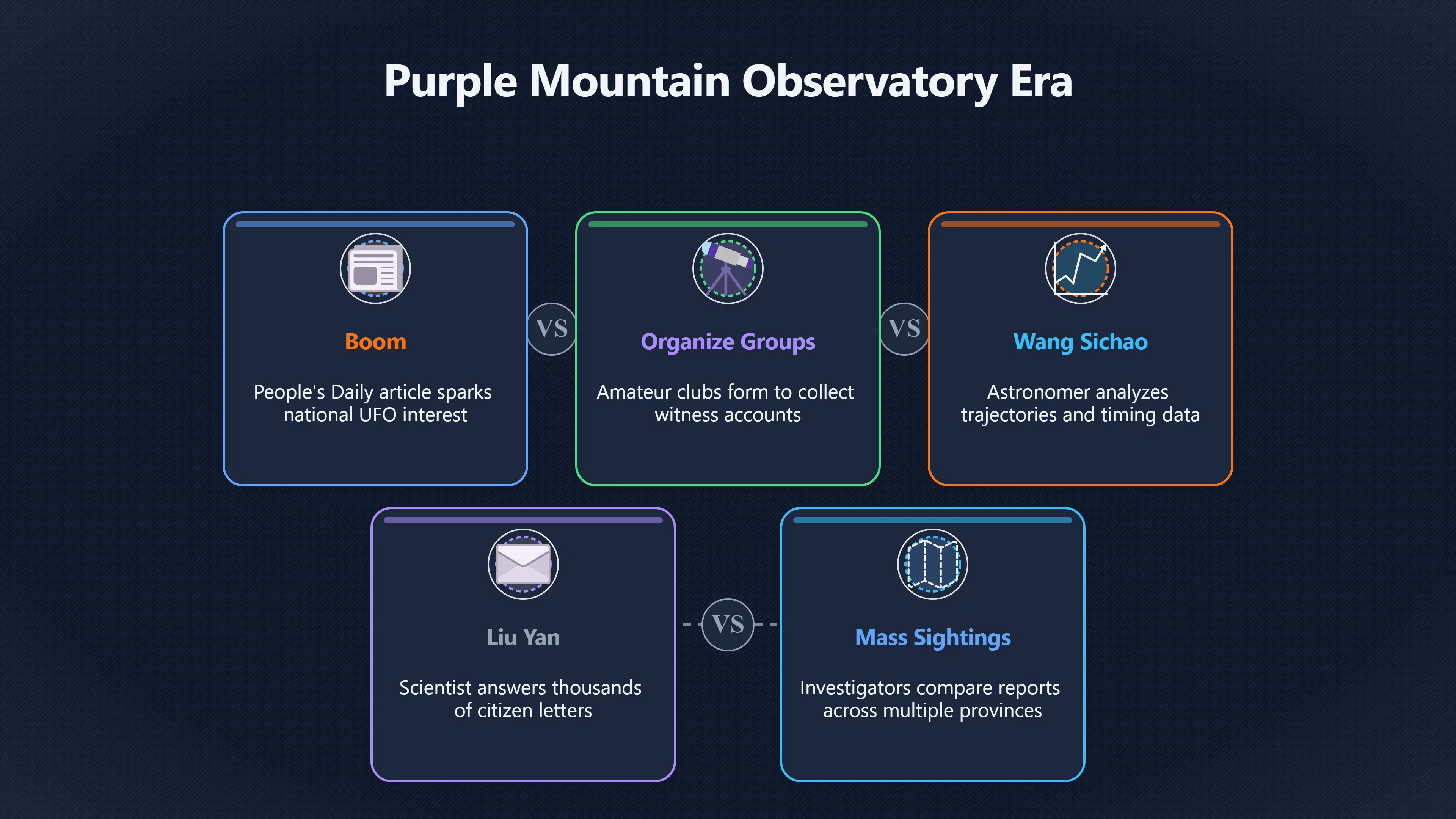
One major catalyst was a 1978 People’s Daily article discussing extraterrestrial life and unidentified aerial phenomena. Interest surged almost immediately. Student groups, amateur astronomy societies, and local enthusiast clubs appeared across the country. By the 1980s, China reportedly had dozens of UFO-related organisations, including the China UFO Research Association and numerous provincial societies. [#SixthTone]sixthtone.com#SixthToneThe Astronomer Who Calmed China's UFO Craze20 May 2023 — He signed the letter, as he always does, “Purple Mountain Observatory…
Unlike some Western UFO subcultures, many early Chinese groups tried to present themselves as scientific rather than mystical. Meetings often included lectures on astronomy, aerospace technology, meteor showers, and atmospheric optics. Reports were collected systematically, especially after large regional sightings. Members attempted to compare witness accounts across provinces to estimate altitude, direction, and duration.
At the same time, sensational media coverage encouraged dramatic interpretations. Public fascination sometimes outran the available evidence. Rumours of alien contact, crashed spacecraft, or secret military knowledge spread through magazines and local newspapers, especially during periods of major sightings in the 1980s and 1990s. This created pressure on professional scientists to respond publicly.
Purple Mountain Observatory became the movement’s scientific centre
No institution shaped Chinese UFO investigation more than the Purple Mountain Observatory. Founded in the 1930s and later operated by the Chinese Academy of Sciences, the observatory became a central point for evaluating reports from across China. [Wikipedia]WikipediaWang SichaoBetween 1963 and 1999, he was a researcher at the Purple Mountain Observatory in Nanjing. Wang researched asteroids, meteors, comets, and…
Wang Sichao and the case for structured investigation
The astronomer Wang Sichao became the country’s most recognisable UFO investigator. Trained as an astronomer and asteroid researcher, Wang argued that unidentified aerial phenomena deserved systematic analysis rather than dismissal. He spent decades studying reports while working at Purple Mountain Observatory. [2bjreview.com]bjreview.comTracking UFOsIn addition to studying the sightings, Wang, who started work on UFOs nearly 40 years ago, has to check and reply to mail ab…
Wang occupied an unusual middle ground. He did not openly endorse sensational alien-abduction narratives, but he also resisted the idea that every report had a simple explanation. He believed some mass sightings contained genuinely unexplained elements and argued that China’s cases were often more credible than heavily commercialised Western UFO stories. [China.org.cn]china.org.cnRomantic encounter with E.T1 Nov 2010 — Wang Sichao, a research fellow at the Chinese Academy of Sciences' Purple Mountain Observatory in Jiangsu's provincial capit…
His approach focused heavily on observational detail:
- comparing witness reports from multiple regions;
- checking astronomical conditions;
- analysing trajectories and timing;
- distinguishing high-altitude phenomena from low-altitude objects;
- considering rocket launches and atmospheric effects before extraordinary explanations.
Wang’s prominence gave Chinese UFO research an unusual degree of institutional legitimacy. In many countries, UFO groups existed largely outside mainstream science. In China, at least during the 1980s and 1990s, a respected state-affiliated astronomer publicly discussed the topic and answered citizen correspondence about sightings. [#SixthTone]sixthtone.com#SixthToneThe Astronomer Who Calmed China's UFO Craze20 May 2023 — He signed the letter, as he always does, “Purple Mountain Observatory…
Liu Yan and the sceptical correspondence tradition
Another important figure was Liu Yan, also associated with Purple Mountain Observatory. Liu became known less for promoting mysteries than for calming public excitement. During major sighting waves, the observatory received large volumes of letters from citizens reporting strange objects in the sky. Liu reportedly answered thousands of them over several decades. [#SixthTone]sixthtone.com#SixthToneThe Astronomer Who Calmed China's UFO Craze20 May 2023 — He signed the letter, as he always does, “Purple Mountain Observatory…
His method reflected a more cautious scientific culture:
- begin with ordinary explanations;
- avoid declaring cases extraterrestrial;
- treat poor evidence as unresolved rather than extraordinary;
- separate astronomy from paranormal belief systems.
Liu repeatedly warned that UFO culture could drift into pseudoscience if investigators abandoned rigorous standards. He criticised attempts to merge UFO claims with psychic powers, spiritual practices, or conspiracy mythology. [#SixthTone]sixthtone.com#SixthToneThe Astronomer Who Calmed China's UFO Craze20 May 2023 — He signed the letter, as he always does, “Purple Mountain Observatory…
This internal scepticism became one of the defining features of Chinese UFO research. Many investigators were not debunkers in the Western “nothing unusual ever occurs” sense. Instead, they argued that unidentified did not automatically mean alien, and that scientific uncertainty had to be preserved.
Why Chinese investigators focused on mass sightings
Chinese UFO investigators often concentrated on large-scale sightings visible across multiple provinces. This reflected both practical and political realities.
A single witness account was difficult to verify. But when thousands or millions of people observed the same phenomenon, investigators could compare timelines, directions, photographs, and regional reports. This gave astronomers more data than many classic close-encounter stories elsewhere.
Several famous Chinese cases reinforced this approach:
- the 1981 spiral-light event seen across western China;
- repeated reports of luminous formations near aerospace activity;
- airport-area sightings later linked to military or civilian air traffic;
- high-altitude atmospheric displays associated with rockets or satellites.
Researchers at Purple Mountain Observatory increasingly concluded that many dramatic “UFO” waves could be explained by aerospace technology viewed under unusual atmospheric conditions. [#SixthTone]sixthtone.com#SixthToneThe Astronomer Who Calmed China's UFO Craze20 May 2023 — He signed the letter, as he always does, “Purple Mountain Observatory…
This mattered because China’s rapidly expanding aerospace and missile programmes created an environment where unusual sky phenomena genuinely increased. Civilian observers often lacked information about launches, military exercises, or high-altitude tests, making misidentification more likely.
Where science split from paranormal culture
By the late 1980s and 1990s, Chinese UFO culture had become more fragmented. Some organisations still promoted observational research and astronomy education. Others moved toward paranormal speculation.
This divide mirrored broader debates inside China over “extraordinary human abilities”, qigong movements, and claims of psychic phenomena. UFO narratives sometimes became entangled with stories about alien contactees, spiritual powers, or cosmic prophecy. Scientists worried that serious investigation was being undermined by sensationalism.
Liu Yan and other sceptically minded astronomers pushed back strongly against this trend. They argued that:
- extraordinary claims required measurable evidence;
- witness sincerity did not guarantee factual accuracy;
- photographs were often unreliable;
- media exaggeration distorted public understanding;
- unresolved cases should remain unresolved rather than becoming mythology.
Their position resembled scientific scepticism more than outright denial. The goal was not to prove all sightings false, but to preserve methodological discipline.
This tension also affected public credibility. Enthusiast organisations that mixed astronomy with paranormal claims gradually lost standing among professional scientists. Meanwhile, purely sceptical voices gained influence as China’s scientific institutions became more cautious about fringe topics.
Chinese scepticism differed from Western debunking culture
China developed sceptical UFO investigators, but the tone often differed from the confrontational debunking style common in some Western countries.
Western sceptical organisations such as the Committee for Skeptical Inquiry typically approached UFO claims as examples of pseudoscience requiring aggressive criticism. Their investigators emphasised hoaxes, psychological errors, and media amplification. [Wikipedia]WikipediaPurple Mountain ObservatoryPurple Mountain Observatory
Chinese scepticism was often less ideological and more administrative or scientific in tone. Many Chinese investigators accepted that some sightings remained unexplained while still insisting on natural explanations wherever evidence allowed. The emphasis was frequently on social stability, scientific literacy, and preventing irrational speculation.
That difference became especially visible during periods of intense public excitement. Rather than ridicule witnesses, Chinese astronomers often acted as translators between public curiosity and institutional science. The Purple Mountain Observatory’s practice of answering letters and analysing reports reflected this educational role. [#SixthTone]sixthtone.com#SixthToneThe Astronomer Who Calmed China's UFO Craze20 May 2023 — He signed the letter, as he always does, “Purple Mountain Observatory…
The problem of credibility inside Chinese UFO organisations
China’s UFO groups faced a persistent credibility problem: the more attention they received, the harder it became to separate disciplined investigation from entertainment and folklore.
Several pressures contributed to this:
- local newspapers preferred sensational stories;
- television coverage rewarded dramatic claims;
- amateur investigators lacked access to military or aerospace data;
- photographs and videos were difficult to authenticate;
- online forums amplified rumours rapidly after the 2000s.
As a result, some investigators who originally approached UFOs as scientific anomalies became associated with fringe speculation. Even Wang Sichao, despite his professional astronomy background, drew criticism from sceptics who believed his public comments lent too much legitimacy to UFO culture. [Zhihu]zhihu.comZhihuHow should Professor Wang Sichao, a former researcher…He has unknowingly caused a lot of harm to many innocent children by spread…
At the same time, outright debunkers sometimes underestimated how rapidly China’s airspace environment was changing. Expanding drone use, aerospace testing, satellite launches, and military secrecy created genuine identification challenges. Many sightings were explainable, but not always immediately explainable.
That ambiguity helped keep UFO research alive even as mainstream science grew more cautious.

Why these investigators still matter in China’s UFO history
The most important contribution of China’s UFO investigators was not proving alien visitation. It was creating a public framework for discussing unexplained aerial events during a period of enormous technological and social change.
Figures such as Wang Sichao and Liu Yan helped establish several enduring patterns in Chinese UFO culture:
- treating sightings as observational problems rather than purely supernatural stories;
- using astronomy and trajectory analysis to evaluate reports;
- distinguishing unresolved cases from confirmed extraterrestrial claims;
- recognising the role of aerospace activity in modern sightings;
- resisting the merger of UFO study with broader paranormal belief systems.
Their work also revealed a deeper tension inside modern Chinese society. UFOs became a way to negotiate questions about science, secrecy, authority, and uncertainty. Citizens wanted explanations for strange events in the sky, but official information was often incomplete. Investigators occupied the uncomfortable space between public imagination and institutional caution.
That legacy remains visible today. Chinese discussions of UFOs still oscillate between scientific curiosity, nationalist speculation about advanced technology, internet-driven sensationalism, and sceptical attempts to impose evidential standards. The country’s early investigators shaped all of those currents, even when they disagreed sharply with one another.
Amazon book picks
Further Reading
Books and field guides related to Who Investigated China's UFO Reports?. Use these as the next step if you want deeper reading beyond the article.
The UFO Experience
Strong fit for discussions of investigators, astronomy, and scientific evaluation.
Passport to Magonia
Relevant to debates between scientific and cultural interpretations.
Endnotes
-
Source: sixthtone.com
Link: https://www.sixthtone.com/news/1012934Source snippet
#SixthToneThe Astronomer Who Calmed China's UFO Craze20 May 2023 — He signed the letter, as he always does, “Purple Mountain Observatory...
Published: May 2023
-
Source: Wikipedia
Title: Wang Sichao
Link: https://en.wikipedia.org/wiki/Wang_SichaoSource snippet
Between 1963 and 1999, he was a researcher at the Purple Mountain Observatory in Nanjing. Wang researched asteroids, meteors, comets, and...
-
Source: Wikipedia
Title: Purple Mountain Observatory
Link: https://en.wikipedia.org/wiki/Purple_Mountain_Observatory -
Source: bjreview.com
Link: https://www.bjreview.com/quotes/txt/2010-09/28/content_301050.htmSource snippet
Tracking UFOsIn addition to studying the sightings, Wang, who started work on UFOs nearly 40 years ago, has to check and reply to mail ab...
-
Source: china.org.cn
Title: Romantic encounter with E.T
Link: https://www.china.org.cn/china/2010-11/01/content_21246670.htmSource snippet
1 Nov 2010 — Wang Sichao, a research fellow at the Chinese Academy of Sciences' Purple Mountain Observatory in Jiangsu's provincial capit...
-
Source: Wikipedia
Title: Center for Inquiry
Link: https://en.wikipedia.org/wiki/Center_for_Inquiry -
Source: Wikipedia
Title: Committee for Skeptical Inquiry
Link: https://en.wikipedia.org/wiki/Committee_for_Skeptical_Inquiry -
Source: zhihu.com
Link: https://www.zhihu.com/en/answer/106866201Source snippet
ZhihuHow should Professor Wang Sichao, a former researcher...He has unknowingly caused a lot of harm to many innocent children by spread...
-
Source: zhihu.com
Link: https://www.zhihu.com/en/answer/2424090144Source snippet
etirement was astronomy. Overall, he has good scientific literacy...
-
Source: Wikipedia
Title: Robert Sheaffer
Link: https://en.wikipedia.org/wiki/Robert_SheafferSource snippet
Robert SheafferHe is a paranormal investigator of unidentified flying objects, having researched many sightings and written critiques...
-
Source: Wikipedia
Title: Barry Karr
Link: https://en.wikipedia.org/wiki/Barry_KarrSource snippet
Barry KarrHe has been consulted by the media on the paranormal. Karr has been involved in many investigations including faith healing...
Additional References
-
Source: english.cas.cn
Link: https://english.cas.cn/newsroom/archive/news_archive/nu2010/201502/t20150215_139920.shtml?_bhlid=bc28c02d21f88d45a8908d520e837d824dba30ddSource snippet
Chinese Academy of Sciences"Great Events" Concerning UFOs to Come out in ChinaIn addition to studying the sightings, Wang, who started wo...
-
Source: skepticalinquirer.org
Link: https://skepticalinquirer.org/pantheon-of-skeptics/Source snippet
Pantheon of SkepticsSome were already well established when CSICOP (the Committee for the Scientific Investigation of Claims of the Paran...
-
Source: captaincool07.medium.com
Title: chinese government encounters with paranormal activities c3dea3eb832e
Link: https://captaincool07.medium.com/chinese-government-encounters-with-paranormal-activities-c3dea3eb832eSource snippet
paranormal research — despite skepticism and ridicule from many colleagues.... China UFO Research Association. He visited Kaifeng to stu...
-
Source: youtube.com
Title: ‘Could that be a UFO?’ Mysterious light appears moving across night sky in China
Link: https://www.youtube.com/watch?v=nlSOfeL16IUSource snippet
China UFO research Purple Mountain Observatory Chinese Gov't Astronomer: UFOs Over China Are "Alien Spacecraft" (Purple Mountain Observat...
-
Source: lenr-canr.org
Link: https://www.lenr-canr.org/acrobat/MalloveEcsicopscie.pdfSource snippet
CSICOP: “Science Cops” at War with Cold FusionCSICOP's purpose is succinctly stat- ed on Skeptical Inquirer's cover: “The...
-
Source: reddit.com
Link: https://www.reddit.com/r/UFOs/comments/4mxpzu/what_happened_to_chinese_astronomer_and_ufologist/Source snippet
esearch, and he's still responding to Chinese press inquiries.Read more...
-
Source: reddit.com
Title: the astronomer who calmed chinas ufo craze
Link: https://www.reddit.com/r/UFOs/comments/13rvbo3/the_astronomer_who_calmed_chinas_ufo_craze/Source snippet
The Astronomer Who Calmed China's UFO Craze25 May 2023 — The Astronomer Who Calmed China's UFO Craze. Article · r/UFOs - The Astronomer W...
Published: May 2023
-
Source: centerforinquiry.org
Title: preliminary report investigating in china
Link: https://centerforinquiry.org/blog/preliminary_report_investigating_in_china/Source snippet
Paranormal Investigation (2007). Joe Nickell investigates historical, paranormal, and forensic mysteries, myths and hoaxes and writes abo...
-
Source: youtube.com
Link: https://www.youtube.com/watch?v=aidShZd-iXUSource snippet
UFO Filmed Hovering Near Solar Eclipse In China- Purple Mountain...
-
Source: youtube.com
Title: Did Chinese Researchers Pick Up Signals From Alien Civilizations?
Link: https://www.youtube.com/watch?v=-6YhAADM1YESource snippet
Chinese Gov't Astronomer: UFOs Over China Are "Alien Spacecraft" (Purple Mountain Observatory)...
Topic Tree