Within FranceUFOs
Inside GEIPAN: France's UFO Investigation Process
Learn how France's GEIPAN systematically collects, analyses, and classifies UAP reports.
On this page
- Organizational Structure and Partnerships
- Data Collection and Witness Reporting
- Classification Criteria and Methodology
Page outline Jump by section
Introduction
France’s GEIPAN system is unusual because it treats unidentified aerospace phenomena as an administrative and analytical problem rather than a purely military secret or a fringe curiosity. Operating inside the French space agency CNES, GEIPAN gathers reports from the public, police, pilots and local authorities, then subjects them to a structured investigative process designed to separate explainable sightings from unresolved cases. Its importance lies less in dramatic conclusions than in methodology: standardised witness collection, multi-agency cooperation, case reconstruction, scientific consultation, and a transparent classification framework that is publicly archived online. [cnes-geipan.fr]cnes-geipan.frns; Around 20 volunteer investigators, selected…Read more… [cnes-geipan.fr]cnes-geipan.frational service based on investigations related…Read more…
 The French approach also tries to avoid a common problem in UFO debates: treating every unexplained report as evidence of something extraordinary. GEIPAN instead evaluates reports according to data quality and “residual strangeness” after ordinary explanations have been tested. Most reports are ultimately explained or judged too weak for firm conclusions, while only a small minority remain unidentified after investigation. [cnes-geipan.fr]cnes-geipan.frHow does GEIPAN classify observation cases?Strangeness (E): This is the measure of the residual strangeness after comparison with known p… [cnes-geipan.fr]cnes-geipan.frClassificationStrangeness (E): This is the measure of the residual strangeness after comparison with known phenomena hypotheses. Consiste…
Why GEIPAN Was Built as a Civilian Investigation System
GEIPAN inherited a framework first created in 1977 under the earlier GEPAN programme. From the beginning, the French system was organised inside CNES rather than as a purely military intelligence project. That institutional choice shaped the methodology that still exists today: investigations are expected to be documented, archived, technically reviewed and eventually released to the public in anonymised form. [CNES]cnes.frCNESGEIPAN7 Jul 2025 — GEIPAN, the French UAP research and information group created by CNES in 1977, collects, analyses and archives inf…
The office’s official mission is threefold:
- collect reports of unidentified aerospace phenomena; [cnes-geipan.fr]cnes-geipan.frational service based on investigations related…Read more…
- analyse them using available scientific and technical knowledge;
- inform the public through publication and archiving. [cnes-geipan.fr]cnes-geipan.frOpen source on cnes-geipan.fr.
This structure creates a hybrid system somewhere between a scientific observatory, a public reporting office and an investigative clearinghouse. Witnesses are not simply logging sightings into a database. Their reports can trigger interviews, site visits, astronomical checks, aviation analysis, weather reconstruction and consultation with external specialists.
France also deliberately adopted the term “UAP” or “PAN” rather than “UFO”. The terminology matters because the framework is designed to avoid prematurely assuming that witnesses observed a solid craft. A report may involve lights, atmospheric effects, optical misperception, re-entry debris, astronomical bodies or aircraft activity. [cnes-geipan.fr]cnes-geipan.frOpen source on cnes-geipan.fr.
How Reports Enter the GEIPAN Pipeline
Witness Reporting and Initial Intake
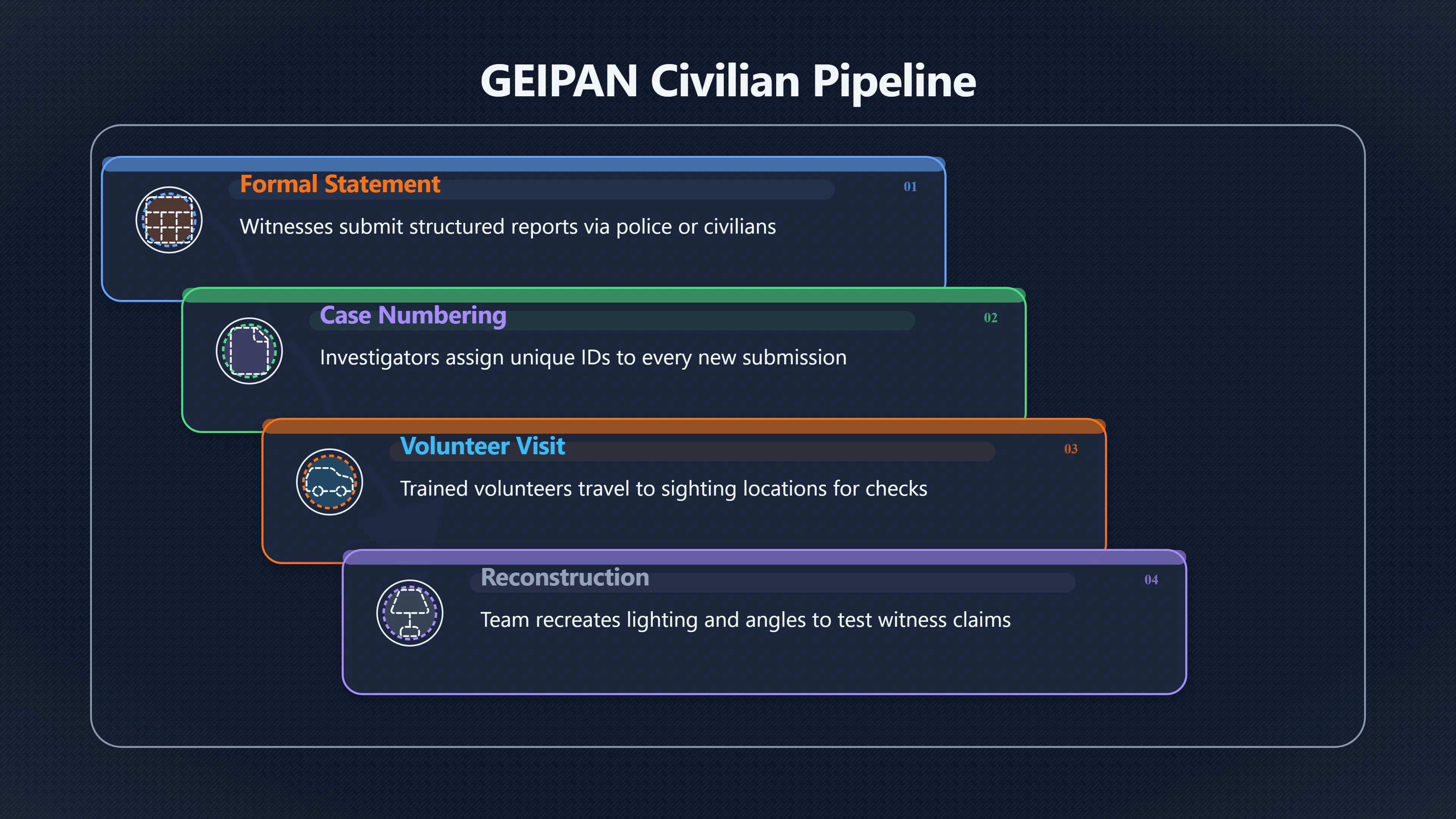
The reporting process begins with a formal witness statement. GEIPAN accepts submissions from civilians, but many reports also arrive through the French gendarmerie or police network. This partnership is central to the system because it gives investigators access to official statements, timelines and local verification procedures. [cnes-geipan.fr]cnes-geipan.frns; Around 20 volunteer investigators, selected…Read more…
Once a report is submitted, GEIPAN assigns a case number and records it in its investigation database. The witness receives confirmation that the testimony has been formally registered. Processing time varies depending on complexity and workload. [geipan.fr]geipan.freen processed and officially recorded in our investigation database.Read more…
The reporting forms themselves are designed to extract structured information rather than encourage speculation. Witnesses are asked about:
- date and time;
- viewing direction;
- weather conditions;
- duration;
- apparent movement;
- sound;
- number of observers;
- emotional reactions;
- photographs or physical traces;
- nearby aviation or industrial activity.
The emphasis on chronology and environmental context reflects a core GEIPAN principle: anomalous experiences are easier to analyse when separated into measurable components.
Local Investigation and Reconstruction
GEIPAN maintains a network of trained volunteer investigators distributed across France. According to CNES, these investigators can travel to sighting locations, interview witnesses and organise reconstructions of events. [cnes-geipan.fr]cnes-geipan.frational service based on investigations related…Read more…
This reconstruction stage is one of the most distinctive parts of the French methodology. Investigators may attempt to reproduce:
- witness viewing angles;
- lighting conditions;
- estimated object trajectories;
- distances and elevations;
- atmospheric visibility at the reported time.
Rather than treating testimony as fixed evidence, the process tests whether the reported perception changes when environmental conditions are recreated. Many cases reportedly become less mysterious once investigators compare witness descriptions against astronomical objects, aircraft approach paths or atmospheric effects visible from the same position.
The reconstruction process also helps investigators detect inconsistencies between multiple witnesses. A dramatic narrative may weaken if observers actually viewed the event from very different angles or if timings conflict.
The Multi-Agency Network Behind GEIPAN
GEIPAN is small, but it operates through a much wider institutional network. CNES identifies partnerships with:
- the gendarmerie; [gendarmerie.interieur.gouv.fr]gendarmerie.interieur.gouv.frdes gendarmes face aux phenomenes aerospatiaux non identifiesDes gendarmes face aux phénomènes aérospatiaux non…18 Apr 2018 — Le Geipan rend compte à un Comité de pilotage formé des Institutions…
- national police;
- the French Air and Space Force;
- civil aviation authorities;
- Météo-France;
- CNRS scientific researchers. [CNES]cnes.frCNESGEIPAN7 Jul 2025 — GEIPAN, the French UAP research and information group created by CNES in 1977, collects, analyses and archives inf…
This network matters because most UFO reports require cross-checking against ordinary aerospace activity. Investigators may compare witness accounts with:
- air traffic records;
- satellite passes;
- rocket re-entries;
- meteorological events;
- astronomical data;
- military exercises.
The methodology therefore assumes that unidentified reports should first be tested against known systems before being treated as anomalies.
GEIPAN also consults outside specialists. CNES states that around fifteen scientific experts may be called upon in fields including meteorology, photography, psychology and plasma-related phenomena. [cnes-geipan.fr]cnes-geipan.frHow does GEIPAN classify observation cases?Strangeness (E): This is the measure of the residual strangeness after comparison with known p…
The inclusion of psychology experts is particularly important. The French framework does not treat witnesses as dishonest by default, but it recognises that perception, memory distortion, expectation and stress can shape testimony. This is a major methodological difference from many popular UFO narratives, which often assume sincerity automatically equals accuracy.
How GEIPAN Evaluates Evidence
The Two Core Variables: Consistency and Strangeness
GEIPAN’s classification system rests on two analytical variables:
- consistency; [cnes-geipan.fr]cnes-geipan.frHow does GEIPAN classify observation cases?Strangeness (E): This is the measure of the residual strangeness after comparison with known p…
- residual strangeness. [cnes-geipan.fr]cnes-geipan.frClassificationStrangeness (E): This is the measure of the residual strangeness after comparison with known phenomena hypotheses. Consiste… [cnes-geipan.fr]cnes-geipan.frOpen source on cnes-geipan.fr.
Consistency refers to the quantity and reliability of evidence gathered during the investigation. GEIPAN says this includes weighting the objectivity of available information according to a structured assessment table. [cnes-geipan.fr]cnes-geipan.frOpen source on cnes-geipan.fr.
A case gains consistency when it includes factors such as:
- multiple independent witnesses; [uapedia.ai]uapedia.aiD2: very strange, strong consistency (e.g., multiple independent witnessesUAPedia - Unlocking New RealitiesGEIPAN: France's Official UAP UnitOctober 29, 2025 — D1: “strange,” medium consistency (e.g., single cre…
- radar or sensor correlation;
- photographs with verifiable metadata;
- physical traces;
- precise timelines;
- corroborating environmental records.
A vague single-witness account with uncertain timing is therefore considered weak even if the story sounds dramatic.
Residual strangeness measures how unusual the event remains after conventional explanations have been tested. This is a critical distinction. GEIPAN does not classify a case as mysterious simply because witnesses found it emotionally shocking. The question is whether the anomaly survives comparison with known phenomena.
This approach attempts to separate psychological impact from analytical anomaly.
The A-B-C-D Classification System
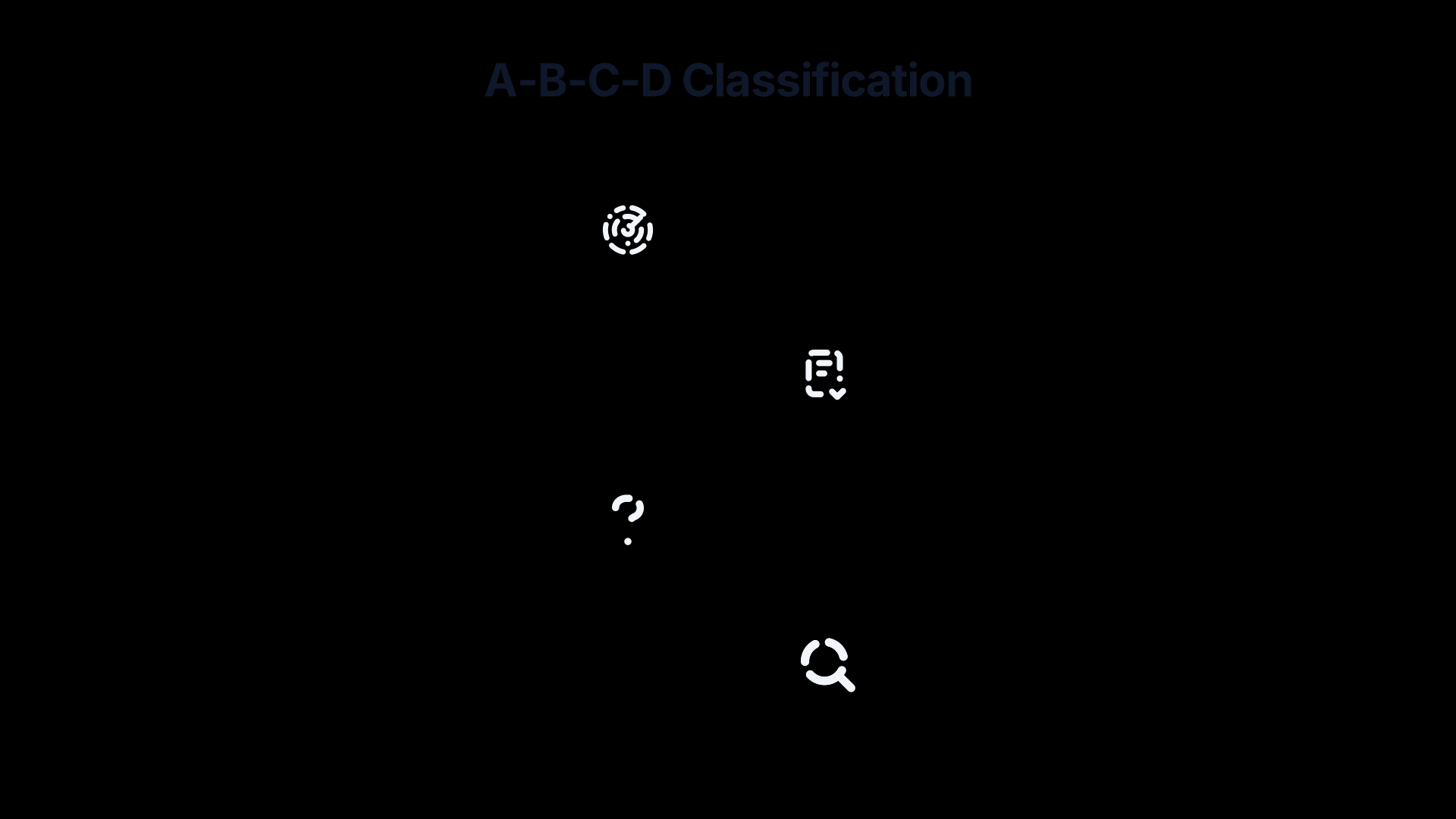
After investigation, cases are assigned to one of four categories:
- A: clearly identified;
- B: probably identified;
- C: insufficient information;
- D: unidentified after investigation. [cnes-geipan.fr]cnes-geipan.frOpen source on cnes-geipan.fr. [cnes-geipan.fr]cnes-geipan.frOpen source on cnes-geipan.fr.
The distinction between C and D is one of the most misunderstood parts of the French system.
A Category C case is not especially mysterious. It usually means the evidence is too poor to investigate properly: missing dates, weak testimony, lack of corroboration or late reporting.
A Category D case is different. It means investigators gathered substantial information yet could not reach a conventional explanation within the available evidence.
This distinction is methodologically important because public UFO discussions often treat all “unexplained” reports as equal. GEIPAN explicitly does not.
Some later discussions of the system refer to informal D1 and D2 subcategories, distinguishing between moderately strange and highly strange unresolved cases with stronger evidential consistency. These distinctions appear in analytical commentary around GEIPAN’s framework, though the main official public structure remains the A-B-C-D model. [UAPedia]uapedia.aiD2: very strange, strong consistency (e.g., multiple independent witnessesUAPedia - Unlocking New RealitiesGEIPAN: France's Official UAP UnitOctober 29, 2025 — D1: “strange,” medium consistency (e.g., single cre… - Unlocking New Realities
Why Most Cases Become Ordinary Explanations
One of the defining characteristics of the French system is that most reports eventually receive conventional explanations. Current GEIPAN statistics indicate that only a small percentage remain unresolved after investigation. [CNES]WikipediaOpen source on wikipedia.org.
This outcome is not accidental. The methodology is deliberately designed to eliminate common sources of misidentification through layered comparison.
Typical explanations include:
- Venus and bright planets;
- aircraft landing lights;
- satellites and Starlink trains;
- rocket debris;
- atmospheric re-entries;
- lanterns;
- meteors;
- drones;
- optical illusions caused by perspective and darkness.
The famous nationwide sightings of November 1990 illustrate the process. Thousands of French witnesses reported a giant silent craft crossing the country. Later analysis strongly linked the event to the atmospheric re-entry of a Soviet rocket stage. The case became an example of how mass witness agreement can still emerge around a conventional aerospace event.
GEIPAN’s methodology therefore places strong emphasis on environmental reconstruction and external data correlation rather than witness certainty alone.
Publication, Transparency and Anonymisation
Public Archives as Part of the Method
A major part of GEIPAN’s framework is publication. Since 2007, CNES has progressively released thousands of archived reports online. [Wikipedia]WikipediaGroupe d'études des phénomènes aérospatiaux non identifiésGroupe d'études des phénomènes aérospatiaux non identifiés
This archive serves several methodological purposes:
- independent review by researchers;
- institutional transparency;
- long-term statistical comparison;
- preservation of historical records.
Files are anonymised before publication. Witness names and identifying details are removed, but investigation summaries, maps, sketches and analytical conclusions are often retained. [cnes-geipan.fr]cnes-geipan.frOpen source on cnes-geipan.fr.
The publication system creates an unusual degree of openness compared with many national UAP programmes. Researchers can examine how classifications were reached instead of relying solely on official statements.
Why Transparency Also Creates Criticism
Transparency has made GEIPAN influential, but it has also exposed the office to criticism from multiple directions.
Sceptics argue that some cases classified as unidentified rely too heavily on witness testimony or insufficient elimination of mundane explanations. Some French critics have claimed that earlier phases of the programme occasionally treated weak cases too generously. [Wikipedia]WikipediaOpen source on wikipedia.org.
UFO proponents often criticise the opposite tendency, arguing that GEIPAN over-favours conventional explanations and closes cases too conservatively.
This tension is built into the methodology itself. GEIPAN attempts to operate between two pressures:
- avoiding sensational conclusions unsupported by evidence;
- avoiding premature dismissal of anomalous reports.
The office’s continued use of probabilistic categories such as “probably identified” reflects that balancing act.
Scientific Ambitions and Their Limits
GEIPAN frequently presents itself as a scientific and technical investigation body rather than a belief-oriented UFO office. Conferences such as the CAIPAN meetings in Toulouse have brought together investigators, engineers, pilots and researchers to discuss investigative techniques and data analysis methods. [france-science.com]france-science.comCAIPA N II International Conference on UnidentifiedCAIPAN II International Conference on Unidentified…October 14, 2022 — 14 Oct 2022 — The CAIPAN II international conference in Toulouse…
Yet the framework also faces structural limitations.
Most sightings are reported after the event, often with incomplete data. Unlike a laboratory science, investigators cannot usually reproduce the phenomenon itself. GEIPAN therefore operates more like accident investigation or forensic reconstruction than experimental physics.
This limitation explains why the French methodology prioritises:
- witness reliability;
- environmental reconstruction;
- elimination of alternatives;
- evidence weighting;
- statistical categorisation.
The system is ultimately designed less to “prove aliens” than to manage uncertainty systematically.
What Makes the GEIPAN Framework Distinctive
Several characteristics make the French approach different from many other national UFO efforts.
A Civilian Rather Than Purely Military Structure
Because GEIPAN sits inside CNES, it emphasises public documentation and technical analysis more than intelligence secrecy. Military institutions still participate, but they do not dominate the process. [CNES]WikipediaOpen source on wikipedia.org.
Standardised Classification
The A-B-C-D framework gives France a relatively consistent way to compare cases across decades. Even critics generally acknowledge that the classification structure is clearer than many ad hoc UFO databases elsewhere.
Integration With National Institutions
The use of police, gendarmerie, meteorological agencies and aviation data gives investigators access to information that private civilian UFO groups often lack.
Openness About Uncertainty
Perhaps the most important feature is methodological restraint. GEIPAN openly acknowledges that some cases remain unresolved while also insisting that unresolved does not mean extraterrestrial.
That position frustrates believers hoping for confirmation and sceptics wanting total dismissal, but it is central to how the French system defines itself.
Amazon book picks
Further Reading
Books and field guides related to Inside GEIPAN France's UFO Investigation Process. Use these as the next step if you want deeper reading beyond the article.
Passport to Magonia: from Folklore to Flying Saucers
Provides intellectual background to many European UFO discussions.
Endnotes
-
Source: cnes-geipan.fr
Link: https://www.cnes-geipan.fr/en/missions-methodes-et-resultatsSource snippet
ns; Around 20 volunteer investigators, selected...Read more...
-
Source: cnes-geipan.fr
Link: https://www.cnes-geipan.fr/en/node/58792Source snippet
ational service based on investigations related...Read more...
-
Source: cnes.fr
Link: https://cnes.fr/en/projects/geipanSource snippet
CNESGEIPAN7 Jul 2025 — GEIPAN, the French UAP research and information group created by CNES in 1977, collects, analyses and archives inf...
-
Source: cnes-geipan.fr
Link: https://www.cnes-geipan.fr/en/node/412Source snippet
How does GEIPAN classify observation cases?Strangeness (E): This is the measure of the residual strangeness after comparison with known p...
-
Source: cnes-geipan.fr
Link: https://www.cnes-geipan.fr/en/node/58787Source snippet
ClassificationStrangeness (E): This is the measure of the residual strangeness after comparison with known phenomena hypotheses. Consiste...
-
Source: Wikipedia
Title: Groupe d’études des phénomènes aérospatiaux non identifiés
Link: https://fr.wikipedia.org/wiki/Groupe_d%27%C3%A9tudes_des_ph%C3%A9nom%C3%A8nes_a%C3%A9rospatiaux_non_identifi%C3%A9s -
Source: Wikipedia
Link: https://en.wikipedia.org/wiki/GEIPAN -
Source: geipan.fr
Link: https://geipan.fr/en/node/414Source snippet
een processed and officially recorded in our investigation database.Read more...
-
Source: cnes-geipan.fr
Link: https://www.cnes-geipan.fr/en/node/58788 -
Source: uapedia.ai
Title: D2: very strange, strong consistency (e.g., multiple independent witnesses
Link: https://uapedia.ai/wiki/geipan-frances-official-uap-unit/Source snippet
UAPedia - Unlocking New RealitiesGEIPAN: France's Official UAP UnitOctober 29, 2025 — D1: “strange,” medium consistency (e.g., single cre...
Published: October 29, 2025
-
Source: Wikipedia
Title: Objet volant non identifié
Link: https://fr.wikipedia.org/wiki/Objet_volant_non_identifi%C3%A9 -
Source: Wikipedia
Link: https://en.wikipedia.org/wiki/CNES -
Source: france-science.com
Title: CAIPA N II International Conference on Unidentified
Link: https://france-science.com/en/caipan-ii-international-conference-on-unidentified-aerospace-phenomena-organized-by-geipan-in-toulouse/Source snippet
CAIPAN II International Conference on Unidentified...October 14, 2022 — 14 Oct 2022 — The CAIPAN II international conference in Toulouse...
Published: October 14, 2022
-
Source: cnes-geipan.fr
Link: https://www.cnes-geipan.fr/en/faq-page -
Source: youtube.com
Title: Meeting France’s UFO detectives • FRANCE 24 English
Link: https://www.youtube.com/watch?v=zczcBLukQ6sSource snippet
Geipan: France is also interested in UFOs...
-
Source: youtube.com
Title: Geipan: France is also interested in UFOs
Link: https://www.youtube.com/watch?v=OLXDikL331Y -
Source: newspaceeconomy.ca
Title: GEIPA N: Frances UAP Investigation Unit
Link: https://newspaceeconomy.ca/2025/07/29/geipan-frances-uap-investigation-unit/Source snippet
These are studied, cross‑checked and sometimes followed by field visits from volunteer...Read more...
Additional References
-
Source: facebook.com
Link: https://www.facebook.com/groups/southwestfrance/posts/1342464920438589/Source snippet
France has an official **UFO office** (GEIPAN) inside the...GEIPAN publishes data on UFO sightings in France, including witness testimon...
-
Source: assets.publishing.service.gov.uk
Title: publishing.service.gov.uk Forensic Science Regulator Guidance1.1.1
Link: https://assets.publishing.service.gov.uk/media/5ea6fa0586650c0314ac74f0/Statement_and_Report_Guidance_Appendix_Issue_4.pdfSource snippet
This guidance sets out the legal requirements for expert reports and requirements imposed by certain prosecuting authorities. It also pro...
-
Source: gendarmerie.interieur.gouv.fr
Title: des gendarmes face aux phenomenes aerospatiaux non identifies
Link: https://www.gendarmerie.interieur.gouv.fr/gendinfo/terrain/immersion/2018/des-gendarmes-face-aux-phenomenes-aerospatiaux-non-identifiesSource snippet
Des gendarmes face aux phénomènes aérospatiaux non...18 Apr 2018 — Le Geipan rend compte à un Comité de pilotage formé des Institutions...
-
Source: arxiv.org
Link: https://arxiv.org/html/2502.06794v2Source snippet
"aux non identifiés., [https://cnes-geipan.fr/..."](https://cnes-geipan.fr/...")...
-
Source: youtube.com
Link: https://www.youtube.com/watch?v=hn2xTieploUSource snippet
Meeting France's UFO detectives • FRANCE 24 English...
-
Source: youtube.com
Title: Presentation of GEIPAN, the Official UAP Study Group in France
Link: https://www.youtube.com/watch?v=eze1ikq-sMQSource snippet
Ancient Aliens: 300+ "Flying Saucer" Incidents in France (Season 19) | History...
-
Source: cps.gov.uk
Title: expert evidence
Link: https://www.cps.gov.uk/prosecution-guidance/expert-evidenceSource snippet
20 Nov 2023 — Section 30 of the Criminal Justice Act 1988 states that an expert's report is admissible as evidence of fact and opinion, w...
-
Source: 3af.fr
Title: Work progress
Link: https://www.3af.fr/docs/1432sigma2_progress_report_2015_summary.pdfSource snippet
summary 2015 Technical Commission...A methodology has been established to provide a systematic classification with an... These contacts...
-
Source: youtube.com
Title: Ancient Aliens: 300+ “Flying Saucer” Incidents in France (Season 19) | History
Link: https://www.youtube.com/watch?v=dcMrAX4zRwo
Topic Tree