Within Angola UFOs
Why Are Angola UFO Reports So Scarce?
The sparse record likely reflects reporting pathways, language, conflict, and archival survival more than the true number of sightings.
On this page
- Reporting culture and database bias
- Conflict, language, and archival survival
- Luanda, Lunda, and visibility gaps
Page outline Jump by section
Introduction
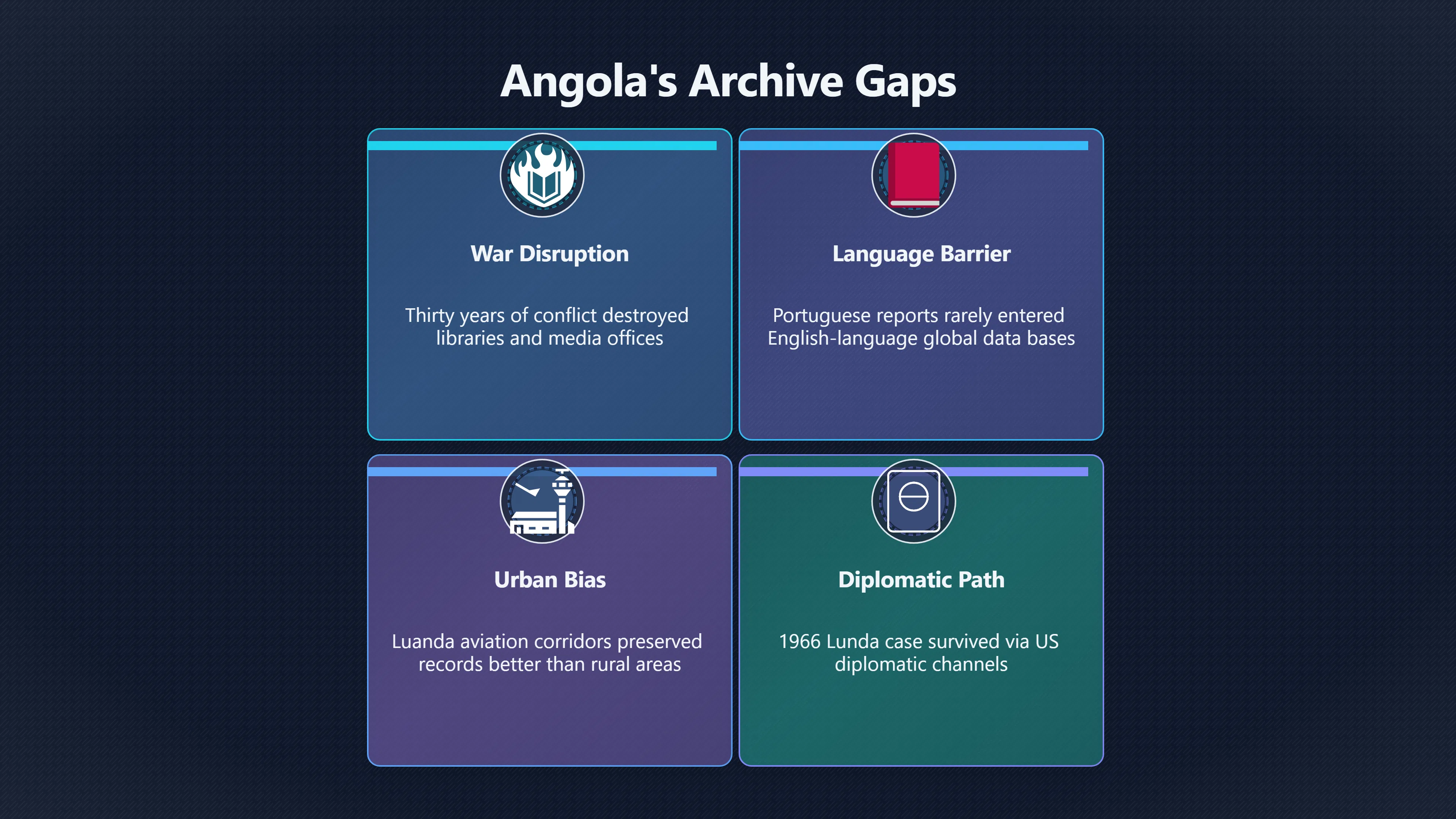
Angola’s UFO record is remarkably thin compared with countries that developed large civilian UFO organisations, active aviation archives, or long-running tabloid reporting cultures. That scarcity does not necessarily mean unusual aerial sightings never occurred. In Angola, the public record was shaped by colonial administration, decades of war, limited media infrastructure, language barriers, and fragile archival survival. The result is a country where isolated reports occasionally surfaced — such as the 1966 Lunda aviation sighting — but few were systematically preserved, translated, or incorporated into international UFO databases.
 The important distinction is between a lack of sightings and a lack of visible surviving reports. In Angola’s case, the evidence strongly favours the second explanation. Much of the country’s twentieth-century history disrupted the very institutions that normally generate UFO archives: newspapers, local radio, civilian aviation reporting systems, universities, enthusiast groups, and regional libraries. [Conciliation Resources]c-r.orgrole media during conflict and construction democracyConciliation ResourcesThe role of the media during the conflict and in…15 Oct 2004 — The Angolan media is currently facing the enormou… [2UN Trade and Development (UNCTAD]unctad.orgUN Trade and Development (UNCTAD)Mapping the cultural and creative industries in AngolaAngola experienced an intense civil war, which las…
Reporting Culture and Database Bias
Angola never developed a large civilian UFO network
Many countries with extensive UFO catalogues built them through enthusiasts rather than governments. Brazil, France, Britain, and the United States all developed overlapping ecosystems of local investigators, hobbyist magazines, regional archives, amateur astronomy clubs, and journalists who collected stories from witnesses over decades.
Angola largely lacked that infrastructure. During both the late Portuguese colonial era and the post-independence civil war period, public communication systems were heavily centralised or politically constrained. Media institutions were frequently tied to state priorities, ideological conflict, or wartime information control rather than civilian anomaly reporting. [Conciliation Resources]c-r.orgrole media during conflict and construction democracyConciliation ResourcesThe role of the media during the conflict and in…15 Oct 2004 — The Angolan media is currently facing the enormou… Wikipedia That matters because UFO history is often an archival by-product of ordinary civic activity. A sighting becomes [Wikipedia]WikipediaAngolan Civil WarThe Angolan Civil War (Portuguese: Guerra Civil Angolana) was a civil war in Angola, beginning in 1975 and continuing, with interludes, u…“part of the record” only if somebody interviews witnesses, stores notes, republishes the case, or preserves the files. In Angola, many of those intermediate steps either never existed or were repeatedly interrupted.
The contrast becomes clearer when examining the 1966 Lunda case. The report survived largely because it passed through diplomatic and aviation channels connected to Portuguese colonial administration and United States archival systems. Without that bureaucratic pathway, it might have disappeared entirely.
International UFO databases favour English and major Western archives
Another mechanism behind Angola’s sparse visibility is database bias. Most widely cited UFO catalogues were built from English-language newspapers, North American research groups, Cold War military archives, and European press networks. Portuguese-language African material was much less likely to be indexed internationally.
This creates a filtering effect:
- Reports published only in Angolan or Portuguese colonial newspapers often never entered global UFO catalogues.
- Regional African radio stories were rarely archived internationally.
- Oral accounts without printed documentation disappeared quickly.
- Later online UFO communities tended to recycle already digitised Western cases rather than search African archives.
The imbalance is not unique to Angola. Historians of colonial archives have repeatedly noted that entire categories of local experience become effectively invisible when preservation systems depend on metropolitan institutions and selective indexing practices. [arXiv]arxiv.orgarXiv Unsilencing Colonial Archives via Automated Entity RecognitionarXivUnsilencing Colonial Archives via Automated Entity RecognitionOctober 3, 2022…
In practical terms, Angola’s UFO silence is partly an information-survival problem.
Conflict, Language, and Archival Survival
Nearly three decades of civil war disrupted record keeping
Angola’s modern history was dominated by war. After the anti-colonial conflict against Portugal, the country entered a civil war that lasted from 1975 until 2002. [2UN Trade and Development (UNCTAD]unctad.orgUN Trade and Development (UNCTAD)Mapping the cultural and creative industries in AngolaAngola experienced an intense civil war, which las…
Long conflicts damage exactly the kinds of systems that preserve unusual civilian reports:
- provincial newspapers close or lose archives;
- libraries deteriorate;
- transportation and telecommunications collapse;
- local police and aviation offices stop maintaining accessible records;
- journalists prioritise violence, displacement, and survival over anomaly reporting.
Research on Angola’s media history describes a heavily constrained and conflict-shaped information environment in which journalism became tied to ideological struggle and wartime priorities. [Conciliation Resources]c-r.orgrole media during conflict and construction democracyConciliation ResourcesThe role of the media during the conflict and in…15 Oct 2004 — The Angolan media is currently facing the enormou…
In that context, even genuine unexplained sightings would struggle to become durable public records.
The timing is important. The peak decades of global UFO culture — roughly the 1950s through the 1980s — overlapped almost exactly with Angola’s transition from colonial rule into prolonged warfare. Countries that produced large UFO archives during those years often had expanding middle-class media systems, commercial magazines, hobby clubs, and relatively stable civilian institutions. Angola instead faced infrastructure collapse, mass displacement, and fragmented territorial control. Oxford University Research Archive [ReliefWeb]reliefweb.intangola idp rehabilitation held back devastated infrastructureAngola: IDP rehabilitation held back by devastated…4 Oct 2005 — Since April 2002, close to four million internally displaced Angolans…
Colonial and post-colonial archives were fragmented
Even before independence, Angola’s administrative records were partly externalised into Portuguese colonial systems. Some surviving colonial-era documents connected to Angola now reside in Portuguese archival institutions rather than within Angola itself. [Wikipedia]WikipediaAngolan Civil WarThe Angolan Civil War (Portuguese: Guerra Civil Angolana) was a civil war in Angola, beginning in 1975 and continuing, with interludes, u…
That produces another visibility gap. Researchers searching only Angolan archives may miss material stored abroad, while international UFO researchers often never search Portuguese colonial repositories in the first place.
The problem deepened after independence. Cultural and research institutions experienced disruption, closure, restructuring, and war-related losses. Studies of Angolan heritage institutions describe severe damage to museums, archives, and cultural infrastructure during years of instability. [UNESCO Digital Library]unesdoc.unesco.orgDigital Library Angola's National Museum during the civil warcultural destruction during times of civil disturbance or war is commercially driven…. Culture, Media and Sports. This role is fundame… [ICCROM]iccrom.orgiccrom ics06 culturalheritagepostwar en 0 0Cultural Heritage in Postwar RecoveryCultural Heritage in Postwar Recovery. Papers from the ICCROM FORUM held on October 4-6, 2005, edite… A UFO report preserved in a fragile regional newspaper or police file during the 1970s or 1980s therefore had low odds of surviving into thedigital era.

Portuguese-language material remained under-circulated
Language also matters more than many readers realise. Angola’s formal administrative and media language remained Portuguese, while many international UFO researchers worked primarily in English, French, or Spanish.
That mismatch had several consequences:
- local reports were less likely to be translated;
- English-language UFO books rarely cited Angolan newspapers;
- digitisation efforts concentrated elsewhere;
- searchability remained poor even after the internet era began.
As a result, Angola entered global UFO culture mostly through occasional recycled references rather than through a large searchable corpus of local cases.
Luanda, Lunda, and Visibility Gaps
Reports cluster around aviation and urban centres
The small number of surviving Angolan UFO references tend to appear in predictable locations:
- Luanda, the capital and primary media hub;
- aviation corridors;
- mineral or frontier regions such as Lunda;
- areas connected to foreign personnel or infrastructure.
This pattern says more about observation visibility than about where unusual phenomena allegedly occurred.
Aviation-linked sightings survive more often because pilots, towers, and diplomatic offices generate paperwork. Urban centres survive more often because newspapers operate there. Remote sightings disappear more easily because there are fewer institutional witnesses and fewer surviving archives.
The famous 1966 case fits this pattern almost perfectly. It involved an airline crew, an air traffic control chain, colonial administration, and international diplomatic reporting. Those institutional layers gave the event archival durability even though investigators later declined to treat it as proof of unidentified craft.
Rural Angola was historically under-documented
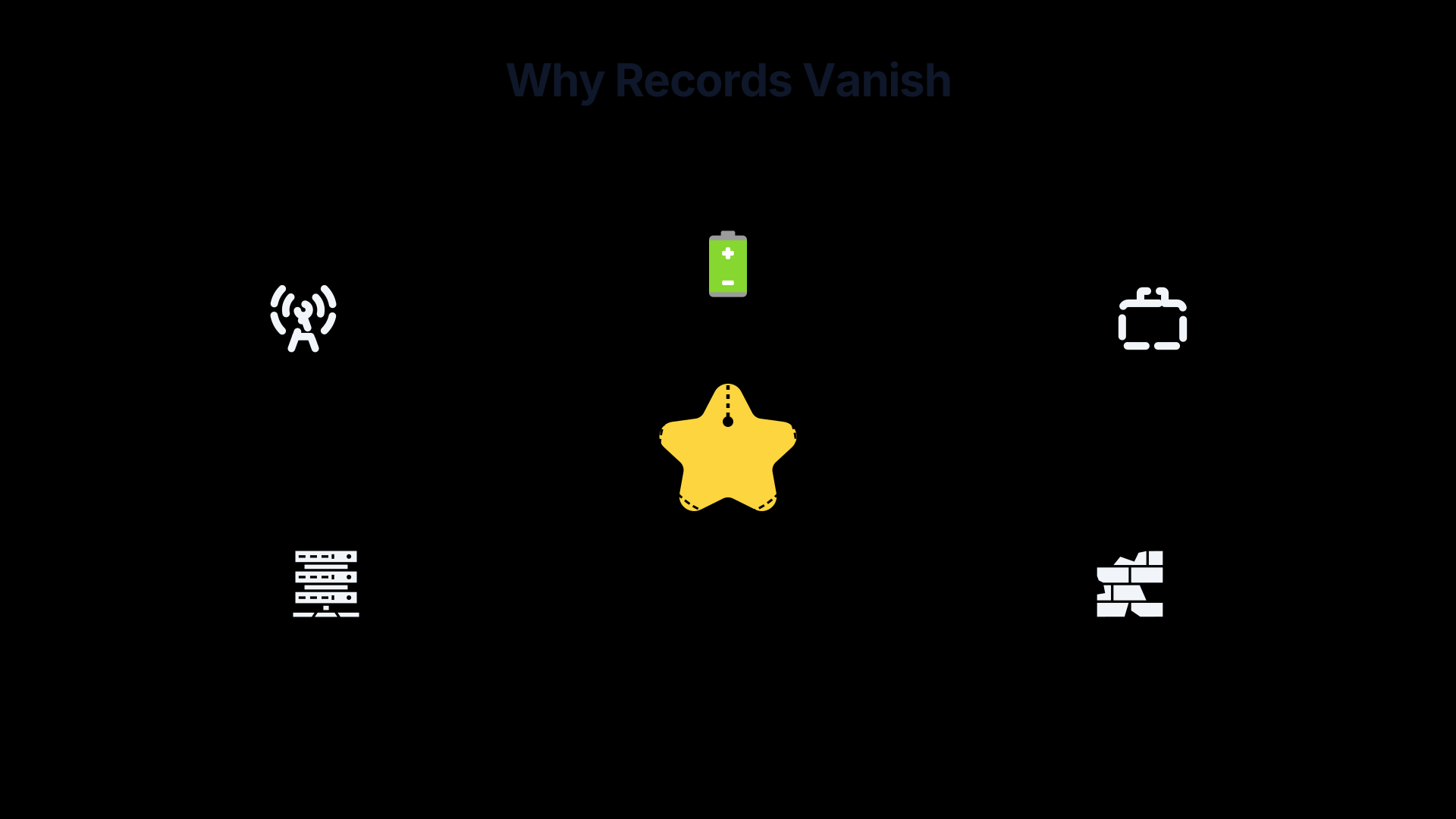
Large areas of Angola remained sparsely connected for much of the twentieth century, especially during wartime. Infrastructure studies repeatedly describe severe transportation and communications limitations across the country, particularly outside major urban areas. [Chatham House]chathamhouse.orgChatham HouseAngola's Infrastructure Ambitions Through Booms and BustsSeptember 17, 2018 — by SK Jensen · Cited by 8 — The government's p…
That creates a classic “visibility gap”:
- fewer telephones and newspapers mean fewer reports filed;
- weaker transport links reduce journalist access;
- low electrification limits photography and recording;
- oral testimony remains local rather than entering national archives.
In countries with stronger media penetration, unusual lights might become newspaper stories within hours. In wartime Angola, the same event could remain an unrecorded local memory.
The Sparse Record Does Not Automatically Support Extraordinary Claims
One common mistake in UFO discussion is treating missing records as evidence of suppression. Angola’s history suggests a more ordinary explanation. Sparse archives can emerge naturally when institutions are weak, fragmented, or repeatedly interrupted.
The known evidence does not support a theory of systematic concealment by a sophisticated Angolan UFO programme. Instead, the pattern is consistent with broader structural realities:
- unstable archival continuity;
- limited scientific infrastructure;
- constrained media ecosystems;
- war-related destruction;
- low international indexing;
- language isolation from dominant UFO research communities.
This also explains why many Angola-related UFO references online ultimately trace back to the same few documents or recycled anecdotes. Thin archival ecosystems tend to produce circular citation patterns in which later writers repeatedly reference earlier summaries without uncovering substantial new primary material.
Why Angola Matters in UFO Research Despite the Thin Archive
Angola remains important precisely because it demonstrates how uneven the global UFO record really is. Public UFO history is not merely a catalogue of sightings; it is also a map of which societies preserved records effectively.
The country highlights several broader lessons:
- archives shape perceived reality;
- conflict destroys anomaly documentation as easily as cultural heritage;
- English-language databases systematically underrepresent parts of Africa;
- aviation bureaucracy preserves reports more reliably than civilian memory;
- absence of documentation is not the same thing as absence of experiences.
The 1966 Lunda report survives because it intersected with international bureaucratic systems strong enough to preserve paper trails across decades. Most other Angolan sightings — if they occurred — likely did not pass through those systems at all. [Conciliation Resources]c-r.orgrole media during conflict and construction democracyConciliation ResourcesThe role of the media during the conflict and in…15 Oct 2004 — The Angolan media is currently facing the enormou…
Endnotes
-
Source: unctad.org
Link: https://unctad.org/system/files/official-document/ditctsce2023d2_en.pdfSource snippet
UN Trade and Development (UNCTAD)Mapping the cultural and creative industries in AngolaAngola experienced an intense civil war, which las...
-
Source: Wikipedia
Title: Angolan Civil War
Link: https://en.wikipedia.org/wiki/Angolan_Civil_WarSource snippet
The Angolan Civil War (Portuguese: Guerra Civil Angolana) was a civil war in Angola, beginning in 1975 and continuing, with interludes, u...
-
Source: Wikipedia
Title: Mass media in Angola
Link: https://en.wikipedia.org/wiki/Mass_media_in_Angola -
Source: Wikipedia
Title: Corruption in Angola
Link: https://en.wikipedia.org/wiki/Corruption_in_Angola -
Source: arxiv.org
Title: arXiv Unsilencing Colonial Archives via Automated Entity Recognition
Link: https://arxiv.org/abs/2210.02194Source snippet
arXivUnsilencing Colonial Archives via Automated Entity RecognitionOctober 3, 2022...
Published: October 3, 2022
-
Source: reliefweb.int
Title: angola idp rehabilitation held back devastated infrastructure
Link: https://reliefweb.int/report/angola/angola-idp-rehabilitation-held-back-devastated-infrastructureSource snippet
Angola: IDP rehabilitation held back by devastated...4 Oct 2005 — Since April 2002, close to four million internally displaced Angolans...
Published: April 2002
-
Source: Wikipedia
Title: Arquivo Histórico Ultramarino
Link: https://en.wikipedia.org/wiki/Arquivo_Hist%C3%B3rico_Ultramarino -
Source: unesdoc.unesco.org
Title: Digital Library Angola’s National Museum during the civil war
Link: https://unesdoc.unesco.org/ark%3A/48223/pf0000133488Source snippet
cultural destruction during times of civil disturbance or war is commercially driven.... Culture, Media and Sports. This role is fundame...
-
Source: iccrom.org
Title: iccrom ics06 culturalheritagepostwar en 0 0
Link: https://www.iccrom.org/sites/default/files/publications/2019-11/iccrom_ics06_culturalheritagepostwar_en_0_0.pdfSource snippet
Cultural Heritage in Postwar RecoveryCultural Heritage in Postwar Recovery. Papers from the ICCROM FORUM held on October 4-6, 2005, edite...
-
Source: Wikipedia
Title: Archaeology of Angola
Link: https://en.wikipedia.org/wiki/Archaeology_of_Angola -
Source: c-r.org
Title: role media during conflict and construction democracy
Link: https://www.c-r.org/accord/angola/role-media-during-conflict-and-construction-democracySource snippet
Conciliation ResourcesThe role of the media during the conflict and in...15 Oct 2004 — The Angolan media is currently facing the enormou...
-
Source: chathamhouse.org
Link: https://www.chathamhouse.org/sites/default/files/publications/research/2018-09-14-angola-infrastructure-ambitions-kirk-jensen-final.pdfSource snippet
Chatham HouseAngola's Infrastructure Ambitions Through Booms and BustsSeptember 17, 2018 — by SK Jensen · Cited by 8 — The government's p...
Published: September 17, 2018
Additional References
-
Source: facebook.com
Title: since the end of civil war in 2002 angola has spent over 120 billion on infrastr
Link: https://www.facebook.com/AfricaFactsZone/posts/since-the-end-of-civil-war-in-2002-angola-has-spent-over-120-billion-on-infrastr/609894867470620/Source snippet
Since the end of civil war in 2002, Angola has spent over...Since the end of civil war in 2002, Angola has spent over $120 billion on in...
-
Source: ora.ox.ac.uk
Link: https://ora.ox.ac.uk/objects/uuid%3Aa1eaeab2-9116-45d8-8df3-47b967fd9f1f/files/mbc1ad9baa3d51e9cd2cb2b069349f613Source snippet
Oxford University Research ArchiveControl, ideology and identity in civil war:by J Pearce · 2011 · Cited by 18 — This thesis examines the...
-
Source: nora.nerc.ac.uk
Title: nerc.ac.uk Chapter 2
Link: https://nora.nerc.ac.uk/id/eprint/536205/1/1.%20Chapter%202_IPBES%20IAS%20Assessment.pdfSource snippet
Trends and status of alien and invasive alien...by H Seebens · 2023 · Cited by 48 — Records on alien animal species are incomplete with...
-
Source: escholarship.org
Link: https://escholarship.org/uc/item/9jc8m1mmSource snippet
UFOs - Forty Years of Facts and Research, ed. John Spencer and Hilary Evans (London: Futura Publications, 1988), 26–45. 6. A similar UFO...
-
Source: youtube.com
Title: Why Are There So Few UFO Reports in Certain Countries?
Link: http://www.youtube.com/watch?v=6P0aG1j8GgISource snippet
The Sociology of UFO Sightings and Cultural Bias...
-
Source: youtube.com
Title: Understanding Archival Gaps in History
Link: http://www.youtube.com/watch?v=l4j7yX2H4jUSource snippet
Why Eyewitness Testimony Often Fails in Official Records...
-
Source: youtube.com
Link: https://www.youtube.com/watch?v=fYnHfOS_D8w&vl=enSource snippet
Angola's Wars, 1961-2002 | Conflict ExplainerAngola was locked in Conflict following a war for independence it was plunged into one of th...
-
Source: youtube.com
Title: How Governments Hide UFO Files
Link: http://www.youtube.com/watch?v=F-h7a_2yP1gSource snippet
Why Are There So Few UFO Reports in Certain Countries?...
-
Source: youtube.com
Title: The Sociology of UFO Sightings and Cultural Bias
Link: http://www.youtube.com/watch?v=kY3P3O6T5hASource snippet
Understanding Archival Gaps in History...
-
Source: youtube.com
Title: Why Eyewitness Testimony Often Fails in Official Records
Link: http://www.youtube.com/watch?v=j3A-s93n-pY
Topic Tree