Within Laos UFOs
What the 1968 Defense Intelligence Report Reveals About Unidentified Objects
The 1968 defense report examined radar and visual anomalies near Laos and Thailand during wartime operations.
On this page
- Radar anomalies and helicopter searches
- Possible explanations and operational context
- Impact on regional airspace monitoring
Page outline Jump by section
Introduction
The 1968 Laos–Thailand Department of Defense intelligence report on unidentified aerial phenomena stands out as the most substantial open-source official document touching on what might be called a “UFO” case in the context of the Lao People’s Democratic Republic and its immediate region. Unlike civilian sighting logs or loosely framed anecdotes, this wartime report emerged from real military operations along the Laos–Thailand border, where radar operators and air attachés grappled with ambiguous radar echoes and night‑time aerial contacts during peak conflict operations. Although often cited in fringe UFO discussions, its content and conclusions are grounded in conventional military intelligence evaluation rather than claims of extraterrestrial visitation.[Openminds.tv]openminds.tvUF Os during the Vietnam War1968, deals with “Unidentified Flying Objects” in the “Laos/Thailand” border area.Read more…
Radar Anomalies and Helicopter Searches in Late 1968
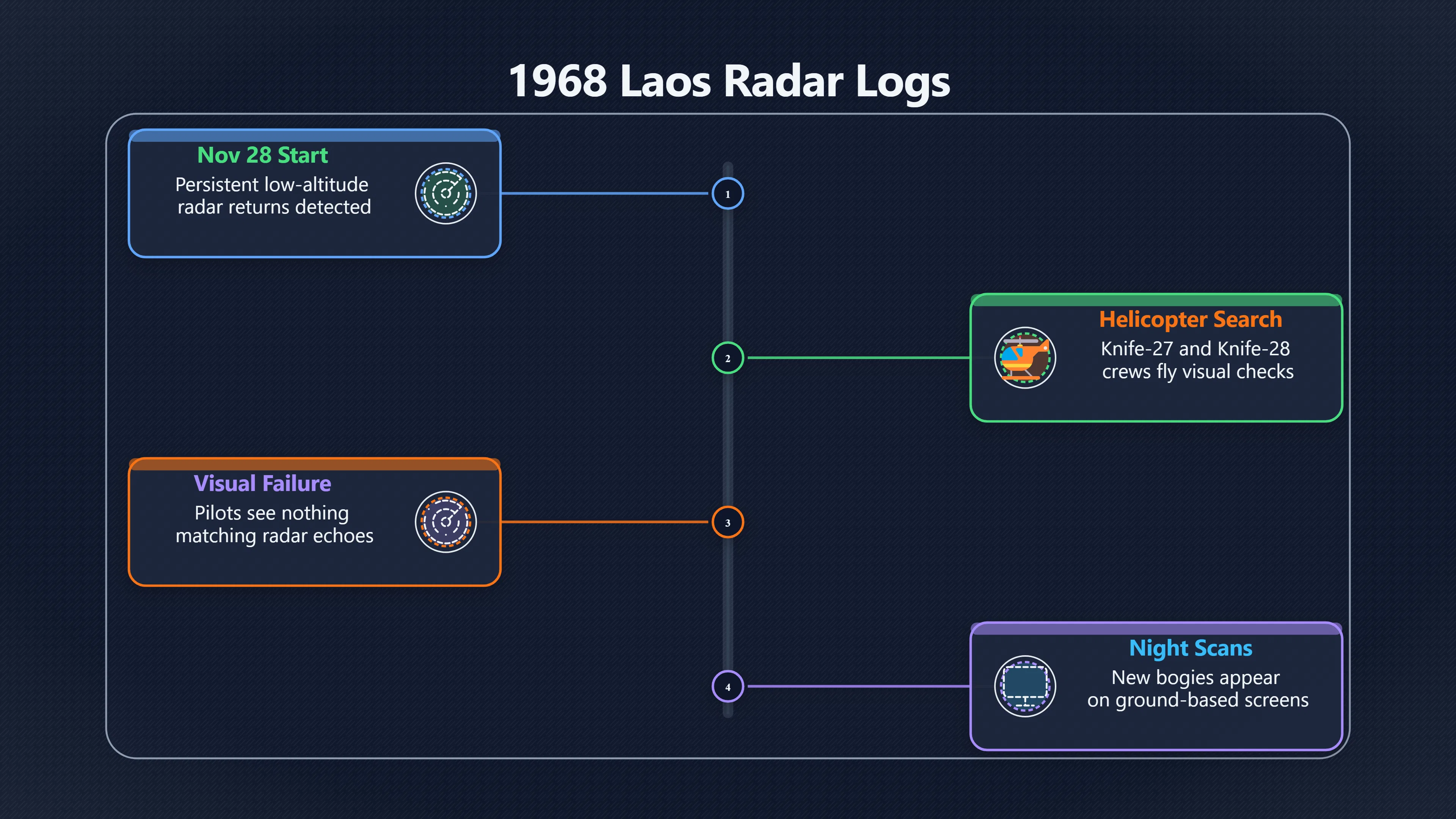
The report in question, issued on 26 December 1968, was a U.S. Department of Defense Intelligence Information Report authored by United States Air Force Major Dale Fulton, then Air Attaché stationed in Vientiane, Laos. It concerned a series of unidentified radar contacts detected along the Laos–Thailand border area, particularly around the Nakhon Phanom Command Post — a key allied monitoring and support base on the Thai side of the border.[Openminds.tv]openminds.tvUF Os during the Vietnam War1968, deals with “Unidentified Flying Objects” in the “Laos/Thailand” border area.Read more…
The sequence began on 28 November 1968 with unusually persistent low‑altitude, slow‑moving radar returns that Thai military controllers could not immediately correlate with known friendly aircraft operations. Described in later summaries, the radar operators reportedly insisted the returns “were not ghosts,” indicating they had ruled out common radar artifacts and were treating the echoes as genuine aerial contacts. In response, allied forces dispatched Knife‑27 and Knife‑28 helicopters from nearby bases to investigate visually; in both sorties, crews reported seeing nothing in the airspace corresponding to the radar echoes.[Openminds.tv]openminds.tvUF Os during the Vietnam War1968, deals with “Unidentified Flying Objects” in the “Laos/Thailand” border area.Read more…
Despite the lack of visual confirmation, the radar returns persisted intermittently during the night, prompting repeat scans and aircraft sorties into the hours when air traffic was minimal. The report explicitly noted that at least one new set of bogies (unexplained radar contacts) appeared on returning helicopters’ ground‑based radar screens, even though pilots remained unaware of any physical object near their flight paths.[Openminds.tv]openminds.tvUF Os during the Vietnam War1968, deals with “Unidentified Flying Objects” in the “Laos/Thailand” border area.Read more…
Military Context and Operational Considerations
To understand the report’s content and evaluation, it is crucial to situate it within the operational circumstances of late‑1960s Southeast Asia. The us presence in Laos, though officially neutral, was deeply entangled in clandestine conflict efforts tied to the wider Vietnam War, with U.S. and allied forces monitoring enemy movements and supporting anti‑communist proxies. Radar installations, such as those at Nakhon Phanom, were continuously scanning contested border airspace for unauthorised aircraft, helicopter insertions, and espionage missions, which made distinguishing actual threat aircraft from mundane or environmental returns a persistent analytical challenge.[The Night Sky II]thenightskyii.orgThe Night Sky IIUFOs During The Vietnam WarThe Night Sky IIUFOs During The Vietnam War
The intelligence report itself emphasised multiple non‑exotic hypotheses for the unexplained contacts. Investigators drew attention to seasonal natural and cultural factors known to produce radar clutter, including high numbers of birds migrating, small balloons released during local festivities, and atmospheric conditions that could create radar “ghost” echoes or anomalous returns. The report did not isolate the unidentified returns as evidence of hostile penetration; rather, it framed them as ambiguous signals requiring cautious interpretation.[The Night Sky II]thenightskyii.orgThe Night Sky IIUFOs During The Vietnam WarThe Night Sky IIUFOs During The Vietnam War
By the end of the incident analysis, the intelligence judgement was deliberately conservative: there was no confirmed evidence that hostile fixed‑wing aircraft or covert helicopters had crossed Thai airspace in support of insurgent activities, and the unidentified contacts were not definitively linked to any advanced enemy capability. The conclusion underscored that the most plausible explanations included a mixture of friendly operations not centrally logged, conventional aerial phenomena, and environmental radar artefacts rather than any unknown craft of a non‑terrestrial nature.[The Night Sky II]thenightskyii.orgThe Night Sky IIUFOs During The Vietnam WarThe Night Sky IIUFOs During The Vietnam War
Possible Explanations and Operational Context
Why radar contacts were ambiguous: Military radar systems of the era were sensitive to multiple classes of false or uncertain targets, especially at night. Birds, atmospheric ducting, and precipitation can all generate returns that look “real” to air traffic controllers, particularly in low‑altitude corridors where clutter rejection is difficult. Analysts in the report acknowledged these limitations and treated radar returns on their own terms, which in intelligence parlance means no conclusion beyond “unexplained” rather than “unidentified craft with exotic origin.”[The Night Sky II]thenightskyii.orgThe Night Sky IIUFOs During The Vietnam WarThe Night Sky IIUFOs During The Vietnam War
Role of unfriendly or informal flights: The geopolitical environment in the Laos–Thailand border region saw frequent movement by local air assets — including allied reconnaissance flights — that were not always centrally logged or communicated across units. In such a high‑tempo zone, a radar contact that does not match a flight plan might be termed “unidentified” even when it corresponds to an allied or civilian aircraft lacking proper notification.[The Night Sky II]thenightskyii.orgThe Night Sky IIUFOs During The Vietnam WarThe Night Sky IIUFOs During The Vietnam War
Cultural radar clutter: Thai and Lao local activities — festivals, agriculture, and even celebratory balloon releases — were explicitly mentioned in the intelligence analysis as contributors to radar clutter. Such factors are well‑known in military aviation for causing temporary or puzzling radar signatures that do not reflect tangible airborne vehicles.[The Night Sky II]thenightskyii.orgThe Night Sky IIUFOs During The Vietnam WarThe Night Sky IIUFOs During The Vietnam War
Impact on Regional Airspace Monitoring
While the 1968 report has since been cited in UFO literature as an “official unidentified objects report”, its true significance lies less in mystery and more in how military intelligence managed ambiguous contacts in a complex theatre of operations. It illustrates some perennial issues in air defence and surveillance:
- Ambiguity of radar data: Until corroborated by visual or secondary sensor data, radar returns can be misleading or inconclusive — a challenge that persists in modern airspace surveillance contexts.
- Operational fog of war: In conflict zones like Laos during the Vietnam War era, gaps in coordination between units can make ordinary flights appear “unknown” to certain radar operators.
- Separation from extraterrestrial claims: The document itself never posits non‑terrestrial origins and, by internal assessment, finds credible terrestrial explanations more plausible for each unexplained contact.
These points underscore why researchers view the incident as historically valuable for study of radar phenomena and military intelligence practice rather than as evidence of anomalous craft — and why it remains the primary official case referenced for Lao‑adjacent unidentified aerial observations.[Openminds.tv]openminds.tvUF Os during the Vietnam War1968, deals with “Unidentified Flying Objects” in the “Laos/Thailand” border area.Read more…

What the Report Does Not Show
Importantly, there is no public record indicating that the 1968 Laos–Thailand intelligence report contained descriptions of physical craft recovered, shaped anomalies, or any sensory data (such as trace materials or imagery) that would elevate the case beyond ambiguous military observations. The available summaries and fragments focus strictly on text‑based radar logs, helicopter search outcomes, and interpretive analysis typical of a defence intelligence document, not fringe UFO dossiers.[Openminds.tv]openminds.tvUF Os during the Vietnam War1968, deals with “Unidentified Flying Objects” in the “Laos/Thailand” border area.Read more…
In the broader tapestry of UFO/UAP histories, this report remains a military assessment with conventional explanations foremost — a reminder that contextualising unexplained radar or visual sightings within their operational environment is essential before leaping to extraordinary hypotheses.[Openminds.tv]openminds.tvUF Os during the Vietnam War1968, deals with “Unidentified Flying Objects” in the “Laos/Thailand” border area.Read more…
Amazon book picks
Further Reading
Books and field guides related to What the 1968 Defense Intelligence Report Reveals About Unidentified Objects. Use these as the next step if you want deeper reading beyond the article.
The UFO Experience
Focuses on evaluating sightings, radar cases and official investigations rather than extraterrestrial claims.
The Hynek UFO Report
Examines notable cases and investigative methods similar to a defense intelligence report.
Passport to Magonia
Provides broader context for how unusual aerial reports are interpreted across cultures and eras.
UFOs and Government
Explores government involvement in UFO inquiries and intelligence assessments.
Endnotes
-
Source: openminds.tv
Title: UF Os during the Vietnam War
Link: https://openminds.tv/ufos-during-the-vietnam-war/Source snippet
1968, deals with “Unidentified Flying Objects” in the “Laos/Thailand” border area.Read more...
-
Source: thenightskyii.org
Title: The Night Sky IIUFOs During The Vietnam War
Link: https://www.thenightskyii.org/vietnam.html -
Source: files.ncas.org
Link: https://files.ncas.org/condon/text/Source snippet
44620-67-C-0035 With the United States Air Force Dr. Edward U. Condon, Scientific Director...
Additional References
-
Source: cia.gov
Link: https://www.cia.gov/readingroom/document/cia-rdp81r00560r000100070028-5Source snippet
October 14, 1968 — (U) INVESTIGATION OF UFO SIGHTINGS OVER OFF-SHORE ISLANDS AND TAIWAN STRAIT Document Type: CREST Collection: General C...
Published: October 14, 1968
-
Source: archives.gov
Link: https://www.archives.gov/research/topics/uaps/presidential-librariesSource snippet
Library Holdings | National ArchivesJanuary 30, 2026 — * 1967: Unidentified Flying Objects, July - November (folder B79-45) (National Arc...
Published: January 30, 2026
-
Source: archives.gov
Link: https://www.archives.gov/research/topics/uaps/rg-collectionsSource snippet
ecord Group or Collection | National ArchivesDecember 12, 2025 — RECORDS RELATED TO UNIDENTIFIED FLYING OBJECTS (UFOS) AND UNIDENTIFIED A...
Published: December 12, 2025
-
Source: archives.gov
Link: https://www.archives.gov/research/topics/uaps/textual-and-microfilmSource snippet
icrofilm | National ArchivesApril 24, 2025 — RECORDS RELATED TO UNIDENTIFIED FLYING OBJECTS (UFOS) AND UNIDENTIFIED ANOMALOUS PHENOMENA (...
Published: April 24, 2025
-
Source: alien.net
Link: https://alien.net/disclosure/government-releasesSource snippet
Filter, sort, and search official releases. Search[Input: Title or description]Agency[Select]Evidence[Select]Release[Select][Butt...
-
Source: cia.gov
Title: gathering intelligence in laos in 1968
Link: https://www.cia.gov/resources/csi/studies-in-intelligence/volume-49-no-1/gathering-intelligence-in-laos-in-1968/Source snippet
CSI GATHERING INTELLIGENCE IN LAOS IN 1968 Volume 49, No. 1 laosmemoir_t.jpg | laos_map_t.jpg | PUBLICATION DETAILS By: Frederic McCann D...
-
Source: theblackvault.com
Title: the full condon committee report on ufos 1968
Link: https://www.theblackvault.com/documentarchive/the-full-condon-committee-report-on-ufos-1968/Source snippet
The Full Condon Committee Report on UFOs, 1968 - The Black VaultJuly 30, 2018 — THE FULL CONDON COMMITTEE REPORT ON UFOS, 1968 Image: Joh...
Published: July 30, 2018
-
Source: ufotransparency.com
Title: decade 1960s condon report 1968 ad0680975
Link: https://ufotransparency.com/files/decade-1960s-condon-report-1968-ad0680975Source snippet
Air Force (sponsor) · 1969 · UFO TransparencyJanuary 1, 1968 — THE CONDON REPORT (DTIC AD0680975) Scientific Study of Unidentified Flying...
Published: January 1, 1968
-
Source: govinfo.gov
Title: GPO CRECB 1968 pt4 4 3
Link: https://www.govinfo.gov/content/pkg/GPO-CRECB-1968-pt4/pdf/GPO-CRECB-1968-pt4-4-3.pdfSource snippet
February 29, 1968 4759February 29, 1968 questing Congress to give him authority to eliminate the need!or alien visitors to this country...
Published: February 29, 1968
-
Source: hummedia.manchester.ac.uk
Link: https://hummedia.manchester.ac.uk/wordpress-websites/archer/wordlist_3-2.txtSource snippet
du 44 rounded 44 kidney 44 policeman 44 depart 44...
Topic Tree