Within SVG UFOs
Why Island UFO Reports Are So Hard to Check
Scattered islands, sea horizons and limited archives make Saint Vincent sightings unusually hard to pin down after the fact.
On this page
- How sea horizons distort distance and direction
- Why falling objects may disappear into open water
- Where local reports survive or vanish
Page outline Jump by section
Introduction
Saint Vincent and the Grenadines presents a special problem for anyone trying to verify unusual aerial sightings. The country is not a single landmass but a chain of islands spread across open sea, with steep volcanic terrain, long coastal sightlines and limited archival infrastructure. A light, fireball or aircraft seen from Bequia may appear completely different to observers on mainland Saint Vincent, Mustique or Union Island. When an object disappears beyond the horizon, witnesses often have no way to judge whether it fell into nearby water, passed behind another island or continued far beyond the visible coastline. [Wikipedia]WikipediaSaint Vincent and the GrenadinesSaint Vincent and the Grenadines
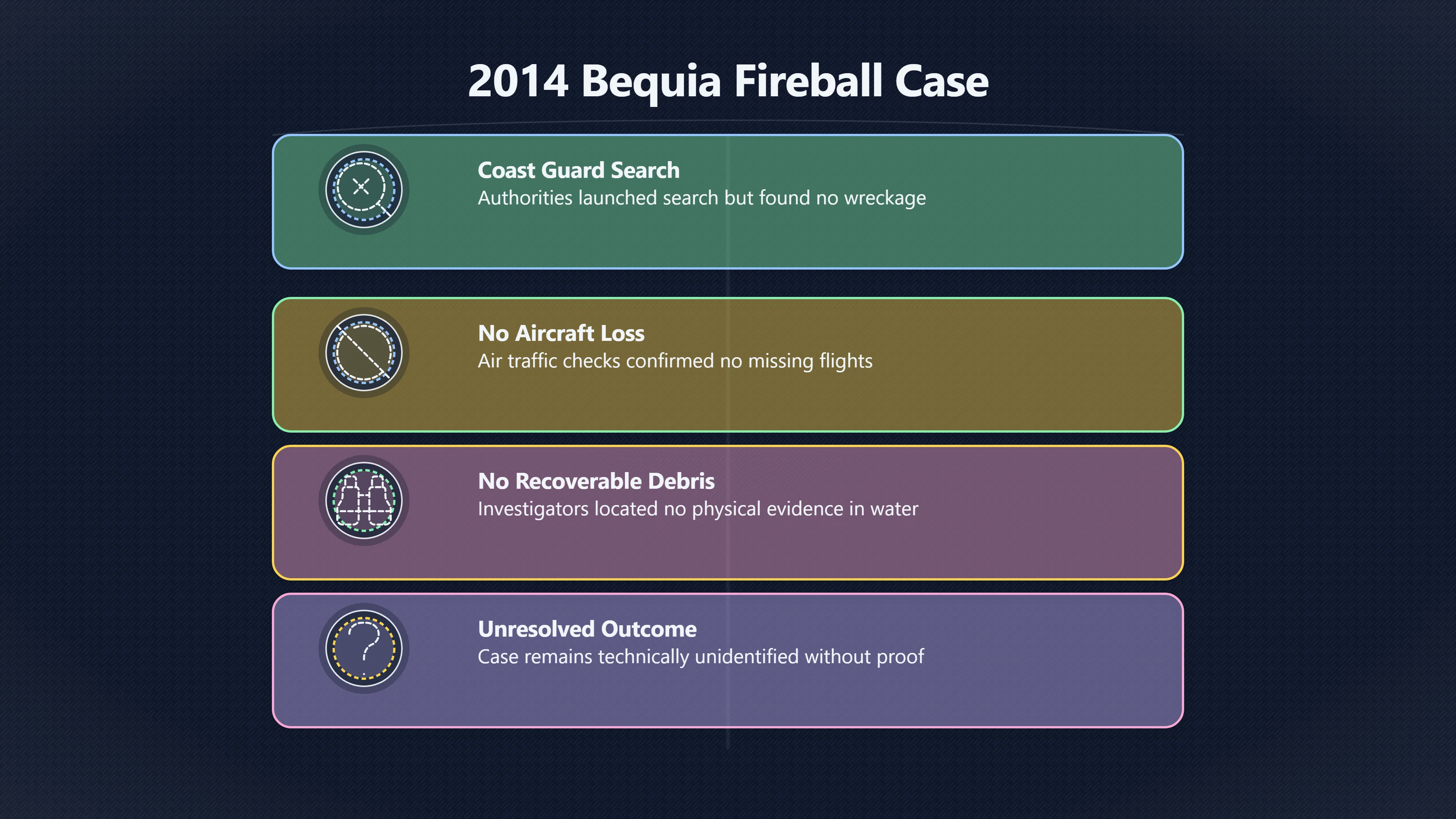
 That geography helps explain why Saint Vincent’s small UFO record contains more unresolved observations than hard evidence. The country’s most discussed modern aerial mystery, the 2014 fiery object seen from several islands, generated a Coast Guard search but produced no debris, no confirmed aircraft loss and no recoverable physical evidence. The case illustrates a broader pattern: island conditions can create genuine uncertainty without necessarily producing evidence for extraordinary explanations. [Searchlight]searchlight.vcWe didn't find anything to say it was or wasn't a meteoriteand 7:30 p.m., several residents in Bequia, Mustique and mainland St Vincent witnessed an object on fire…Read more…
How Sea Horizons Distort Distance and Direction
One of the most important factors in Saint Vincent and the Grenadines is the way the sea alters human perception.
Across much of the country, observers look outward over open water with very few reference points. Unlike sightings over cities, there are often no buildings, roads or landmarks that help estimate an object’s distance, altitude or speed. A bright meteor hundreds of kilometres away can appear to be descending into nearby water. An aircraft approaching from beyond the horizon may seem stationary for long periods before abruptly changing appearance as its lights shift relative to the viewer.
The geography of the state amplifies this effect. Saint Vincent itself is mountainous and volcanic, while the Grenadines form a scattered chain extending southward across more than sixty kilometres of sea. Different islands provide different viewing angles, meaning that a single event can generate several apparently contradictory witness accounts. [Wikipedia]WikipediaGeography of Saint Vincent and the GrenadinesGeography of Saint Vincent and the Grenadines
In practical terms, witnesses on separate islands may disagree about:
- Whether an object was moving north or south.
- Whether it was descending or travelling level.
- Whether it was close to shore or far offshore.
- Whether it disappeared behind land, cloud or the horizon.
These disagreements do not necessarily indicate unreliable witnesses. They are often a predictable consequence of viewing the same event from different points across an island chain.
Why Bright Objects Look Closer Than They Are
Many reported aerial mysteries involve luminous objects rather than clearly visible structures.
At night, observers often judge distance from brightness. Over water this can be misleading because there are fewer visual cues available. A meteor burning high in the atmosphere may appear low and local. Reflections on water can also reinforce the impression that something is approaching the surface.
This is particularly relevant in the eastern Caribbean, where meteor fireballs are periodically visible across multiple islands at once. Witnesses frequently describe them as aircraft crashes, falling satellites or unidentified craft before astronomical explanations emerge. The dramatic appearance of orange trails, flashes and colour changes can make an ordinary atmospheric event appear far more unusual than it actually is. [Searchlight]searchlight.vcWe didn't find anything to say it was or wasn't a meteoriteand 7:30 p.m., several residents in Bequia, Mustique and mainland St Vincent witnessed an object on fire…Read more…
Why Falling Objects May Seem to Vanish Into the Sea
The sea creates another verification problem: objects often appear to enter the water even when they do not.
From a coastal viewpoint, anything descending toward the horizon can seem to disappear into the ocean. In reality, the object may simply pass below the observer’s line of sight. The effect is especially strong during twilight, when contrast between sky and water is reduced.
This helps explain why reports of “something falling into the sea” are common throughout island regions. Unless debris is recovered or a radar track exists, investigators may never determine whether the object actually impacted the water.
The July 2014 incident around Bequia, Mustique and mainland Saint Vincent illustrates the difficulty. Witnesses reported a fiery object moving rapidly through the sky, generating rumours of a downed aircraft. Air traffic checks found no missing flights, and Coast Guard searches located no wreckage or debris. Authorities ultimately stated that they found nothing proving the object either was or was not a meteorite. [Searchlight]searchlight.vcWe didn't find anything to say it was or wasn't a meteoriteand 7:30 p.m., several residents in Bequia, Mustique and mainland St Vincent witnessed an object on fire…Read more…
The most important lesson from that case is not that something extraordinary occurred. Rather, it demonstrates how an object observed over water can remain unresolved after all immediate safety checks have been completed.
Search Areas Become Enormous Very Quickly
Even when authorities respond rapidly, island geography works against certainty.
If witnesses disagree about an object’s direction or estimated impact point, search zones expand dramatically. A small error in judging distance can translate into many square kilometres of ocean. Currents, darkness and weather conditions further complicate recovery efforts.
Saint Vincent and the Grenadines also faces the practical limitations common to small island states. Search-and-rescue resources are designed primarily for maritime safety rather than forensic investigation of unusual sky events. Once an object is not linked to a confirmed aircraft emergency, the likelihood of obtaining definitive evidence drops sharply.
The result is a category of cases that remain technically unidentified without becoming persuasive evidence of anything extraordinary.

Where Local Reports Survive or Vanish
The country’s fragmented geography affects records as much as observations.
Many Caribbean UFO claims survive only through oral retellings, social media discussions or brief local news reports. Saint Vincent and the Grenadines has a much smaller media and archival footprint than larger countries, making older reports difficult to trace. A sighting discussed widely on one island may leave little permanent documentation beyond a newspaper article, radio mention or Facebook post.
This creates several challenges:
- Original witness statements may disappear.
- Dates and locations become harder to verify.
- Later retellings may exaggerate details.
- Multiple versions of the same event can circulate simultaneously.
Unlike countries with large UFO organisations, dedicated national archives or extensive declassified government collections, Saint Vincent and the Grenadines has very little publicly accessible historical material focused on aerial anomalies. Researchers therefore rely heavily on local journalism and contemporary reporting when reconstructing events. [Searchlight]searchlight.vcWe didn't find anything to say it was or wasn't a meteoriteand 7:30 p.m., several residents in Bequia, Mustique and mainland St Vincent witnessed an object on fire…Read more…
Social Media Solves One Problem and Creates Another
Modern communication has improved the speed at which sightings become known.
A dramatic light seen from Bequia can now be photographed and shared across the country within minutes. Multiple witnesses may upload accounts from different islands, creating a broader record than would have existed twenty years ago.
At the same time, social media introduces new complications:
- Incorrect locations can spread rapidly.
- Witnesses may influence each other’s descriptions.
- Images are often reposted without original context.
- Later corrections receive less attention than the initial claim.
The 2014 incident itself spread rapidly through public discussion before authorities had completed basic checks on aircraft movements and possible crash reports. [Searchlight]searchlight.vcWe didn't find anything to say it was or wasn't a meteoriteand 7:30 p.m., several residents in Bequia, Mustique and mainland St Vincent witnessed an object on fire…Read more…
For researchers, the challenge is separating the first-hand observation from the narrative that develops afterwards.
Island-to-Island Viewing Creates Contradictory Accounts
A distinctive feature of Saint Vincent and the Grenadines is that many sightings are regional rather than local.
Because islands are separated by relatively short stretches of sea, a bright atmospheric event may be visible from several communities simultaneously. This can be useful because multiple observers provide additional data. However, it can also generate confusion because each witness sees the event from a different angle.
In larger countries, investigators sometimes reconstruct trajectories using reports from many locations. In Saint Vincent and the Grenadines, that process is harder because:
- Population centres are small.
- Reports may emerge unevenly.
- Exact observation points are often unknown.
- Formal collection of witness testimony is rare.
As a result, even genuinely interesting sightings often remain stuck between two categories: too widely observed to dismiss immediately, yet too poorly documented to reconstruct confidently.
The Main Pattern: Uncertainty Rather Than Strong Evidence
The strongest conclusion from Saint Vincent and the Grenadines’ limited UFO history is not that the country has a hidden concentration of unexplained phenomena. It is that island geography naturally produces cases that are difficult to verify after the fact.
Open sea, scattered islands, mountainous coastlines and limited archival preservation create ideal conditions for uncertainty. A fireball may appear to plunge into nearby water. Witnesses on different islands may disagree about direction and distance. Searches may find nothing because there was never a local impact point to begin with. Reports can then survive only as fragments in local media or community memory.
The 2014 Bequia–Mustique sighting remains the clearest example. It was serious enough to trigger aviation checks and a Coast Guard response, yet the available evidence never moved beyond an unresolved observation over water. In a country defined by sea horizons and dispersed islands, that outcome is often more revealing than the sighting itself. [Searchlight]searchlight.vcWe didn't find anything to say it was or wasn't a meteoriteand 7:30 p.m., several residents in Bequia, Mustique and mainland St Vincent witnessed an object on fire…Read more…
Amazon book picks
Further Reading
Books and field guides related to Why Island UFO Reports Are So Hard to Check. Use these as the next step if you want deeper reading beyond the article.
The UFO Experience
Focuses on witness reliability, observation problems and case evaluation.
After the Flying Saucers Came
Provides context for how reports are recorded and interpreted.
The Demon-Haunted World
Explains how perception and evidence can produce misleading conclusions.
Endnotes
-
Source: Wikipedia
Title: Saint Vincent and the Grenadines
Link: https://en.wikipedia.org/wiki/Saint_Vincent_and_the_Grenadines -
Source: Wikipedia
Title: Geography of Saint Vincent and the Grenadines
Link: https://en.wikipedia.org/wiki/Geography_of_Saint_Vincent_and_the_Grenadines -
Source: searchlight.vc
Title: We didn’t find anything to say it was or wasn’t a meteorite
Link: https://www.searchlight.vc/news/2014/07/31/we-didnt-find-anything-to-say-it-was-or-wasnt-a-meteorite-coastguard/Source snippet
and 7:30 p.m., several residents in Bequia, Mustique and mainland St Vincent witnessed an object on fire...Read more...
-
Source: Wikipedia
Title: Saint Vincent (Saint Vincent and the Grenadines)
Link: https://en.wikipedia.org/wiki/Saint_Vincent_%28Saint_Vincent_and_the_Grenadines%29 -
Source: facebook.com
Link: https://www.facebook.com/beautedelacaraibeworld/posts/-saint-vincent-the-grenadines-a-volcanic-paradise-of-the-caribbean-geography-loc/926994343645475/Source snippet
illes island chain, south of Saint Lucia and north of Grenada.Read more...
-
Source: facebook.com
Title: Lite FM
Link: https://www.facebook.com/litefmbequia/posts/press-statement-concerning-the-press-release-that-was-issued-by-the-royal-st-vin/759233512900202/Source snippet
BequiaThe RSVGPF acknowledges that there was an error in the release where it stated that the four bodies were recovered from the aircraf...
-
Source: facebook.com
Link: https://www.facebook.com/groups/barbadosft/posts/1886743608744156/ -
Source: facebook.com
Link: https://www.facebook.com/APISVG/posts/the-svg-coast-guard-facilitated-a-tour-of-the-entire-coastline-around-st-vincent/3943411049084728/Source snippet
Vincent to get a firsthand view of the damage after the La Soufriere eruptions.Read more...
-
Source: facebook.com
Title: Interesting research going on In Brazil
Link: https://www.facebook.com/groups/1446381838864959/posts/1990401747796296/Source snippet
UFOs created by the Air Force must be sent annually to the National Archive. This week, 35 records were sent to the National Archives, al...
Additional References
-
Source: usufocenter.com
Link: https://www.usufocenter.com/ufo-sighting-reports/worldwide/saint-vincent-the-grenadines-ufo-sightings.htmlSource snippet
Saint Vincent the Grenadines UFO Sighting ReportsThere has been much evidence to support the existence of Saint Vincent the Grenadines UF...
-
Source: assets.publishing.service.gov.uk
Link: https://assets.publishing.service.gov.uk/media/5a74eb88ed915d3c7d528fb6/Archive_inventory.csvSource snippet
Archives' secure cabinet,1,0.135,"Includes Guidance notes; annual budget details; finding aids, etc ",8,"files, loose documents",,Special...
-
Source: paho.org
Title: research for action on climate change and health in the caribbean 2024 0
Link: https://www.paho.org/sites/default/files/research-for-action-on-climate-change-and-health-in-the-caribbean_2024_0.pdfSource snippet
CF Allen · Cited by 1 — Jamaica, Saint Lucia, and Saint Vincent and the Gr...
-
Source: dukespace.lib.duke.edu
Title: From where I stand, I see Saint Lucia on the horizon. Thus, step by step
Link: https://dukespace.lib.duke.edu/bitstreams/be0d9c4b-9c59-4e2c-97ce-d9e8cc95d2a6/downloadSource snippet
Islands: A Caribbean Tidalectics by Carmen Beatriz...by CB Llenín-Figueroa · 2012 · Cited by 22 — Vincent & the Grenadines,” which seem...
-
Source: stvincenttimes.com
Title: st vincent police laud bequia divers for recovering plane crash victims
Link: https://www.stvincenttimes.com/st-vincent-police-laud-bequia-divers-for-recovering-plane-crash-victims/Source snippet
St Vincent Police laud Bequia divers for recovering plane...5 Jan 2024 — Bequia Plane Crash Police give fishermen full credit for recove...
-
Source: caribank.org
Title: Updated Sourcebook Integration of Natural Hazards into EIA Process
Link: https://www.caribank.org/sites/default/files/publication-resources/Updated%20Sourcebook_Integration%20of%20Natural%20Hazards%20into%20EIA%20Process.pdfSource snippet
Updated Sourcebook on the Integration of Natural Hazards...23 Jul 2015 — The Caribbean region is subject to a broad range of potentially...
-
Source: worldoceanreview.com
Link: https://worldoceanreview.com/wp-content/downloads/wor6/WOR6_en.pdfSource snippet
The bimonthly German-language magazine mare, which focuses on the topic of the sea, was...Read more...
-
Source: researchgate.net
Link: https://www.researchgate.net/publication/222143799_Submarine_evidence_for_large-scale_debris_avalanches_in_the_Lesser_Antilles_ArcSource snippet
entified on the floor of the Grenada Basin west of active volcanoes on Dominica...Read more...
-
Source: nsf-gov-resources.nsf.gov
Title: usgs final eis oeis with appendices
Link: https://nsf-gov-resources.nsf.gov/files/nsf-usgs-final-eis-oeis-with-appendices.pdfSource snippet
This Final Programmatic Environmental Impact Statement (EIS)/Overseas Environmental Impact. Statement (OEIS) (hereafter called PEIS) for...
-
Source: instagram.com
Title: An image of the remnants of a marine vessel in St
Link: https://www.instagram.com/p/DU6f6cSkYEP/Source snippet
image of the remnants of a marine vessel in St. Lucia which was pulled ashore. The vessel was thought to be impacted by a dea...
Topic Tree