What Really Happened in Costa Rica's UFO Record?
Costa Rica’s UFO record is unusually concentrated around one famous image: the 1971 Lake Cote aerial photograph, taken during an official mapping flight and preserved in Costa Rica’s archival record.
Page outline Jump by section
Introduction
Costa Rica’s UFO record is unusually concentrated around one famous image: the 1971 Lake Cote aerial photograph, taken during an official mapping flight and preserved in Costa Rica’s archival record. That photograph is not proof of extraterrestrial visitation, but it is a serious case because it has a known institutional origin, technical metadata, later image analysis, and published sceptical objections. Beyond Lake Cote, Costa Rica’s UFO history is thinner: a small number of local media stories, the 2007 Tarbaca mobile-phone video, and recurring folklore around lakes, mountains, and rural skies. The strongest reading is therefore cautious: Costa Rica has one internationally significant contested photographic case, a few weaker modern video claims, and no publicly established official investigation system comparable to specialist UAP offices in larger countries. [archivodigital.go.cr]archivodigital.go.crOpen source on go.cr. [NICAP]nicap.orgOpen source on nicap.org.
Why Costa Rica’s UFO file begins at Lake Cote
The central Costa Rican case occurred on 4 September 1971 over Lake Cote, near Arenal in northern Costa Rica. The photograph was produced during an aerial survey associated with Costa Rica’s mapping work, not during a UFO hunt. The Archivo Nacional de Costa Rica catalogues the material as photographs of an unidentified flying object accidentally photographed during trips made by the Instituto Geográfico Nacional at Lake Cote, Guanacaste, under the reference CR-AN-AH-FO-002544-1-002544-3. That archival description matters because it separates the case from anonymous internet imagery: whatever the object was, the image entered a public documentary chain as a government mapping photograph. [archivodigital.go.cr]archivodigital.go.crInformation object browseInformation object browse
Contemporary and retrospective accounts identify Sergio Loaiza as the aerial photographer on the flight, with pilot Omar Arias, navigator Francisco Reyes, and photographer Juan Bravo also associated with the mission. Local reporting says the story first became public in Costa Rican media years later, with La Nación publishing the case on 1 November 1979. That delay is part of the case’s mystique, but it also complicates witness reconstruction: the people on board did not report seeing the object in real time; it was noticed after development of the photographic material. [La Prensa Gráfica]laprensagrafica.comSource details in endnotes.
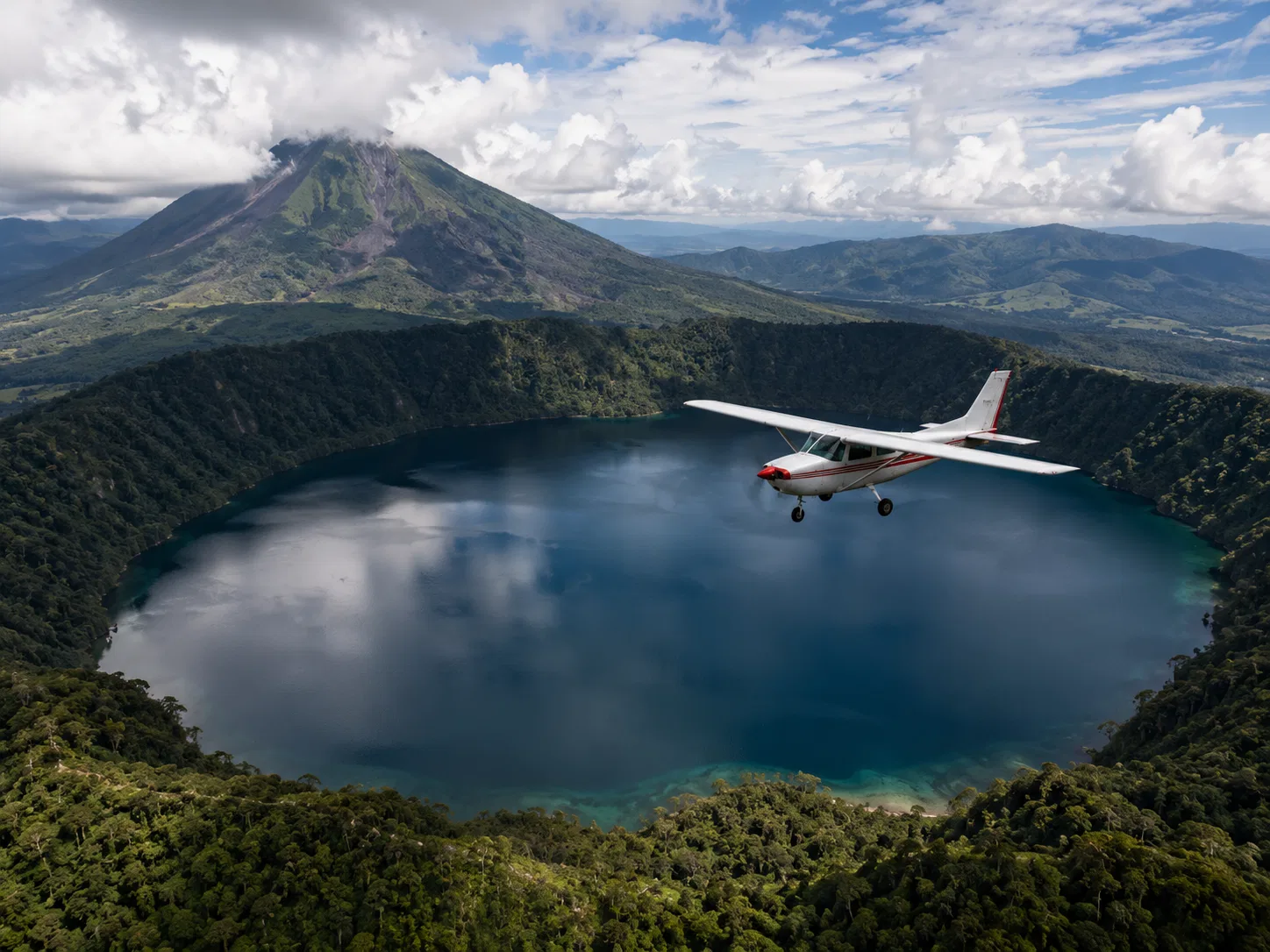
The setting also helped the image travel. Lake Cote is a small crater lake in the northern highlands near Arenal and Tenorio, visually dramatic and easy to mythologise. UFO narratives in Costa Rica often cluster around this Arenal–Cote landscape because the photograph appears to show a disc-shaped form over water, inviting speculation about an object entering or leaving the lake. The available evidence, however, supports only a narrower claim: an anomalous form appears in one survey frame, while adjacent frames do not show it. [NICAP]nicap.orgOpen source on nicap.org.
What the 1971 photograph can and cannot prove
Richard Haines and Jacques Vallée published a detailed analysis of the Lake Cote image in the Journal of Scientific Exploration. They emphasised several features that made the case worth examining: a professional mapping camera, a downward-looking image geometry, a relatively uniform lake background, and a large, focused anomalous image with visible detail. Their analysis also noted that the immediately preceding and following frames, numbered 299 and 301, did not show the disc visible in frame 300. [NICAP]nicap.orgOpen source on nicap.org.
Their conclusion was careful but sympathetic to the anomaly. They argued that the image suggested an unidentified opaque aerial object at a maximum distance of 10,000 feet, with no visible lift, propulsion, or ordinary markings, and they found no indication of double exposure or deliberate fabrication. They did not identify it as an extraterrestrial craft; they left the case open pending further information. [NICAP]nicap.orgOpen source on nicap.org.
The same publication also contained a sceptical referee review by Marilyn E. Bruner of Lockheed Palo Alto Research Laboratory. Bruner found the image suggestive, but suspected it might not represent a physical object. Her objections focused on photographic characteristics: unusual grain at the edge of the oval image, very high density, abnormal sharpness, and lack of expected light diffusion or halation. In plainer terms, the most sceptical technical reading is that the “disc” may be a photographic or negative artefact rather than a craft in the air. [NICAP]nicap.orgOpen source on nicap.org.
That is why Lake Cote is best classified as contested rather than confirmed. It is stronger than a casual sighting because it has provenance, image data, and technical analysis. It is weaker than a confirmed extraordinary event because no independent sensor track, contemporaneous visual witness, shadow calculation, recovered object, or repeat observation ties the shape to a physical craft. The New Yorker’s later discussion captured this divide: proponents point to the image’s official origin and detail, while sceptics point to possible camera, negative, pressure-mark, or glass-related artefacts; neither side has conclusively closed the case. [The New Yorker]newyorker.comThe New Yorker The Enticing Mysteries of U.F.O. Photography | The New YorkerThe New Yorker The Enticing Mysteries of U.F.O. Photography | The New Yorker
The Tarbaca video shows the modern problem
Costa Rica’s best-known modern UFO claim is the 2007 Tarbaca video, attributed to Marvin Badilla and recorded on a Motorola RAZR V3 mobile phone. Local media later reported Badilla’s account of seeing and recording an object from Tarbaca, Aserrí. A 2024 Spanish-language review described the claim as a short mobile-phone recording of a disc-shaped object seen on 22 November 2007 while Badilla was working outdoors. [Telediario Costa Rica]telediario.crSource details in endnotes.
The Tarbaca case is visually striking but evidentially much weaker than Lake Cote. It depends on a low-resolution consumer video, limited metadata, and retrospective storytelling. Sceptics have pointed to its resemblance to earlier model-saucer imagery and to the possibility of a staged miniature; defenders respond that a definitive hoax mechanism has not been proved. That unresolved status is not the same as strong evidence: it means the video remains an interesting claim without the documentation needed to move it into a higher evidential category. [Espacio Misterio]espaciomisterio.comEspacio Misterio El vídeo del caso Tarbaca a examenEspacio Misterio El vídeo del caso Tarbaca a examen
The contrast with Lake Cote is useful. Lake Cote has institutional provenance but ambiguous photographic interpretation. Tarbaca has a dramatic close-up look but weak chain of custody. Together they show the two recurring weaknesses in Costa Rican UFO material: either the record is technically interesting but underdetermined, or it is visually compelling but too poorly documented to bear much weight.
Official records are narrow, not a hidden national archive
The most important official Costa Rican record currently visible to the public is archival rather than investigative: the Archivo Nacional catalogue entry for the Lake Cote photographs. That is significant, but it should not be overstated. It shows that the photographic material exists in a recognised archival framework; it does not show that Costa Rica reached an official conclusion about extraterrestrial craft, advanced technology, or national-security implications. [archivodigital.go.cr]archivodigital.go.crOpen source on go.cr.
Costa Rica also lacks a major public UAP institution comparable to Chile’s former aviation-linked UFO investigation body or the United States’ All-domain Anomaly Resolution Office. For readers comparing sibling country pages in a wider Latin American UFO project, this is a key distinction: Costa Rica’s national UFO reputation rests less on formal state investigation and more on one archival image, local journalists, independent ufologists, and online re-circulation. [Costa Rica Star News]news.co.crsta Rica Star News Video: Chilean Navy Releases Stunning UFO Footagesta Rica Star News Video: Chilean Navy Releases Stunning UFO Footage
The broader official UAP context also argues for caution. NASA’s UAP material states that there is no credible evidence that UAPs are extraterrestrial, and the US AARO historical review reported no evidence of extraterrestrial origin for UFO/UAP cases it examined. Those statements do not explain the Costa Rican photograph, but they set a useful evidential standard: “unidentified” means not identified from the available data, not automatically alien. [NASA Science]science.nasa.govScience UAP FAQsScience UAP FAQs
Region-level patterns: why Arenal, Cote, and rural skies dominate
Costa Rican UFO stories are not evenly distributed in the public record. The Arenal–Lake Cote area dominates because of the 1971 photograph, because water-and-volcano landscapes invite unusual interpretations, and because tourism media repeatedly repackage the case as part of the region’s mystery. Lake Cote’s physical setting near Arenal, its crater-lake form, and its relative isolation make it a memorable location even before UFO folklore is added. [The Tico Times]ticotimes.netcosta ricas mysterious lago cote and its ufo sighting historycosta ricas mysterious lago cote and its ufo sighting history
The Central Valley and San José province appear more often in modern video-era claims, including Tarbaca. That is unsurprising: higher population density, more phones, and easier media access create more reports. But more reports do not necessarily mean better evidence. Urban and peri-urban sightings are also more likely to involve aircraft, drones, balloons, reflections, insects near the lens, satellites, and camera artefacts.
Rural Costa Rican sightings, by contrast, often rely on witness memory and landscape drama: lights over valleys, objects near water, or shapes seen against mountains. Such accounts may be sincere, but without exact time, bearing, weather, aircraft checks, original files, and corroborating witnesses, they remain local testimony rather than robust case evidence.
Evidence quality: confirmed, contested, and debunked
A useful Costa Rica UFO page should not treat every claim equally. The available record separates into three broad categories.
Confirmed as a record, not confirmed as a craft: The Lake Cote photograph is confirmed as an archival and historical object. It was produced in a mapping context, is catalogued by Costa Rica’s national archive, and has been analysed by named researchers. What is not confirmed is the nature of the object or mark in the image. [archivodigital.go.cr]archivodigital.go.crOpen source on go.cr.
Contested but significant: Haines and Vallée’s analysis keeps Lake Cote in the serious contested category because it rejects easy dismissal as a deliberate fake or double exposure, while the referee review and later sceptical discussion keep photographic artefact explanations alive. This is the strongest Costa Rican UFO case precisely because the disagreement is technical rather than merely rhetorical. [NICAP]nicap.orgOpen source on nicap.org.
Contested and weakly documented: The Tarbaca video is worth noting in a national chronology, but not worth treating as a high-confidence case. The source chain is weaker, the recording quality is limited, and the resemblance to model-saucer imagery gives sceptics an obvious alternative hypothesis. [Espacio Misterio]espaciomisterio.comEspacio Misterio El vídeo del caso Tarbaca a examenEspacio Misterio El vídeo del caso Tarbaca a examen
Debunked or probably mundane claims: Costa Rica has many social-media UFO posts and recycled clips, but few have enough documentation to deserve case status. Some may be ordinary aircraft, drones, balloons, astronomical objects, reflections, or edited media. The absence of a firm explanation in a viral post should not be mistaken for evidence of an extraordinary object.

Local-source reliability: how to read Costa Rican UFO material
Costa Rican UFO research is shaped by a mixture of national newspapers, television segments, tourism sites, ufology blogs, sceptical forums, and archive catalogues. The strongest sources for factual scaffolding are the archival catalogue, original or near-original photographic documentation, named technical analyses, and local reporting that identifies people, dates, aircraft, and publication history. The weakest sources are reposted videos without original files, social-media captions, and sensational articles that present “best UFO photo ever” language as if it were a conclusion rather than an opinion. [2La Prensa Gráfica]laprensagrafica.comSource details in endnotes.
The Lake Cote case also shows why local sources should be cross-checked rather than dismissed. Spanish-language reporting preserves details about Loaiza, the flight crew, the later Costa Rican media publication, and the local memory of the case. English-language coverage often makes the image easier for international readers to find, but it can also amplify claims about “the best UFO photograph” without adding new evidence. [La Prensa Gráfica]laprensagrafica.comSource details in endnotes.
For future Costa Rica sightings, the standard should be simple: original media files, exact time and location, weather and astronomical checks, aviation or drone context, witness independence, and access to unedited metadata. Without those, even a sincere report remains a story rather than a well-supported case.
The most defensible Costa Rica chronology
The Costa Rican chronology is short but clear enough to be useful.
1971 — Lake Cote aerial photograph. An aerial survey associated with the Instituto Geográfico Nacional captures an anomalous disc-like form in one frame over Lake Cote. The archival record later identifies the material as photographs of an unidentified flying object accidentally photographed during Instituto Geográfico Nacional trips. [archivodigital.go.cr]archivodigital.go.crInformation object browseInformation object browse
1979 — Public attention in Costa Rican media. Local reporting says the case became public years after the flight, with La Nación publishing the story on 1 November 1979. This helped move the image from internal mapping material into Costa Rican public UFO culture. [La Prensa Gráfica]laprensagrafica.comSource details in endnotes.
1980s–1990s — Technical analysis and dispute. Haines and Vallée analyse a second-generation negative and publish a detailed study, while a referee review raises strong artefact objections. This period turns Lake Cote from a local curiosity into an international case cited in UFO photography debates. [NICAP]nicap.orgOpen source on nicap.org.
2007 — Tarbaca mobile-phone video. Marvin Badilla’s alleged disc-shaped object video becomes Costa Rica’s best-known digital-era case. It remains contested, with proponents treating it as striking footage and sceptics pointing to staging or model explanations. [Espacio Misterio]espaciomisterio.comEspacio Misterio El vídeo del caso Tarbaca a examenEspacio Misterio El vídeo del caso Tarbaca a examen
2020s — Re-circulation and re-scanning culture. Lake Cote gains renewed attention through high-resolution scans, international articles, and social-media circulation. This has improved public access to the image but has not resolved the underlying evidential dispute. [The New Yorker]newyorker.comThe New Yorker The Enticing Mysteries of U.F.O. Photography | The New YorkerThe New Yorker The Enticing Mysteries of U.F.O. Photography | The New Yorker
What Costa Rica contributes to the wider UFO debate
Costa Rica’s value in UFO research is not that it provides proof of alien craft. Its value is that it supplies a compact case study in how an unusually good-looking image can still resist final interpretation. Lake Cote has many features UFO researchers want: official origin, professional equipment, a known location, adjacent frames, and later analysis. Yet even with those advantages, the case remains unresolved because the crucial question is not whether the image is interesting, but whether the image records a real external object.
That makes Costa Rica a useful sibling branch for comparison with countries where UFO cases are driven by military pilots, radar tracks, mass sightings, or formal government investigations. Costa Rica’s strongest case is photographic and archival. Its weakness is the lack of corroborating sensor or witness evidence. Its lesson is that provenance raises a UFO case’s seriousness, but it does not by itself establish what the anomaly was.
Amazon book picks
Further Reading
Books and field guides related to What Really Happened in Costa Rica's UFO Record?. Use these as the next step if you want deeper reading beyond the article.
Passport to Magonia
Provides broader interpretive context for famous international UFO cases.
Endnotes
-
Source: archivodigital.go.cr
Link: https://www.archivodigital.go.cr/index.php/fotografias-de-un-objeto-volador-no-identificado-fotografiado-accidentalmente-durante-las-giras-hechas-por-el-instituto-geografico-nacional-en-la-lagua-de-cote-guanacaste-costa-rica -
Source: nicap.org
Link: https://www.nicap.org/articles/710904_JSE_03_2_haines.pdf -
Source: telediario.cr
Link: https://www.telediario.cr/videos/nacional/costarricense-vio-ovni-abro-camara-empiezo-grabar -
Source: archivodigital.go.cr
Title: Information object browse
Link: https://www.archivodigital.go.cr/index.php/informationobject/browse?levels=237&media=print&mediatypes=136&page=37&sf_culture=es&sort=identifier&sortDir=asc&topLod=0&view=table -
Source: aaro.mil
Link: https://www.aaro.mil/ -
Source: science.nasa.gov
Title: Science UAP FAQs
Link: https://science.nasa.gov/uap/faqs/ -
Source: aaro.mil
Title: AARO Historical Record Report Vol 1 2024
Link: https://www.aaro.mil/Portals/136/PDFs/AARO_Historical_Record_Report_Vol_1_2024.pdf -
Source: aaro.mil
Link: https://www.aaro.mil/UAP-Cases/Official-UAP-Imagery/ -
Source: science.nasa.gov
Title: uap independent study team final report
Link: https://science.nasa.gov/wp-content/uploads/2023/09/uap-independent-study-team-final-report.pdf -
Source: science.nasa.gov
Link: https://science.nasa.gov/uap/ -
Source: archivodigital.go.cr
Link: https://www.archivodigital.go.cr/index.php/fotografias-de-un-objeto-volador-no-identificado-fotografiado-accidentalmente-durante-las-giras-hechas-por-el-instituto-geografico-nacional-en-la-lagua-de-cote-guanacaste-costa-rica%3Bisad?sf_culture=fr -
Source: archivodigital.go.cr
Link: https://www.archivodigital.go.cr/index.php/informationobject/browse?levels=237&mediatypes=136&page=38&sf_culture=es&sort=identifier&sortDir=asc&topLod=0&view=card -
Source: archivodigital.go.cr
Title: Information object browse
Link: https://www.archivodigital.go.cr/index.php/informationobject/browse?levels=237&media=print&mediatypes=136&page=76&repos=444&sf_culture=en&sort=relevance&sortDir=desc&view=table -
Source: archivodigital.go.cr
Title: Information object browse
Link: https://www.archivodigital.go.cr/index.php/informationobject/browse?media=print&mediatypes=136&onlyMedia=1&page=83&repos=444&sf_culture=fr&sort=referenceCode&sortDir=desc&topLod=0&view=table -
Source: archivodigital.go.cr
Link: https://www.archivodigital.go.cr/index.php/informationobject/browse?languages=es&media=print&mediatypes=136&onlyMedia=1&page=40&sf_culture=fr&showAdvanced=1&sort=identifier&sortDir=asc&topLod=0&view=card -
Source: archivodigital.go.cr
Title: Information object browse
Link: https://archivodigital.go.cr/index.php/informationobject/browse?languages=es&levels=237&mediatypes=136&onlyMedia=1&page=56&repos=444&sf_culture=es&sort=startDate&sortDir=desc&topLod=0&view=table -
Source: archivodigital.go.cr
Title: Information object browse
Link: https://www.archivodigital.go.cr/index.php/informationobject/browse?languages=es&mediatypes=136&onlyMedia=1&page=49&sf_culture=es&showAdvanced=1&sort=startDate&sortDir=asc&topLod=0&view=card -
Source: archivodigital.go.cr
Link: https://archivodigital.go.cr/index.php/informationobject/browse?levels=237&media=print&mediatypes=136&onlyMedia=1&page=83&sf_culture=fr&sort=alphabetic&sortDir=desc&view=card -
Source: nicap.org
Link: https://www.nicap.org/710904costarica_dir.htm -
Source: newyorker.com
Title: The New Yorker The Enticing Mysteries of U.F.O. Photography | The New Yorker
Link: https://www.newyorker.com/culture/photo-booth/the-enticing-mysteries-of-ufo-photography -
Source: laprensagrafica.com
Link: https://www.laprensagrafica.com/tendencias/Un-ovni-sobre-un-lago-en-Costa-Rica-La-foto-que-hace-50-anos-cambio-la-vida-a-un-cartografo-20211113-0027.html -
Source: espaciomisterio.com
Title: Espacio Misterio El vídeo del caso Tarbaca a examen
Link: https://www.espaciomisterio.com/ovnis-y-vida-extraterrestre/video-caso-tarbaca-examen_58777 -
Source: news.co.cr
Title: sta Rica Star News Video: Chilean Navy Releases Stunning UFO Footage
Link: https://news.co.cr/video-chilean-navy-releases-stunning-ufo-footage/54946/ -
Source: ticotimes.net
Title: costa ricas mysterious lago cote and its ufo sighting history
Link: https://ticotimes.net/2024/11/12/costa-ricas-mysterious-lago-cote-and-its-ufo-sighting-history -
Source: Wikipedia
Title: Lake Cote
Link: https://en.wikipedia.org/wiki/Lake_Cote -
Source: x.com
Link: https://x.com/disclosureorg/status/2005680226387501462
Additional References
-
Source: youtube.com
Link: https://www.youtube.com/watch?v=TWVSgomDPr0Source snippet
What's the size of the Costa Rica UFO?? - 3D recreation reveals it...
-
Source: youtube.com
Title: What’s the size of the Costa Rica UFO??
Link: https://www.youtube.com/watch?v=Bu03kUBCLS0Source snippet
Volcanic UFO Mysteries (2021) | Documentary | Darcy Weir | Stephen Bassett...
-
Source: arxiv.org
Link: https://arxiv.org/html/2502.06794v1 -
Source: nsa.gov
Link: https://www.nsa.gov/portals/75/documents/news-features/declassified-documents/tech-journals/communications-extraterrestrial-intelligence.pdf -
Source: archives.gov
Link: https://www.archives.gov/research/topics/uaps -
Source: youtube.com
Link: https://www.youtube.com/watch?v=SzAG1tzhcsYSource snippet
Reconstructing the 1971 Costa Rica UFO in "Blender" - maybe there IS something to it...
-
Source: reddit.com
Link: https://www.reddit.com/r/interestingasfuck/comments/ulivdn/best_ever_photo_of_ufo_emerges_50_years_after_it/ -
Source: researchgate.net
Link: https://www.researchgate.net/publication/374373111_UFOs_and_Unidentified_Anomalous_Phenomena_The_NASA_report_1492023_has_found_no_evidence_to_suggest_that_UAPs_are_extraterrestrial_in_origin -
Source: reddit.com
Link: https://www.reddit.com/r/aliens/comments/13ltxz2/upscaled_60fps_stabilized_the_costa_rica_ufo/ -
Source: facebook.com
Link: https://www.facebook.com/TheCostaRicaNews/posts/a-few-years-ago-a-supposed-ufo-sighting-was-reported-in-the-skies-of-costa-rica-/1235103388650760/
Topic Tree
Follow this branch
Related pages 192
- Afghanistan UAP
- AlbanianUFOs
- Algeria UFOs
- Antigua UFOs
- Monaco UFOs
- +187 more in sidebar