Within Mongolia UFOs
Could Mongolia's UFOs Be Fireballs or Satellites?
Many Mongolia sky mysteries may fit natural or human-made explanations such as fireballs, satellites, balloons, or debris.
On this page
- Fireballs and meteor reports over Mongolia
- Aircraft balloons satellites and rocket debris
- How to test a modern sighting claim
Page outline Jump by section
Introduction
Across Mongolia’s vast, dark skies, many dramatic “unidentified” aerial sightings reported over the years have plausible natural or human‑made origins. In this sub‑topic we focus on how bright meteors (especially fireballs), satellites and space debris can be mistaken for anomalous objects in the Mongolian sky, why such misidentifications occur, and what documented examples exist of these astronomical and satellite phenomena near Mongolia.

Bright Meteors and Fireballs: Ordinary Sky Phenomena That Surprise Observers
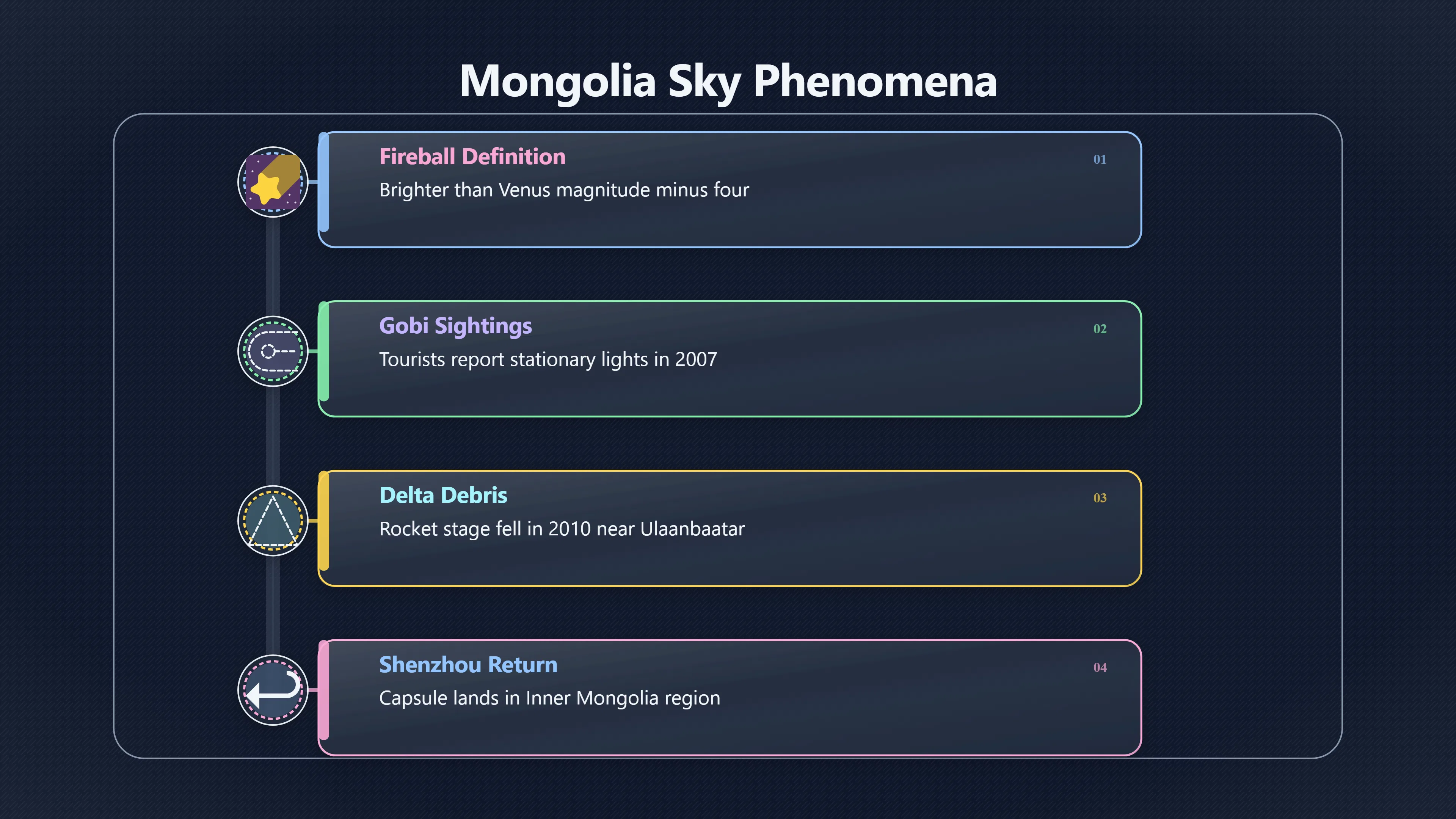
Bright meteors, often called fireballs, are meteoroids entering Earth’s atmosphere and glowing intensely as they ablate. They can be so bright that they outshine planets or even appear in daylight, leading unprepared witnesses to describe them as unusual or “UFO‑like.” A fireball is technically defined as a meteor brighter than about magnitude –4 (brighter than Venus) when seen from its zenith position. Exceptionally bright ones, sometimes exploding in bright airbursts, are termed bolides. Most meteors and fireballs occur every day around the globe, though most go unnoticed because they happen over oceans or sparsely populated areas, or during daylight. [Wikipedia]WikipediaOpen source on wikipedia.org.
In regions like Mongolia with very low light pollution and clear horizons, meteors and fireballs are more visible to ground observers than in light‑polluted cities. International networks like the International Meteor Organization track these events globally, including reports from amateur observers. [International Meteor Organization]academia.eduThe International Meteor OrganizationPDF) The International Meteor OrganizationFounded in 1988, the International Meteor Organization (IMO) is an international scientific no…
Even in the Gobi Desert, people have reported bright lights in the sky that coincide with known periodic meteor activity. For example, tourists near the Flaming Cliffs in the Gobi once described a bright, stationary‑appearing object in 2007 that one witness suggested “could be a satellite … given the angle the sun’s rays would have been travelling at the time.” [The Phenomenon]thephenomenon.appSource details in endnotes.
Because meteors travel at high speed and produce trails of light, brief bright streaks across the sky—especially those seen during peaks of annual meteor showers—are a well‑understood astronomical phenomenon. A live meteor shower such as the Perseids or the Geminids can produce multiple fireballs visible from East Asia, including regions not far from Mongolia’s border. [International Meteor Organization]academia.eduThe International Meteor OrganizationPDF) The International Meteor OrganizationFounded in 1988, the International Meteor Organization (IMO) is an international scientific no…
Satellites, Space Junk and Atmospheric Re‑entries Near Mongolia
Objects related to Earth orbit—satellites, rocket bodies, and space debris—can also produce aerial sights that are misinterpreted. Ordinary satellites become visible as slow, steady points of light moving across the sky when the Sun reflects off their surfaces, especially near dawn or dusk. More dramatic are re‑entries of spent spacecraft and rocket stages, which can produce bright, sometimes fragmenting trails as they break up in the atmosphere.
Documented history shows that rocket debris has fallen in Mongolia. For example, on 19 February 2010, pieces from the second stage of a Delta II rocket (2009‑052C) were tracked to a re‑entry over Mongolia. The Research Center of Astronomy and Geophysics at the Mongolian Academy of Sciences reported the coordinates of the fall and provided photographs of components including a propellant tank and titanium pressure sphere. [Satellites Overhead]satobs.orgSatellites Overhead Satellite Re-entriesSatellites Overhead Satellite Re-entries
Re‑entries like this can be mistaken for unexplained lights or objects, particularly when seen at night and moving rapidly or breaking into fragments. Although not frequent, such space debris events show that human‑made objects occasionally return to Earth over or near Mongolia.
Beyond debris, satellites and spacecraft have scheduled atmospheric entries nearby. For instance, the Chinese Shenzhou‑20 capsule re‑entered and landed in China’s Inner Mongolia region in January 2026, an example of a planned return of spacecraft that could be visible at high altitude during descent if observed from neighbouring areas. [Facebook]facebook.comFacebookThe Shenzhou-20 capsule re-entered Earth's atmosphere…The Shenzhou-20 capsule re-entered Earth's atmosphere and safely landed…
Mongolia’s own Mazaalai satellite, launched in 2017 as the country’s first nanosatellite, orbited Earth for nearly two years before deorbiting in 2019. Although its decay from orbit was unremarkable and not tied to public reports of bright re‑entries over Mongolia, such missions remind us that satellites operate continuously in low Earth orbit and can occasionally appear to casual observers. [Wikipedia]WikipediaMazaalai (satelliteMazaalai (satellite

Why Misidentifications Happen in Mongolia’s Skies
Several factors make meteors and satellite phenomena prone to misidentification in Mongolia:
- Low population and sparse reporting infrastructure — Many bright sky events occur in remote parts of Mongolia without immediate radar, official tracking, or multiple independent observers, meaning unusual sightings often rely on single eyewitness accounts. This promotes ambiguity in description and interpretation.
- Lack of local real‑time astronomical context — Without immediate access to official tracking data (e.g., satellite passes or meteor events), witnesses are left to interpret what they saw with limited reference points.
- Visual similarity to UFO descriptions — Fast moving fireballs, slowly moving satellites glinting sunlight, and re‑entry debris breaking apart can all mimic classic UFO report features such as bright lights, sudden disappearance, or apparent acceleration.
Scientific studies of UFO identification show that astronomical causes—planets, stars, meteors and re‑entries—account for a large share of identifiable UFO reports once analysed. Meteors and re‑entering space debris in particular are difficult to identify retrospectively absent precise timing and multi‑angle observations. [Wikipedia]WikipediaIdentification studies of UFOsIdentification studies of UFOs
Distinguishing Characteristics: How to Test a Modern Sighting Claim
For any reported “unidentified” sighting over Mongolia, a few concrete steps help distinguish a mundane explanation from something genuinely unexplained:
- Correlate with known meteor showers: Many bright meteors occur at predictable times of year. If a sighting coincides with an active shower, the fireball explanation becomes stronger.
- Check satellite pass predictions: Tools that predict satellite visibility (e.g., Heavens‑Above, satellite trackers) can often match moving lights to known orbital objects.
- Seek multiple independent observations: A single eyewitness report is weak evidence; simultaneous reports across locations with consistent timing and direction strengthen identification.
- Temporal and trajectory data: Precise timing, speed estimation, and path direction help differentiate between ballistic meteors (very fast, straight) and slow‑moving satellites reflecting sunlight.
These methods, applied with the assistance of amateur astronomical groups such as those linked to the Khurel Togoot Astronomical Observatory in Ulaanbaatar, can clarify many ambiguous sightings. [Wikipedia]WikipediaKhurel Togoot Astronomical ObservatoryKhurel Togoot Astronomical Observatory
By focusing on documented cases and known sky phenomena, this page illustrates that many Mongolia UFO reports align with natural or human‑made explanations such as bright meteors, satellites, and space debris, and that careful analysis and correlation with astronomical data often resolve apparent mysteries into identifiable sources.

Amazon book picks
Further Reading
Books and field guides related to Could Mongolia's UFOs Be Fireballs or Satellites?. Use these as the next step if you want deeper reading beyond the article.
Turn Left at Orion
Provides practical sky-observation knowledge relevant to UFO misidentifications.
The Demon-Haunted World
Encourages evidence-based interpretation of unusual observations.
Endnotes
-
Source: Wikipedia
Link: https://en.wikipedia.org/wiki/Meteor -
Source: space.com
Link: https://www.space.com/stargazing/meteor-showers/geminid-meteor-shower-2025-thrills-skywatchers-with-an-end-of-year-celestial-firework-show-photosSource snippet
These meteors appeared to emanate from the constellation Gemini, which was accompanied by Jupiter during December. Astrophotographers acr...
-
Source: facebook.com
Link: https://www.facebook.com/spacecom/posts/the-shenzhou-20-capsule-re-entered-earths-atmosphere-and-safely-landed-in-chinas/1244182640905751/Source snippet
FacebookThe Shenzhou-20 capsule re-entered Earth's atmosphere...The Shenzhou-20 capsule re-entered Earth's atmosphere and safely landed...
-
Source: Wikipedia
Title: Mazaalai (satellite)
Link: https://en.wikipedia.org/wiki/Mazaalai_%28satellite%29 -
Source: Wikipedia
Title: Identification studies of UFOs
Link: https://en.wikipedia.org/wiki/Identification_studies_of_UFOs -
Source: Wikipedia
Title: Khurel Togoot Astronomical Observatory
Link: https://en.wikipedia.org/wiki/Khurel_Togoot_Astronomical_Observatory -
Source: space.com
Link: https://www.space.com/space-exploration/launches-spacecraft/chinas-1st-reusable-rocket-explodes-in-dramatic-fireball-during-landing-after-reaching-orbit-on-debut-flightSource snippet
China's 1st reusable rocket explodes in dramatic fireball...3 Dec 2025 — After making a successful reentry, the rocket's first stage boo...
-
Source: facebook.com
Link: https://www.facebook.com/groups/1534360996972590/posts/2216727448735938/Source snippet
g, marking the successful conclusion of an emergency mission...Read more...
-
Source: facebook.com
Link: https://www.facebook.com/FriendsOfNASA/posts/perseid-meteors-over-chinas-inner-mongolia-autonomous-regionfriendsofnasaorg-the/833247665582346/Source snippet
Perseids are also known for their fireballs.Read more...
-
Source: imo.net
Link: https://www.imo.net/Source snippet
You saw something bright and fast? Like a huge shooting star? Report it: it may be a fireball. Report a Fireball.Read more...
-
Source: thephenomenon.app
Link: https://thephenomenon.app/mongolia/ -
Source: satobs.org
Title: Satellites Overhead Satellite Re-entries
Link: https://www.satobs.org/decay.html -
Source: nuforc.org
Link: https://nuforc.org/sighting/?id=193799Source snippet
NUFORC UFO Sighting 193799November 4, 2025 — NUFORC UFO SIGHTING 193799 Occurred: 2007-04-30 08:30 Local Reported: 2025-11-03 22:13 Pacif...
Published: April 30, 2007
-
Source: nuforc.org
Link: https://nuforc.org/sighting/?id=46662Source snippet
NUFORC UFO Sighting 46662October 11, 2005 — NUFORC UFO SIGHTING 46662 Occurred: 2005-09-30 19:35 Local Reported: 2005-10-01 06:05 Pacific...
Published: September 30, 2005
-
Source: imo.net
Title: Fireballs | IMOFIREBALLS Fireballs are meteors that appear brighter than normal
Link: https://www.imo.net/observations/fireballs/fireballs/Source snippet
A great majority of the material orbiting in outer space are tiny sub-millimeter sized bits of stone, ice, or metal, or a combinatio...
-
Source: imo.net
Link: https://www.imo.net/bg/Source snippet
IMO | International Meteor OrganizationImage: International Meteor Organization Image: Join Us International Meteor Organization Service...
-
Source: cneos.jpl.nasa.gov
Link: https://cneos.jpl.nasa.gov/fireballs/Source snippet
Introduction Map/Data Lightcurves Operational Notes FIREBALL AND BOLIDE DATA The following chart shows reported fireball events for which...
-
Source: popastro.com
Link: https://www.popastro.com/meteor/1998/11/Source snippet
November, 1998 - Meteor Section11 Jun 2024 — SPAMS figures suggest around 15-20% of Leonids on November 16-17 were fireballs, ranging up...
-
Source: academia.edu
Title: The International Meteor Organization
Link: https://www.academia.edu/62344252/The_International_Meteor_OrganizationSource snippet
(PDF) The International Meteor OrganizationFounded in 1988, the International Meteor Organization (IMO) is an international scientific no...
Additional References
-
Source: iaumeteordatacenter.org
Link: https://iaumeteordatacenter.org/Source snippet
IAU Meteor Data CenterThe Meteor Data Center (MDC) of the International Astronomical Union (IAU) provides * a database of all meteor show...
-
Source: strewnify.com
Link: https://www.strewnify.com/Source snippet
Strewnify - Meteorite Strewn Field Maps, News, and ReportsSTREWNIFY Meteorite Strewn Field Maps, News, and Reports * Meteor Events * Mete...
-
Source: planet-terre.ens-lyon.fr
Link: https://planet-terre.ens-lyon.fr/ressource/cratere-meteorite-Mongolie.xmlSource snippet
d'impacts et météorites de Mongolie: état des lieux et découvertes récentes — Planet-TerreDecember 14, 2023 — MÉTÉORITES TROUVÉES EN MON...
Published: December 14, 2023
-
Source: amsmeteors.org
Link: https://www.amsmeteors.org/fireballs/ -
Source: sciencemediacentre.org
Title: expert reaction to reports that debris from a chinese rocket is coming to earth
Link: https://www.sciencemediacentre.org/expert-reaction-to-reports-that-debris-from-a-chinese-rocket-is-coming-to-earth/Source snippet
expert reaction to reports that debris from a Chinese rocket...30 Jan 2026 — Scientists comment on reports that debris from a Chinese ro...
-
Source: youtube.com
Link: https://www.youtube.com/watch?v=WprVmNYt4vgSource snippet
LIVE: Perseid Meteor Shower and Milky Way from MongoliaThese are views of the Milky Way and of the proceed meteor shower live from Mongol...
-
Source: youtube.com
Link: https://www.youtube.com/shorts/zpRp8XHYwAk -
Source: instagram.com
Title: In the upper left corner, you can see Sirius, the brightest star
Link: https://www.instagram.com/reel/DSh56CLj74q/?hl=en-gbSource snippet
CGTN on Instagram: "Recently, a stunning celestial spectacle...This beautiful picture was taken during the Geminids meteor shower in Dec...
-
Source: infobae.com
Title: TAMBIÉN SE PODRÍA TRATAR DE BASURA ESPACIAL, QUE CADA VEZ
Link: https://www.infobae.com/2010/02/25/502581-caen-dos-objetos-extranos-mongolia/Source snippet
Caen dos objetos extraños en Mongolia - InfobaeFebruary 25, 2010 — CAEN DOS OBJETOS EXTRAÑOS EN MONGOLIA ESTIMAN QUE SE TRATEN DE RESTOS...
Published: February 25, 2010
-
Source: weather.com
Title: Incredibly Rare Celestial Phenomenon Spotted | The Weather Channel
Link: https://weather.com/science/news/incredibly-rare-celestial-phenomenon-spottedSource snippet
By ITN•January 22, 2015 A rare celestial phenomenon has appeared in Mongolia where it looks like there are thre...
Published: January 22, 2015
Topic Tree