Within GuatemalaUFOs
How Guatemala’s Early UFO Footage Shaped Skeptical Review
The 1977–78 Guatemala City videotape shows how UFO claims entered skeptical archives.
On this page
- Philip J. Klass Collection overview
- Guatemala City videotape details
- Impact on international UFO critique
Page outline Jump by section
Introduction
Guatemala’s most historically significant UFO material is not a famous crash story or a government disclosure file. Instead, it is a modest archival trace: a Guatemala City videotape from 1977–78 preserved in the papers of the American sceptic Philip J. Klass. That single catalogue entry reveals something important about how Guatemalan UFO claims entered international debate. The footage was not simply circulated among enthusiasts; it became part of a transnational network of technical review, debunking attempts and archival preservation. [American Philosophical Society]as.amphilsoc.orgAmerican Philosophical SocietyGuatemala City-UFO video-tape, 1977, 1978Guatemala: Guatemala City-UFO video-tape, 1977, 1978 · American Ph…
 For historians of UFO culture, the value of the case lies less in proving an extraordinary event and more in showing how evidence moved through the late Cold War UFO world. Guatemala became part of a broader argument over whether filmed sightings represented unknown craft, misidentifications, media amplification or social mythology. The surviving archive demonstrates how sceptics treated even relatively obscure Central American footage as material worth cataloguing, comparing and critiquing alongside better-known North American and European cases.
How a Guatemala City videotape entered the sceptical archive
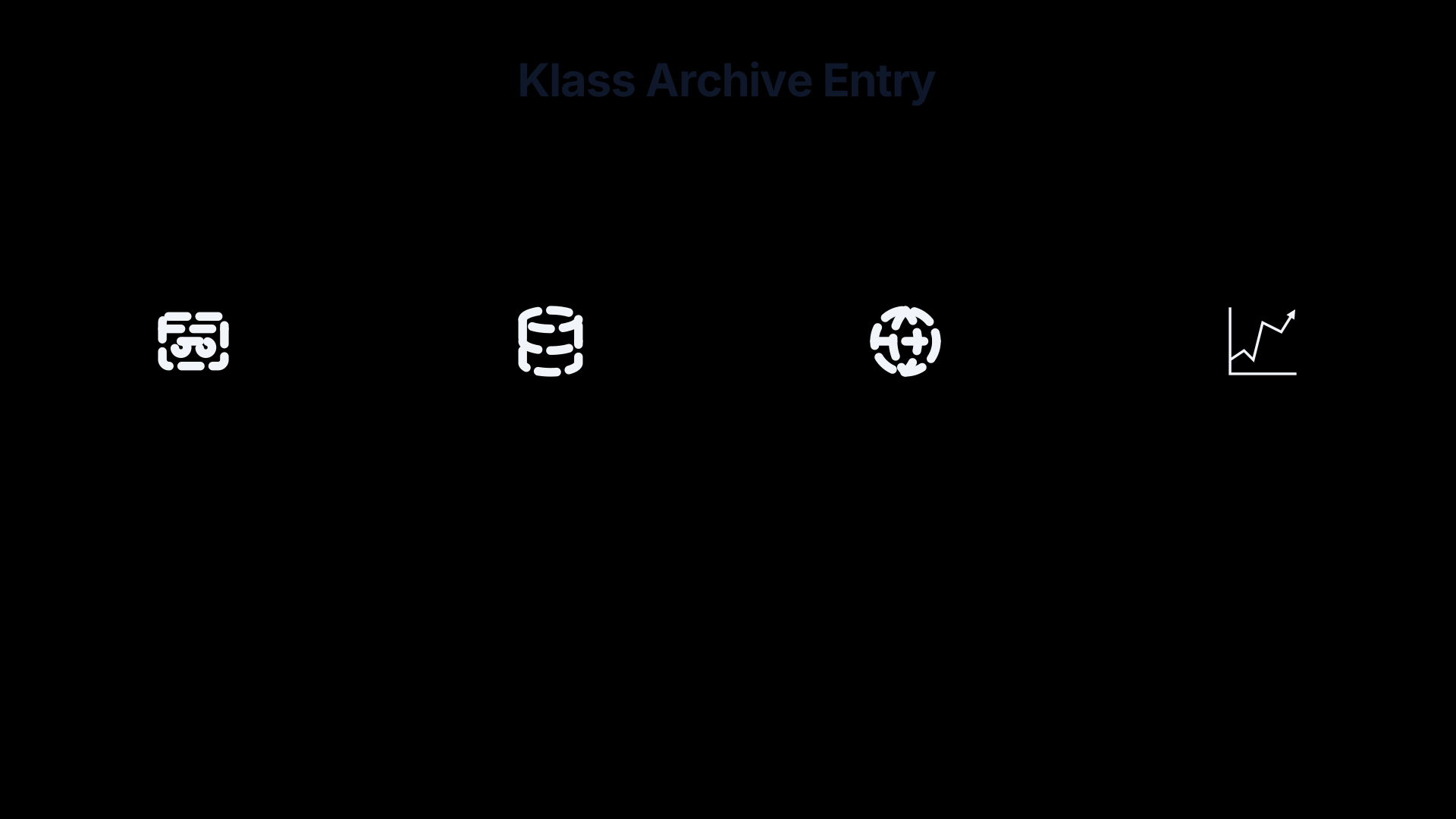
The strongest documented historical anchor is the American Philosophical Society’s listing for “Guatemala: Guatemala City-UFO video-tape, 1977, 1978” within the Philip J. Klass Collection. The archive places the material in “Series II. UFO Case Files, 1948–1993” and dates the file to 1978. [American Philosophical Society]as.amphilsoc.orgAmerican Philosophical SocietyGuatemala City-UFO video-tape, 1977, 1978Guatemala: Guatemala City-UFO video-tape, 1977, 1978 · American Ph…
That may sound minor, but the context matters. Philip J. Klass was one of the best-known UFO sceptics of the twentieth century. Trained as an electrical engineer and known for technical investigations of sightings, Klass argued that most UFO reports could be explained through ordinary phenomena such as aircraft lights, balloons, astronomical objects, camera artefacts and hoaxes. [American Philosophical Society]as.amphilsoc.orgAmerican Philosophical SocietyGuatemala City-UFO video-tape, 1977, 1978Guatemala: Guatemala City-UFO video-tape, 1977, 1978 · American Ph…
Because of Klass’s role, the archive signals several things at once:
- The Guatemala City footage circulated internationally rather than remaining a local curiosity.
- The case was considered sufficiently notable to preserve within a major sceptical research collection.
- The tape became part of comparative UFO analysis rather than merely folklore.
- Guatemala entered the same review pipeline used for more famous UFO reports from the United States and Europe.
Importantly, the archive entry does not confirm what appeared on the tape. No widely available public copy of the footage appears to survive online in a verified form, and the catalogue description is extremely brief. [American Philosophical Society]as.amphilsoc.orgAmerican Philosophical SocietyGuatemala City-UFO video-tape, 1977, 1978Guatemala: Guatemala City-UFO video-tape, 1977, 1978 · American Ph… That absence is itself revealing. Many UFO cases from Latin America survive today only through references in newsletters, newspaper reports or private investigator collections rather than through accessible original media.
Why the Klass connection matters more than the tape itself
The Guatemala file is historically important because it shows how sceptical institutions handled UFO evidence during the 1970s and 1980s. In that era, investigators often exchanged physical tapes, photographs, witness letters and typed reports through mail networks long before digital databases existed.
Klass occupied a central role in that ecosystem. His archive contains decades of UFO case files assembled for technical scrutiny and rebuttal. [American Philosophical Society]as.amphilsoc.orgAmerican Philosophical SocietyGuatemala City-UFO video-tape, 1977, 1978Guatemala: Guatemala City-UFO video-tape, 1977, 1978 · American Ph… The inclusion of a Guatemala City videotape therefore indicates that the case crossed linguistic and geographic barriers into English-speaking sceptical discourse.
This shaped how Guatemala-related sightings were interpreted internationally:
- Technical framing replaced purely local storytelling. Once a case entered sceptical archives, analysts examined filming conditions, optics, exposure problems and witness reliability.
- Evidence became comparative. A Guatemala tape could be discussed alongside American, Soviet or European footage showing similar light patterns or camera behaviour.
- The burden of proof increased. Extraordinary claims required image clarity, multiple witnesses, location data and chain-of-custody evidence that many historical UFO tapes lacked.
- Archival survival became selective. Cases with enough controversy or circulation survived in collections even if the underlying evidence remained weak.
In practice, this meant that Guatemala’s UFO history became tied to international debates about standards of evidence rather than purely to local belief.
The Guatemala City footage and the limits of historical UFO evidence
The surviving record highlights a recurring problem in UFO history: many influential cases are poorly documented by modern standards.
The Guatemala City videotape appears in catalogues, but little detailed technical analysis is publicly accessible. No confirmed frame captures, authenticated duplicate copies or official investigative conclusions are widely available. [American Philosophical Society]as.amphilsoc.orgAmerican Philosophical SocietyGuatemala City-UFO video-tape, 1977, 1978Guatemala: Guatemala City-UFO video-tape, 1977, 1978 · American Ph… That leaves historians with a layered problem:
- A videotape apparently existed.
- Investigators considered it important enough to archive.
- The underlying evidence is now fragmentary.
- Modern audiences inherit mostly secondary references rather than primary material.
This pattern is common across older UFO archives worldwide. Videotape degradation, incomplete cataloguing, private ownership and inconsistent preservation standards all contributed to the disappearance or weakening of many once-discussed cases.
For Guatemala specifically, this creates a sharp contrast with later smartphone-era sightings. Modern events often produce dozens of clips immediately shared online, whereas historical Guatemalan cases may survive only as mentions in foreign archives or newspaper summaries.
The 1989 UFO wave and the growth of public scepticism
By 1989, Guatemala experienced a broader UFO reporting wave that attracted international media coverage. The Los Angeles Times described widespread public fascination, with sightings discussed by students, professionals and even officials in Guatemala City. [Los Angeles Times]latimes.comBy DAVID KIRBY.Read moreLos Angeles TimesUFO Mania Sweeps Guatemala, Keeping Eyes Fixed…March 5, 1989 — 5 Mar 1989 — Extraterrestrials 'Coming Back to Look fo…
The reporting is important because it shows the coexistence of belief and scepticism. Even while some residents linked UFOs to ancient Maya civilisation or extraterrestrial visitation, journalists also documented uncertainty, speculation and disagreement. [Los Angeles Times]latimes.comBy DAVID KIRBY.Read moreLos Angeles TimesUFO Mania Sweeps Guatemala, Keeping Eyes Fixed…March 5, 1989 — 5 Mar 1989 — Extraterrestrials 'Coming Back to Look fo…
This period marked a transition in how UFO stories circulated:
- Reports increasingly moved through television and newspapers rather than specialist UFO groups alone.
- Public excitement amplified ambiguous sightings.
- Sceptics treated “waves” as social phenomena as much as aerospace mysteries.
- International coverage often framed Guatemala as culturally receptive to extraterrestrial speculation because of Maya history and tourism narratives.
Sceptical investigators frequently warned that media attention itself could generate additional sightings by priming observers to reinterpret ordinary lights or aircraft as anomalous objects. That argument became a central feature of UFO critique during the late twentieth century and strongly influenced how Central American reports were received abroad.
What sceptics actually argued about Guatemalan cases
Contrary to caricatures, most sceptical analysis did not claim that witnesses were deliberately lying. Instead, investigators such as Klass focused on recurring technical and psychological patterns. [Wikipedia]WikipediaPhilip J. KlassPhilip J. Klass
Applied to Guatemala, those explanations usually involved combinations of:
- Aircraft viewed from mountainous terrain or valley cities.
- Bright planets and atmospheric distortion.
- Camera exposure problems in low light.
- Reflections and lens artefacts in early video equipment.
- Rumour amplification during periods of intense media coverage.
- Cultural interpretation shaped by Maya mysticism or extraterrestrial narratives.
Guatemala’s geography strengthened some of these concerns. Night-time observation conditions around Guatemala City, Antigua and volcanic regions can distort distance perception and apparent object movement. Volcanic glow, haze and atmospheric scattering further complicate visual interpretation.
Sceptics also emphasised that many historical UFO videos worldwide shared similar weaknesses:
- unclear provenance,
- uncertain recording conditions,
- missing original tapes,
- and lack of corroborating radar or instrument data.
The Guatemala City videotape entered this broader category of “interesting but unresolved” material rather than becoming a definitive proof case.
Why archival survival matters in Guatemala’s UFO history
The Guatemala City tape survives historically because it entered an institutional archive. Many other regional cases did not.
That distinction matters for researchers today. Archived material creates:
- a traceable chain of historical attention,
- evidence of investigative interest,
- and a record of how sceptics and believers interacted.
Without archives such as the Philip J. Klass Collection, many Latin American UFO cases would survive only through oral retellings or fragmented newspaper references. [American Philosophical Society]as.amphilsoc.orgAmerican Philosophical SocietyGuatemala City-UFO video-tape, 1977, 1978Guatemala: Guatemala City-UFO video-tape, 1977, 1978 · American Ph…
The archive therefore preserves two parallel histories at once:
- the history of alleged sightings,
- and the history of organised sceptical review.
That second history is often overlooked. Yet it explains how certain cases became internationally known while others disappeared entirely.
Guatemala’s place in international UFO criticism
Guatemala never developed a public state-run UFO investigation programme comparable to those periodically seen in France, the United Kingdom or parts of South America. As a result, much of its UFO history passed through informal networks: journalists, civilian investigators, foreign researchers and sceptical organisations.
The 1977–78 videotape illustrates this perfectly. Guatemala contributed a case to the global UFO conversation, but the strongest surviving documentation now exists in a United States sceptical archive rather than in a Guatemalan public repository. [American Philosophical Society]as.amphilsoc.orgAmerican Philosophical SocietyGuatemala City-UFO video-tape, 1977, 1978Guatemala: Guatemala City-UFO video-tape, 1977, 1978 · American Ph…
That outcome shaped later interpretations of Guatemalan sightings in several ways:
- International sceptics often approached Guatemala reports through pre-existing technical frameworks developed in North America.
- Guatemalan cases became examples within broader debates about photographic reliability and media contagion.
- The absence of extensive official records encouraged reliance on secondary reporting and archival fragments.
- Historians increasingly study these cases as part of UFO culture and information exchange, not simply as isolated sightings.
The result is a UFO history that is less about definitive evidence and more about circulation, interpretation and preservation. Guatemala’s early footage did not conclusively prove extraordinary craft, but it did help define how sceptical investigators built international case archives and how Latin American sightings entered global UFO discourse.
Amazon book picks
Further Reading
Books and field guides related to How Guatemala’s Early UFO Footage Shaped Skeptical Review. Use these as the next step if you want deeper reading beyond the article.
The Flying Saucer Conspiracy
Reflects the historical culture of UFO investigation and critique.
Endnotes
-
Source: Wikipedia
Title: Philip J. Klass
Link: https://en.wikipedia.org/wiki/Philip_J._Klass -
Source: archive.org
Title: Full text of “The Mammoth Encyclopedia Of Extraterrestrial
Link: https://archive.org/stream/TheMammothEncyclopediaOfExtraterrestrialEncounters/The%20mammoth%20encyclopedia%20of%20extraterrestrial%20encounters_djvu.txtSource snippet
UFO investigators Philip J. Klass, Robert Sheaffer, and James Oberg (Klass is chairman of CSICOP's UFO subcommittee), writers Isaac Asimo...
-
Source: archive.org
Title: 664511356 Glimpses of Other Realities Linda Moulton howe djvu.txt
Link: https://archive.org/stream/664511356-glimpses-of-other-realities-linda-moulton-howe/664511356-Glimpses-of-Other-Realities-Linda-Moulton-howe_djvu.txtSource snippet
The so-called Roswell crash of 1947 did indeed occur and debris of a...Read more...
-
Source: Wikipedia
Title: ALF (TV series)
Link: https://en.wikipedia.org/wiki/ALF_%28TV_series%29Source snippet
ALF (TV series)ALF is an American television sitcom that aired on NBC from September 22, 1986, to March 24, 1990. The titular characte...
Published: September 22, 1986
-
Source: as.amphilsoc.org
Link: https://as.amphilsoc.org/repositories/2/archival_objects/880115Source snippet
American Philosophical SocietyGuatemala City-UFO video-tape, 1977, 1978Guatemala: Guatemala City-UFO video-tape, 1977, 1978 · American Ph...
-
Source: as.amphilsoc.org
Title: American Philosophical Society Philip J
Link: https://as.amphilsoc.org/repositories/2/resources/2894Source snippet
Klass CollectionKlass, an electrical engineer and UFO investigator, consist of 36 linear feet of materials documenting his writing and in...
-
Source: latimes.com
Title: By DAVID KIRBY.Read more
Link: https://www.latimes.com/archives/la-xpm-1989-03-05-mn-184-story.htmlSource snippet
Los Angeles TimesUFO Mania Sweeps Guatemala, Keeping Eyes Fixed...March 5, 1989 — 5 Mar 1989 — Extraterrestrials 'Coming Back to Look fo...
Published: March 5, 1989
Additional References
-
Source: chamsyslighting.com
Link: https://chamsyslighting.com/media-control/Source snippet
ChamSys Media ControlChamSys MediaMaster Media Control unites lighting, pixels, media & networking in one system. Native MagicQ integrati...
-
Source: headrushfx.com
Link: https://www.headrushfx.com/ -
Source: thesocialcontract.com
Link: https://www.thesocialcontract.com/artman2/publish/tsc1401/article_1174.shtmlSource snippet
Immigration and Public HealthJust one illegal alien involved in a car accident, Guatemalan native Luis Jimenez, incurred $2 million in bi...
-
Source: skepticalinquirer.org
Link: https://skepticalinquirer.org/wp-content/uploads/sites/29/2019/03/Issue-04-4.pdfSource snippet
abductions by Philip J. Klass, Hypnosis gives rise to fantasy and is not a truth serum by. Ernest R. Hilgard, A critical analysis of H. S...
-
Source: facebook.com
Link: https://www.facebook.com/CBPgov/posts/us-border-patrol-el-centro-sectors-chief-bovino-we-are-here-and-we-are-not-going/1147726937394307/Source snippet
US Border Patrol El Centro Sector's Chief BovinoThe majority of illegal aliens in this groups were from Guatemala, Honduras, and El Salva...
-
Source: facebook.com
Title: many folks may have forgotten or never knew that the first ever captured video f
Link: https://www.facebook.com/MontanaHistoricalSociety/posts/many-folks-may-have-forgotten-or-never-knew-that-the-first-ever-captured-video-f/846846284148500/Source snippet
Montana Historical SocietyThe late Philip J. Klass commenting on the Nick Mariana UFO film taken on August 15th of 1950. No photo descrip...
-
Source: news.iheart.com
Title: 2025 05 30 watch multiple witnesses film mothership ufo over guatemalan city
Link: https://news.iheart.com/featured/coast-to-coast-am/content/2025-05-30-watch-multiple-witnesses-film-mothership-ufo-over-guatemalan-city/Source snippet
iheart.comWatch: Multiple Witnesses Film 'Mothership' UFO Over...30 May 2025 — Multiple witnesses in Guatemala captured footage of a cur...
Published: May 2025
-
Source: scribd.com
Link: https://www.scribd.com/document/217391592/Ufo-DictionarySource snippet
It includes definitions of terms like abduction, abduction experiences classification, ACCET...Read more...
-
Source: read.dukeupress.edu
Title: Drawing on ethnographic research, the chapter explor
Link: https://read.dukeupress.edu/books/book/3307/chapter/8623283/Resonant-ApopheniaSource snippet
Apophenia | Conspiracy/Theory | Books GatewayThis chapter describes the affects and poetics of uncanny conspiracy theory, especially UFO...
-
Source: academia.edu
Link: https://www.academia.edu/69518005/Proceedings_of_the_Sign_Historical_Group_UFO_History_WorkshopSource snippet
ence, less well known, stretching back to the sixteenth century.Read more...
Topic Tree