What Really Happened in Iran’s UFO Encounters?
Iran’s UFO record is dominated by one exceptionally well-documented case: the 19 September 1976 Tehran incident, in which Iranian F-4 Phantom II crews, air traffic personnel and a later U.S. military message described a bright object, radar contact, communications failures and a reported weapons-system failure.
Page outline Jump by section
Why Iran’s UFO record is unusually shaped by air defence
Iran is not just another country with scattered sky stories. Its most famous UFO reports sit inside a national-security setting: a large country, sensitive borders, military airspace, past U.S.-Iranian military ties before 1979, later confrontation with the United States, and repeated concern about surveillance over nuclear and military facilities. That makes the Iranian record different from countries where most UFO cases are civilian reports with no official follow-up.
This matters because “unidentified” can mean several things in Iran. It can mean a genuinely puzzling sighting; a misidentified aircraft or planet; a meteor or re-entering debris; a secret or foreign drone; or a report that cannot be checked because the source trail is thin. U.S. reporting in 2005, for example, connected some Iranian “UFO” discussion to American surveillance drones near Iran’s borders and nuclear-related sites, with Iranian civilians reportedly seeing red flashes, green and blue streaks, and low lights before Iranian officers judged them to be spy drones. [WIRED]wired.comU.S. Drones Checking on IranU.S. Drones Checking on Iran
That security context does not solve every case. It does, however, change the standard of evidence. In Iran, a bright object near Tehran, Tabriz, Ardebil, Golestan, Kerman or the Caspian region cannot be assessed only as folklore. It has to be read alongside air-defence posture, aircraft availability, missile tests, satellite visibility, regional tension, and the reliability of the reporting chain.
The 1976 Tehran case remains the central incident
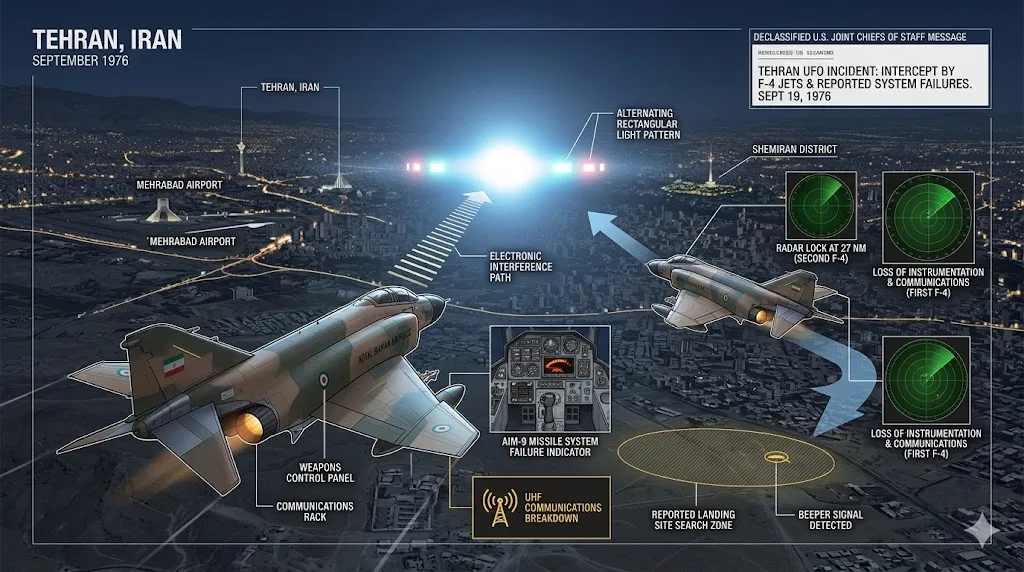
The Tehran incident began shortly after midnight on 19 September 1976, when citizens in the Shemiran area of Tehran reported strange objects in the sky. The declassified U.S. Joint Chiefs of Staff message says some witnesses described a bird-like object and others a helicopter-like light, while no helicopters were airborne at the time. A senior officer then saw an object “similar to a star” but bigger and brighter, and an F-4 was scrambled from Shahrokhi Air Base. [NSA]nsa.govOpen source on nsa.gov.
The first F-4 reportedly saw the brilliant object from about 70 miles away but lost instrumentation and UHF/intercom communications when it approached to roughly 25 nautical miles. According to the same U.S. military message, the aircraft regained its systems after breaking off the intercept. A second F-4 was then launched, acquired a radar lock at 27 nautical miles, and the radar return was described as comparable to a large tanker aircraft. The crew reported flashing lights arranged in a rectangular pattern, with colours alternating so quickly that they appeared visible at once. [NSA]nsa.govjoint chiefs staff reportjoint chiefs staff report
The most dramatic part of the report concerns the second F-4. The message states that a smaller bright object appeared to come out of the primary object and headed towards the fighter. When the pilot tried to fire an AIM-9 missile, the weapons control panel and communications reportedly failed, prompting an evasive manoeuvre. Later, another object was said to have descended towards the ground, glowing brightly over an area later searched by helicopter. The follow-up search reportedly found no obvious landing site, though the crew detected a beeper signal and local residents described a loud noise and bright light. [NSA]nsa.govus gov iran caseus gov iran case
The case has unusual evidential strengths. It involved trained military personnel, at least one reported radar contact, multiple aircraft, air traffic control, and a declassified U.S. document rather than only retrospective testimony. The NSA page identifies the file as a Joint Chiefs of Staff report concerning a UFO sighting in Iran on 19 September 1976. [NSA]nsa.govDocument GalleryDocument Gallery
Its weaknesses are equally important. The surviving official document is a message report, not a complete technical investigation. It does not provide raw radar data, maintenance logs, independent instrument recordings, missile-system diagnostics, radiation results, or a final official explanation. Later retellings often turn the document into a stronger claim than it can bear. It establishes that a serious report was circulated; it does not establish what the object was.

The strongest sceptical reading is not a single tidy debunk
Sceptical analyses usually do not reduce the Tehran case to one simple error. Instead, they treat it as a cluster of events that may have been stitched together by stress, equipment problems, astronomical objects, meteors and later embellishment. Brian Dunning’s Skeptoid analysis argues that the case becomes less extraordinary when separated into its components: a bright sky object, aircraft electrical issues, possible meteor activity, and ambiguous follow-up details. [Skeptoid]skeptoid.comOpen source on skeptoid.com.
One common sceptical explanation is that Jupiter may have contributed to the initial bright-object reports. A separate popular account at History summarises that argument and also notes the claim that the second F-4 had a history of electrical problems, which could explain at least part of the reported instrumentation trouble without requiring external interference. [HISTORY TV Nederland]history.comTV Nederland History's Most Infamous UFO Sightings of the Modern EraTV Nederland History's Most Infamous UFO Sightings of the Modern Era
That still leaves unresolved questions. A conventional explanation has to account for why trained crews reported a radar lock, apparent pursuit behaviour, and a weapons-panel failure at the moment of attempted missile firing. A pro-UFO reading has to account for missing raw data, the absence of a recovered object, the ambiguity of witness memory, and the known tendency of later television and UFO literature to harden uncertain details into dramatic certainties. The case is therefore best classified as contested and unresolved, not confirmed.
The 2004 sighting wave mixed UFO excitement with espionage fears
A second important Iranian cluster occurred in April 2004, when reports circulated of coloured lights and low-altitude objects over northern and north-western Iran. Dawn, citing Iranian state news agency IRNA, reported sightings in towns in northern Iran, including a witness in Tabriz describing red, green and blue lights moving slowly from east to west, and similar reports over Ghonbad-Kavous near the Caspian Sea. [Dawn]beta.dawn.comUFO' sighting in Iran linked to espionageUFO' sighting in Iran linked to espionage
Reuters coverage carried by ABC News described “flying saucer fever” in Iran after dozens of sightings, with local newspapers running alien cartoons and state television showing what it said was a sparkling white disc filmed over Tehran. The same report placed sightings over Tabriz, Ardebil and Golestan, and described people in several towns rushing into the streets to watch bright lights moving through clouds. [ABC News]abc.net.auufo fever grips iranufo fever grips iran
The most grounded explanation for at least part of this wave is surveillance anxiety. Wired, summarising Washington Post reporting, stated that the United States had been flying surveillance drones over Iran since the previous year to gather information connected to nuclear activity and air defences. The same report said Iranian civilians had seen unusual coloured lights and that Iranian air force commanders concluded they were spy drones. [WIRED]wired.comnasa ufos aliens report 2023nasa ufos aliens report 2023
That does not mean every 2004 report was a drone. Some sightings may have been aircraft, planets, media contagion or misperception. The key point is that the 2004 wave shows how Iranian UFO claims can arise where genuine military secrecy, public uncertainty and local media excitement overlap.
The 2007 Kerman reports are weaker but useful as a test case
In January 2007, Fars News Agency reports about a “radiant UFO” in Kerman province were repeated internationally. Wikinews summarised the claim that eyewitnesses saw a bright object crash in the Barez Mountains, while a provincial official said aircraft in the area had been accounted for and did not rule out a meteor. The same report noted that meteors can appear as bright fireballs and may leave smoke-like trails. [Wikinews]en.wikinews.orgIranian news agency reports UFO has crashed in KermanIranian news agency reports UFO has crashed in Kerman
Ynet also reported Fars claims of a yellow-ray object seen in western Iran for more than an hour and referred to a separate alleged crash near Kerman. The language was dramatic, but the available evidence appears to have remained at the level of local agency reporting and witness claims, with no public debris analysis, official technical report or reliable follow-up establishing an anomalous craft. [ynetglobal]ynetnews.comynetglobal Iranians report 'radiant UFOynetglobal Iranians report 'radiant UFO
The Kerman case is valuable because it shows the difference between “reported as a UFO” and “investigated as an unexplained aerial phenomenon”. A crash claim should be among the easiest to strengthen: there should be a location, debris, photographs, environmental effects, official recovery activity or scientific testing. In the public record, the Kerman story does not appear to clear that threshold.
Confirmed, contested and probably explained claims
A useful Iran page should separate evidence categories rather than treat every sighting as equal.
Confirmed as a documented report: The 1976 Tehran incident is confirmed as a documented military and intelligence report. The available U.S. records show that the incident was reported, circulated and taken seriously enough to enter official channels. That does not confirm the nature of the object. [NSA]nsa.govcold war iiicold war iii
Contested and unresolved: The 1976 case remains unresolved in the public record because the official message contains extraordinary claims but lacks the technical materials needed for a firm conclusion. Its strongest features are trained witnesses and radar/aircraft involvement; its weakest features are missing raw data and plausible partial explanations. [Skeptoid]skeptoid.comOpen source on skeptoid.com.
Plausibly conventional or security-related: The 2004 wave is plausibly linked in part to surveillance drones, conventional aircraft, planets, media contagion or mixed causes. The drone explanation is especially relevant because independent reporting connected Iranian UFO rumours to U.S. reconnaissance activity near Iran. [WIRED]wired.comU.S. Drones Checking on IranU.S. Drones Checking on Iran
Weakly evidenced: The 2007 Kerman crash reports remain weak because the public evidence appears to rely on agency summaries and witness statements without a robust debris trail or technical investigation. Meteor, aircraft, drone or other conventional explanations were not excluded in a way that would make the case strong. [Wikinews]en.wikinews.orgTalk:Iranian news agency reports UFO has crashed in Kerman provinceTalk:Iranian news agency reports UFO has crashed in Kerman province

Regional variation: Tehran, the north and Kerman tell different stories
The geography of Iranian UFO reporting is not random in the surviving public material. Tehran dominates because of the 1976 military intercept, Mehrabad-related reporting, and the later symbolic power of the capital. A sighting over Tehran is more likely to gain international attention because it intersects with national airspace, government institutions and media visibility. [NSA]nsa.govOpen source on nsa.gov.
Northern and north-western Iran appear strongly in the 2004 wave, especially Tabriz, Ardebil, Golestan and the Caspian-adjacent reporting corridor. That matters because these areas sit in a broader pattern of border, Caspian and surveillance concerns. Reports of coloured lights there are not automatically exotic; they are exactly the kind of claims that can be produced by drones, aircraft, astronomical objects or mass attention during a politically tense period. [Dawn]beta.dawn.comUFO' sighting in Iran linked to espionageUFO' sighting in Iran linked to espionage
Kerman and Rafsanjan appear in the 2007 crash and fireball-style reports. Those claims are different from Tehran’s radar-and-intercept case: they sound more like meteor, debris or crash-rumour stories, and they suffer from the lack of publicly available physical evidence. [Wikinews]en.wikinews.orgIranian news agency reports UFO has crashed in KermanIranian news agency reports UFO has crashed in Kerman
How official records should be weighed
The strongest Iranian UFO source is not a local newspaper, a documentary or a later interview. It is the declassified U.S. military message on the 1976 Tehran incident, available through NSA-related release pages and mirrored in declassified document collections. It gives a contemporary account of what was reported by Iranian and U.S.-linked military channels, including times, aircraft actions and system failures. [NSA]nsa.govjoint chiefs staff reportjoint chiefs staff report
But official does not mean infallible. Military messages can relay reports without fully verifying them. They may preserve errors, witness impressions, translation issues, incomplete technical checks or early assumptions. For the Tehran case, the official record is enough to say “a serious incident was reported”; it is not enough to say “an advanced non-human craft was proven”.
Modern official UAP work reinforces that caution. NASA’s independent UAP study emphasised the need for rigorous evidence and better data collection, while the U.S. All-domain Anomaly Resolution Office states that it has found no evidence of extraterrestrial technology in its UAP work. These are not Iran-specific verdicts, but they are relevant standards for reading Iranian cases: extraordinary interpretation requires high-quality sensor data, reproducible evidence and careful exclusion of ordinary causes. [NASA Science]science.nasa.govScience Independent Study Team ReportScience Independent Study Team Report
What readers should remember about Iran’s UFO file
Iran’s UFO history is not a long, evenly documented catalogue. It is a sharply uneven record with one major military case and several lower-confidence waves. The 1976 Tehran incident deserves attention because it is better documented than most UFO stories and because its reported combination of visual sighting, radar contact and aircraft system failures remains striking. It also deserves restraint because the public record is incomplete.
The later reports are more fragile. The 2004 sightings are historically interesting because they show a society trying to interpret lights in the sky during a period of real surveillance tension. The 2007 Kerman claims are useful mainly as a reminder that “UFO crash” headlines often outrun evidence. Across Iran, the most reliable approach is to ask five questions: who observed it, what instruments recorded it, what conventional objects were in the sky, what military or surveillance activity was plausible, and whether later sources added certainty that the original record did not support.
Amazon book picks
Further Reading
Books and field guides related to What Really Happened in Iran’s UFO Encounters?. Use these as the next step if you want deeper reading beyond the article.
The Report on Unidentified Flying Objects
Relevant to military and government handling of unidentified aerial reports.
Endnotes
-
Source: nsa.gov
Link: https://www.nsa.gov/Helpful-Links/NSA-FOIA/Declassification-Transparency-Initiatives/FOIA-Reports-and-Releases/FOIA-Reports-and-Releases-List/igphoto/2002761354/ -
Source: nsa.gov
Title: joint chiefs staff report
Link: https://www.nsa.gov/portals/75/documents/news-features/declassified-documents/ufo/joint_chiefs_staff_report.pdf -
Source: skeptoid.com
Link: https://skeptoid.com/episodes/315 -
Source: wired.com
Title: U.S. Drones Checking on Iran
Link: https://www.wired.com/2005/02/u-s-drones-checking-on-iran -
Source: history.com
Title: TV Nederland History’s Most Infamous UFO Sightings of the Modern Era
Link: https://www.history.com/articles/historys-most-infamous-ufo-sightings -
Source: beta.dawn.com
Title: ‘UFO’ sighting in Iran linked to espionage
Link: https://beta.dawn.com/news/356564/ufo-sighting-in-iran-linked-to-espionage -
Source: en.wikinews.org
Title: Iranian news agency reports UFO has crashed in Kerman
Link: https://en.wikinews.org/wiki/Iranian_news_agency_reports_UFO_has_crashed_in_Kerman_province -
Source: science.nasa.gov
Title: Science Independent Study Team Report
Link: https://science.nasa.gov/wp-content/uploads/2023/09/uap-independent-study-team-final-report.pdf -
Source: nsa.gov
Title: us gov iran case
Link: https://www.nsa.gov/portals/75/documents/news-features/declassified-documents/ufo/us_gov_iran_case.pdf -
Source: nsa.gov
Title: Document Gallery
Link: https://www.nsa.gov/Press-Room/Digital-Media-Center/Document-Gallery/?igpage=45 -
Source: nsa.gov
Title: cold war iii
Link: https://www.nsa.gov/portals/75/documents/news-features/declassified-documents/cryptologic-histories/cold_war_iii.pdf -
Source: science.nasa.gov
Link: https://science.nasa.gov/uap/ -
Source: skeptoid.com
Link: https://skeptoid.com/episodes/358 -
Source: en.wikinews.org
Title: Talk:Iranian news agency reports UFO has crashed in Kerman province
Link: https://en.wikinews.org/wiki/Talk%3AIranian_news_agency_reports_UFO_has_crashed_in_Kerman_province -
Source: wired.com
Title: nasa ufos aliens report 2023
Link: https://www.wired.com/story/nasa-ufos-aliens-report-2023/ -
Source: youtube.com
Title: The Tehran Incident
Link: https://www.youtube.com/watch?v=Wf2ZKmk6WrcSource snippet
Pentagon UFO files REVEAL mysterious UAP formations over Iran, CENTCOM captures video | WATCH...
-
Source: abc.net.au
Title: ufo fever grips iran
Link: https://www.abc.net.au/news/2004-04-30/ufo-fever-grips-iran/178068 -
Source: ynetnews.com
Title: ynetglobal Iranians report ‘radiant UFO’
Link: https://www.ynetnews.com/article/3354296 -
Source: cia.gov
Link: https://www.cia.gov/readingroom/document/06741381 -
Source: cia.gov
Link: https://www.cia.gov/readingroom/document/06984637 -
Source: cia.gov
Link: https://www.cia.gov/readingroom/document/06741356 -
Source: cia.gov
Link: https://www.cia.gov/readingroom/document/06935701 -
Source: youtube.com
Link: https://www.youtube.com/watch?v=Ps20aJz9axA
Additional References
-
Source: youtube.com
Link: https://www.youtube.com/watch?v=_NU5VbysFJESource snippet
Pentagon Triggers UFO Panic To Cover Up Iran Military Fail? 'Oversized Eyes, Hairless…' | Watch...
-
Source: youtube.com
Link: https://www.youtube.com/watch?v=Tib8XEPXbNkSource snippet
UFO Files Released as Iran Strike Shakes Strait of Hormuz...
-
Source: youtube.com
Title: UFO Files Released as Iran Strike Shakes Strait of Hormuz
Link: https://www.youtube.com/watch?v=6QuF7F-XnioSource snippet
Government Breaks Silence: Strange Encounters | UFO's Investigating the Unknown...
-
Source: cia.gov
Link: https://www.cia.gov/readingroom/document/0005516652 -
Source: cia.gov
Link: https://www.cia.gov/readingroom/document/cia-rdp87m01007r000400810001-4 -
Source: cia.gov
Link: https://www.cia.gov/resources/csi/static/dce5fdfdd711572e69c678bae6c19abb/Studies-67-2-Extracts-June2023.pdf -
Source: cia.gov
Link: https://www.cia.gov/library/abbottabad-compound/0B/0B72A302B86EECAD443BBCDCDC76A5B1_911Report.pdf -
Source: facebook.com
Link: https://www.facebook.com/futurism/posts/something-like-a-black-monster-has-swallowed-the-sky-over-tehran/1280432137286497/ -
Source: blaze.tv
Link: https://www.blaze.tv/series/quick-history-us-governments-secret-ufo-project-blue-book -
Source: facebook.com
Link: https://www.facebook.com/groups/1207452446678403/posts/2100308087392830/
Topic Tree
Follow this branch
Related pages 192
- Afghanistan UAP
- AlbanianUFOs
- Algeria UFOs
- Antigua UFOs
- Monaco UFOs
- +187 more in sidebar